



Peter Rowe is back with another case report. :).
Peter Rowe’s almost constant flow of case reports has been invaluable in informing doctors of possible diagnoses and treatments. Outside of the rare clinical trials, I don’t know how else doctors can get this information. A list of the latest.
- 2026: Case Report: Neuropsychiatric improvement after treatment of pelvic venous disorder in a multisyndromic patient. (blog coming up)
- 2026: A Continuous Oral Regimen of High-Dose Cromolyn Sodium Is Effective for Some Myalgic Encephalomyelitis/Chronic Fatigue Syndrome (ME/CFS) Patients With Mast Cell Activation Syndrome“
- 2025: The Co-Occurrence of POTS and PPPD: A Pediatric Case Report
- 2023: Case report: Recurrent cervical spinal stenosis masquerading as myalgic encephalomyelitis/chronic fatigue syndrome with orthostatic intolerance
- 2023: A Case Study of Successful Application of the Principles of ME/CFS Care to an Individual with Long COVID
- 2023: Onset of Postural Orthostatic Tachycardia Syndrome (POTS) Following COVID-19 Infection: A Pediatric Case Report

Unlike antihistamines, cromolyn stabilizes mast cells to keep them from becoming activated
THE GIST
- Peter Rowe, MD, is back with another case series. These reports describe in detail how treatments affect a selected group of patients.
- This report focused on the experiences of five ME/CFS/POTS/mast cell activation syndrome (MCAS) patients taking a drug called cromolyn sulfate, which stabilizes mast cells. It comes in various forms: an oral solution, nasal spray (Nasalcrom), ophthalmic solution, and inhalation solution. In the U.S., only Nasalcrom is available without a prescription.
- This case series used the oral formulation. The recommended initial dose, primarily used to treat food allergies, is 200 mg four times a day (for adolescents/adults): 30 minutes before the three main meals and again at bedtime.
- These doctors, however, used a much higher dose. They stated that “exceeding the 800 mg daily dose was both safe and necessary to achieve an optimal therapeutic effect.” Some individuals ended up with double the normal dose or even more.
- The authors had patients put all cromolyn doses for the day in an opaque water bottle, fill it with water, and sip it intermittently throughout the day.
- They started with a low dose of 400 mg and then increased it week by week until it reached maximum effectiveness (see the blog for the schedule and other instructions on how to take the drug)
- The first case report involved a formerly athletic young man who could attend only one day of school a month. After a couple of months of 1600/2000 mg cromolyn a day, he was able to attend school and drive again. His wellness score went from 20/100 to 70/100.
- The second case report involved a woman who, after she found relief from her facial and eye swelling with Nasalcrom (over the counter), began oral cromolyn. 1600 mg daily stabilized her MCAS symptoms, and the oral solution helped with her vaginal pain. After eight months, her wellness score rose from 28 to 61/100, and she went from one day of activity weekly to working 5-7 days per week with no post-exertional increases in fatigue or pain.
- The third case report involved a person with cranial cervical instability and thoracic outlet syndrome, as well as many skin manifestations of MCAS. At 1600 mg daily, his facial flushing, rashes, and hives completely resolved. After years of constant fatigue and minimal activity, he was able to resume swimming. His wellness score went from 30/100 to 70-80/100.
- The fourth case report involved a young woman who had been diagnosed with ME/CFS, POTS, hEDS, asthma, and allergic rhinitis. Her symptoms included fatigue associated with widespread red skin, facial flushing, and itching. At 1600 mg/day, her rashes, hives, and headaches all completely resolved, and her coordination and fine motor skills improved. Her Wellness score increased from 60/100 to 86/100.
- The fifth case report involved a 41-year-old very active (10,000 steps/day; swimmer and runner) with a prior history of allergic inflammation, including asthma, chronic rhinitis, and Raynaud’s syndrome. COVID-19, however, left her in a wheelchair. 2400 mg daily improved her gut symptoms, allowed her to stay upright for 4 hours a day, and enabled her to do 3000 steps without PEM.
- Lastly, a 2023 case report involved a young man who, over a year and a half, went from being unable to tolerate online classes to being able to take in-person classes, bike 30 minutes 4x a week, and eventually complete an 8k running event (!). Various medications were used, including cromolyn.
- Dr. Laura Pace and Dr. Yellman both often use cromolyn in their practices. Cromolyn can initially exacerbate symptoms, but titrating it down will often help. Yellman uses the compounded form more for systemic problems like migraines, neuroinflammation, and craniocervical instability, and gastrocom before meals for gut issues.
- Expense: cromolyn is expensive when bought at retail, but discount cards (like Rx) and insurance can bring the 800 mg/day cost down to $30–$130/month.
- Conclusion: Mast cells are not the end all or be all for diseases like ME/CFS, POTS, or long COVID, but in the right person, cromolyn can clearly make a large difference. It appears to be one of the more effective mast cell-stabilizing drugs. Interestingly, more is often better with cromolyn. If you can afford it, it certainly seems worth a try.
Support Health Rising and Keep the Information Flowing!
Health Rising is not a 501 c (3) non-profit
Hi-Dose Cromolyn (???)
“Exceeding the 800 mg daily dose was both safe and necessary to achieve an optimal therapeutic effect.” The authors

Hi-dose cromolyn- really? (Really)
We’re so used to low-dose formulations that it’s a little shocking to see a high-dose formulation recommended for ME/CFS, but that’s what Peter Rowe’s crew over at Johns Hopkins, and his usual partners (Visser, Van Campen) in the Netherlands, recently reported worked best (!). (Thanks, Geoff, for pointing this out.)
The study “A Continuous Oral Regimen of High-Dose Cromolyn Sodium Is Effective for Some Myalgic Encephalomyelitis/Chronic Fatigue Syndrome (ME/CFS) Patients With Mast Cell Activation Syndrome” was not just novel as regards the dose but in how Cromolyn was delivered – in sips throughout the day.
While the case series was small (5 patients), the authors noted they’ve had 4 years of clinical experience with the drug.


Ammi visnaga- Image from Andrés González, CC BY-SA 4.0, via Wikimedia Commons
Cromolyn sodium is derived from an herb called Ammi visnaga, which the ancient Egyptians used for respiratory infections. We can thank an asthmatic researcher named Roger Altounyan for introducing it to the modern world when, in 1965, he discovered this compound.
Cromolyn Sulfate
Today, cromolyn sulfate is FDA-approved to treat mild to moderate asthma, allergic rhinitis, hay fever, systemic mast cell disease (i.e., mastocytosis), diarrhea, flushing, headaches, vomiting, urticaria, abdominal pain, nausea, and itching, and some eye conditions.
It’s also used off-label to treat adverse reactions to foods and, of course, to treat mast cell activation syndrome (MCAS), which is different from systemic mast cell disease or mastocytosis (a rare disease)
MCAS, as many people know, can produce a wide variety of symptoms. The authors state that all MCAS definitions require symptoms in at least two of the following areas: skin (hives, rashes, swelling), respiratory (asthma, nasal congestion), cardiovascular (low blood pressure, faintness, palpitations), and digestive (esophageal dysfunction, vomiting, nausea, constipation/diarrhea).
Mast Cell Stabilizer

Unlike antihistamines, cromolyn stabilizes mast cells to keep them from becoming activated
Cromolyn sulfate is a mast cell stabilizer, not an antihistamine. Mast cell stabilizers like cromolyn sulfate, ketotifen, quercetin, luteolin, and others inhibit mast cell degranulation and prevent mast cells from releasing inflammatory compounds such as histamine and leukotrienes.
Antihistamines like cetirizine (Zyrtec), fexofenadine (Allegra), and famotidine (Pepcid), on the other hand, reduce histamine’s effects after it’s released. (Ketotifen is both a mast cell stabilizer and an H1 antihistamine blocker).
Cromolyn is often used to help with gut issues in particular, but case reports show it affects many more factors. Just how cromolyn is doing this is a bit of a mystery. Cromolyn’s ability to affect systems across the body has puzzled researchers for decades because its very poor absorption outside the gut (1%) suggests it should only affect the gut. As these case reports show, though, its effects clearly extend beyond the gut.
Cromolyn’s effect on the gut may be the key – and provides another explanation of how the gut, kind of a secondary target in ME/CFS, FM, and Long COVID, may play a more prominent role than we think. We still don’t know how cromolyn shuts down mast cells; i.e., which part of the mast cell it interacts with.
By reducing mast cell activation in the gut, cromolyn may be able to stop a cascade that begins there and extends further. It’s also possible that cromolyn is simply very powerful and that only small amounts in the blood are effective.
A 2023 mouse study found that cromolyn reduced mast cell levels in the gut lining, leaky gut, histamine and IL-6 levels in the blood, and reduced neuroinflammation in older mice that had experienced a stroke.
Types
Cromolyn sulfate comes as an oral solution, nasal spray (Nasalcrom), ophthalmic solution, and inhalation solution. In the U.S., Nasalcrom is available without a prescription. It may take up to 4 weeks to experience maximum benefit. Toxicity is very low.
It’s primarily available in the US as a liquid preparation (100 mg/5mL). The recommended initial dose, which is primarily used to treat food allergies, is 200 mg four times a day (for adolescents/adults): 30 minutes before the three main meals and then again at bedtime.
Sipping Hi-Dose Oral Cromolyn
The authors had patients put all cromolyn doses for the day in an opaque water bottle, fill it with water, and sip it intermittently throughout the day. (They did this, in part, because it’s difficult to remember to take it 30 minutes before every meal and because cromolyn sulfate may help with other than food-related mast cell events.

In a change, more, (much more) of the drug than is usually taken, was actually better for these patients.
They stated that “exceeding the 800 mg daily dose was both safe and necessary to achieve an optimal therapeutic effect.” Some individuals ended up with double the normal dose or even more.
They stated:
- The starting dose for the first week is four 100 mg/5 mL vials daily (400 mg = 20 mL).
- After a week, increase the dose to eight vials per day (800 mg = 40 mL).
- In week 3, if there has been inadequate improvement, increase to 12 vials daily (1200 mg = 60 mL).
- In week 4, if there has been inadequate improvement, increase to 16 vials daily (1600 mg = 80 mL).
- If you increase the dosage and see no benefits within a week, return to the dosing where improvement was first noticed.”
“We recommend that our patients add the entire daily dose of cromolyn to their metal water bottle, then fill the bottle with non-alkaline water. Sipping from it throughout the day provides a slower, more continuous distribution of the dose. Mix cromolyn only with water, not with juice, milk, food, or anything else.”
“We instruct patients to keep the vials out of direct sunlight and not take the ampule of liquid out of the foil package until they are ready to use it. We advise them to store the unopened ampules of liquid at room temperature, away from heat and direct light. “
“There is not a fixed amount of water to add to the cromolyn, but larger volumes of water help reduce any adverse tastes the medication may have as well. During increases in the oral cromolyn dose, other medications remained unchanged.”
They used a Wellness score (“On a scale of 0 to 100, with 0 being ‘dying’ and 100 being ‘the best you can imagine a person to feel’, how would you rate yourself, on average, over the last month?”) to assess the effects of cromolyn sulfate, which they stated is reliable and has been shown to work in ME/CFS.
These were all MCAS/ME/CFS patients, but note how different they were.
Case Reports
Except for one test in one patient, none of the patients showed elevated laboratory levels of mast cell mediators.
Case Report #1
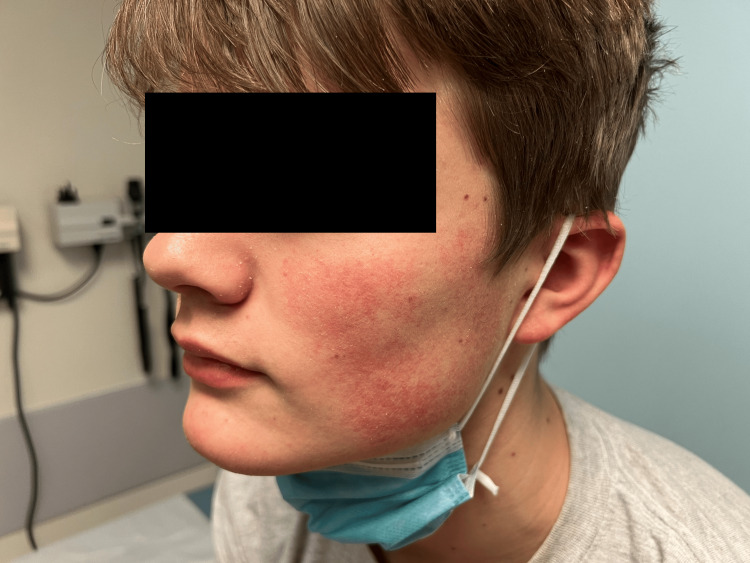
MCAS was causing erythema (red skin) in this young man’s face
Before getting ill, this 16-year-old was a soccer player and good student, but afterward could attend school only every other day. His mother had a history of angioedema (sudden swelling of the lower layers of the skin or mucous membranes) since birth, with severe hives in reaction to multiple foods and direct sun exposure.
He had a three-year history of exercise-induced asthma, facial rash, progressive fatigue, and a documented case of severe, unexplained rhabdomyolysis. He had gluten and dairy intolerance, heat intolerance, red cheeks since infancy, and keratosis pilaris.
Along with his normal mast cell workup, he had a normal muscle biopsy, a normal plasma acylcarnitine profile, and no sign of mitochondrial gene mutations.
Cromolyn
- 800 mg daily – no improvement
- 1200 mg daily – able to sit upright all day instead of having to remain reclined.
- 1600 mg daily, was able to tolerate trips out of the house. After a month, he was able to drive two hours or more without getting lightheaded. (Before Cromolyn, driving a mile caused lightheadedness) and no longer needed breaks to lie down during the day. He was able to attend a soccer game which required walking two miles, and go bowling with his friends, which was unthinkable 2-3 months prior.
Others: A manufacturing shortage reduced his cromolyn intake to 400-800 mg/day, and he felt substantially worse. After he did not recover well from having COVID-19, an increase to 2000 mg daily, however, allowed him to stay upright and drive again.
He was not completely well, but he had come a long, long way.
Adding other MCAS medications (fexofenadine 180 mg daily, famotidine 40 mg twice daily, montelukast 10 mg nightly, quercetin 1000 mg twice daily, and doxepin 10 mg ) nightly had little to no effect.
- Wellness score before cromolyn – 20/100
- Wellness score seven months after beginning cromolyn – 70/100
Case Report #2
This patient was very different. This 37-year-old female had been diagnosed with ME/CFS, postural tachycardia syndrome (POTS), asthma, irritable bowel syndrome (IBS), neurogenic thoracic outlet syndrome (nTOS), constant daily headache, hypermobile Ehlers-Danlos syndrome (hEDS), excessive sweating, hyperhidrosis, anxiety, and depression (!).
Her MCAS symptoms included facial flushing and swelling, generalized skin redness (erythema), upper-chest and facial rashes, and nasal congestion.
After Nasalcrom (OTC) helped with facial swelling, oral cromolyn was tried.
She was being treated with cetirizine 10 mg daily and famotidine 40 mg twice daily, which apparently wasn’t helping much as her wellness score remained a dismal 26/100.
Two sprays of nasalcrom (over-the-counter med) into each nostril 4x daily, though, reduced her facial redness, lessened her anxiety and depression, improved her daily headache, resolved her diarrhea (!), and improved her brain fog. At that point, she was put on an oral cromolyn protocol.
At 8 vials of oral cromolyn, her facial and eyelid swelling further improved.
Using the eye drop form of cromolyn, Opticrom®, at a rate of one drop per eye four times a day (eventually 2 drops per eye per day) substantially helped the “gritty” feeling and eye redness, and ultimately completely resolved her eyelid swelling and cheek rashes.
Continuing to experiment, she found that adding one vial of oral cromolyn to her nasal rinse once a day was most effective for her facial swelling and sinus pressure.
Using oral cromolyn as a topical treatment for vaginal irritation also resulted in an immediate 65% improvement.
Increasing her oral dose to 1600 mg daily stabilized her MCAS symptoms. After eight months on all these forms of cromolyn, her wellness score rose from 28 to 61/100, and she went from one day of activity weekly to working 5-7 days per week with no post-exertional increases in fatigue or pain.
- Wellness score before cromolyn – 28/100
- Wellness score after 8 months of cromolyn – 61/100.
Case Report #3
A 25-year-old male was diagnosed with ME/CFS, POTS, chronic daily headaches, cranio-cervical instability (CCI), and neurogenic thoracic outlet syndrome (nTOS). (This is the second person diagnosed with a spinal problem, which perhaps isn’t that much of a surprise, as mast cells are believed to attack the ligaments and connective tissues in the spine (and elsewhere).
His MCAS symptoms included facial flushing, rashes, redness (erythema )of the ears and hands, itching skin, and hives (urticaria) on the face and neck. Clearly, mast cell activation in the skin was an issue. (Note that 3 of the 5 patients experienced facial rashes, skin redness, or other forms mast cell activation in the skin. It took me over 40 years to recognize that my “red checks” after excessive exercise were likely due to mast cell activation.)
Loratadine (10 mg daily) and cetirizine (10 mg nightly) produced a modest improvement in energy, and montelukast (10 mg nightly) and famotidine (40 mg 2x daily) provided partial relief of facial flushing.
Oral cromolyn at 800 mg daily significantly reduced facial flushing, skin redness, rashes, hives, and itching. At 1600 mg daily, facial flushing, rashes, and hives completely resolved. After years of constant fatigue and minimal activity, he was able to resume swimming.
- Wellness score before cromolyn – 30/100
- Wellness score after 12 months of cromolyn – 70-80/100. (Remarkable!)
Case Report #4
A young woman had been diagnosed with ME/CFS, POTS, hEDS, asthma, and allergic rhinitis. Symptoms included fatigue associated with widespread red skin, facial flushing, and itching. Famotidine 40 mg twice daily provided modest benefits.
Cromolyn dosing
- 400 mg/day – improved orthostatic intolerance, fatigue, and brain fog.
- 800 mg/day – decreased cardiac awareness and improved stamina.
- 1200 mg/day – improved temperature regulation, reduced flushing and lightheadedness, but still experiencing rashes in the shower.
- 1600 mg/day – rashes, hives, and headaches all completely resolved. Coordination and fine motor skills improved.
Wellness score increased from 60/100 to 86/100.
Case Report #5
A 41-year-old very active (10,000 steps/day; swimmer and runner) female with a prior history of allergic inflammation, including asthma, chronic rhinitis, and Raynaud’s syndrome.
She treated her asthma with fluticasone nasal spray and fluticasone via inhalation, loratadine 20 mg twice daily, and montelukast 10 mg nightly.
Four weeks after a probable COVID-19 infection in January 2021, though, she developed profound fatigue, orthostatic intolerance, brain fog, and post-exertional malaise after minimal physical activity. She ended up being housebound and used a motorized wheelchair when outside the house.
As with most of the other people in this series, her MCAS lab tests (histamine, tryptase, chromogranin A) were completely normal.
Nasalcrom® to treat chronic rhinitis and famotidine 20 mg twice daily to treat indigestion, diarrhea, bloating, and abdominal cramps helped with the sinus inflammation but provided no gut help.
At 800 mg cromolyn daily, her gut symptoms, fatigue, and brain fog improved, and she increased her step count to 3500/day without increased symptoms.
At 1600 mg cromolyn daily, all the above symptoms improved further.
A lapse in her cromolyn intake due to a shortage resulted in a significant decline in her wellness. After going back to a 1600 mg daily dose, it helped her, and her dose was increased to 2400 mg daily. Her gut symptoms improved. She could spend 4 hours a day upright and do 3000 steps without PEM. She’s been on the 2400 mg/day dose for two years now, with no side effects and continuous benefit.
There’s clearly more to her story than mast cells, but treating them helped her enormously.
Extra! Rowe’s 2023 Case Report
Peter Rowe’s been going after cromolyn for a while. His 2023 case report, ” A Case Study of Successful Application of the Principles of ME/CFS Care to an Individual with Long COVID identified a long COVID patient with postural orthostatic tachycardia syndrome (POTS) who was also helped by cromolyn. (Evidence suggests that the SARS-CoV-2 virus, which produces COVID-19, activates mast cells).
With a family history of allergies and immunotherapy, and his experiences with allergy inflammation/rhinitis, mild asthma, and sensitivities to foods, this individual was perhaps ripe for MCAS issues.

At the end this person was able to run an 8K. (Image – binary from Gerald_Altman_Pixabay.jpg)
Before treatment, mild exercise provoked post-exertional malaise, and he experienced constant fatigue, unrefreshing sleep, lightheadedness, headaches, occasional cough, chest pain, leg pain, mild anxiety, and depression as well.
This patient’s lab studies indicated that MCAS was present, and a variety of MCAS treatments (famotidine (40 mg 2x’s/day), loratadine (10 mg), fexofenadine (180 mg), quercetin (1000 mg 2x’s/day), oral cromolyn (400 mg, 4x’s/day), and montekulast (10 mg) were attempted (as well as other treatments).
Of MCAS treatments, the H1 blocker fexofenadine (energy/cognitive), the H2 blocker famotidine (energy/cognitive), and mast cell stabilizers cromolyn (reduced heart rate from 130/140 while walking to 100-105) and quercetin (fatigue and allergic symptoms) helped. Over time, these and other interventions (clonidine 0.1 mg, methylphenidate (10 mg, escitalopram (5 mg), naltrexone (4.5 mg)) were successful.
Over a year and a half, he went from being unable to tolerate online classes to being able to take in-person classes, bike 30 minutes 4x a week, and eventually complete an 8k running event (!).
The authors emphasized that his activity gains were not made until his orthostatic intolerance (ability to sit up or stand without symptoms) improved; i.e., don’t push long COVID patients into exercise before you help their orthostatic intolerance.)
Other Doctors Experience with Cromolyn
Laura PACE MD, PhD

Cromolyn is one of Laura Pace’s go to mast cell treatments.
With her board certification in neurogastroenterology and autonomic disorders, Laura Pace brings a technical understanding of gut issues that few can match. She specializes in diagnosing and treating complex, multisystem disorders that involve gastroenterology, neurology, immunology, and genetics. In 2026 and 2025 respectively, she co-authored. “Postural Orthostatic Tachycardia Syndrome: A State-of-the-Art Review” and “The Neuroimmune Axis in Gastrointestinal Disorders – An Underrecognized Problem”
In a presentation, she stated that she employs an H2 blocker 2-3x daily and oral Cromolyn 4x daily. While some people have problems tolerating Cromolyn, she can usually get it to work by slowly titrating it up. Early symptoms can result because, at first, cromolyn can cause significant mast degradation if increased too quickly. She does not require it with or without meals but, like Rowe, spaces it throughout the day. She uses quercetin as a fallback if cromolyn doesn’t work.
Pace, interestingly, believes that histamine-containing foods have, at most, a “local” impact and don’t produce the systemic effects found in these diseases.
Dr. Yellman MD
Dr. Yellman is a long-time ME/CFS/FM/long COVID practitioner, formerly with the Bateman-Horne Center, who now works with Dr. Kaufman.

Dr. Yellman uses either a liquid or compounded form.
Dr. Yellman said he likes to hit people hard and fast with mast cell stabilizers and considers them a bit more effective than using H1/H2 blockers alone. He uses compounded cromolyn sodium or ketotifen, and over-the-counter quercetin.
Yellman reported that liquid cromolyn or Gastrocom – taken 15-20 minutes before eating – can make an enormous difference in gut symptoms. Compounded cromolyn, on the other hand, provides more systemic relief – and he uses it more for symptoms such as migraines, neuroinflammation, and craniocervical instability.
People who have trouble tolerating compounded cromolyn can benefit from taking liquid cromolyn/Gastrocom 15-20 minutes before taking compounded cromolyn.
Dr. Michael Ruscio, DC
Dr. Ruscio provides a nice overview of the study
Cromolyn Expense
An AI search suggested that at retail, 800 mg/day of oral cromolyn sulfate costs between $3 and $ 400 per month. Discount cards, however, can bring the price down significantly (GoodRx coupon price for 96 ampules: $138.20 (vs. $526.99 retail), and compounding can bring the cost down further ($50–$130 for a typical monthly supply). Insurance coverage can drop the 800 mg/day cost to $30–$100/month. Some people will need to double or even triple that dose.
Note that some people report difficulties starting cromolyn sodium due to a temporary flaring of symptoms, and it’s recommended to work up slowly to a final, therapeutic dose. It may take several months to see the benefit.
Studies Underway
Guanfacine and Cromolyn Sodium for POTS – This small (n=25) randomized, placebo-controlled study will specifically test guanfacine or cromolyn sodium in POTS. (Three of the five people in the case reports had POTS). Each person will receive each drug, one drug at a time. Researchers will take various symptom assessments and blood work. Dysautonomia International is one of the funders. This Johns Hopkins study should be wrapping up soon.
Mast Cell Treatment in Post-tick Bite Illness – this 50-person tick-borne illness study at the University of North Carolina will begin recruiting in Jan. 2027. It will pit fexofenadine against a combination of ketotifen, cromolyn, and fexofenadine. Symptom assessments will be done.
- Check out a review of “Never Bet Against Occam: Mast Cell Activation Disease and the Modern Epidemics of Chronic Illness and Medical Complexity” by Dr. Lawrence Afrin”
The Arseneau Test: To Try Cromolyn or Not?
Applying The Arseneau Test
The Arseneau test assesses the factors below to help decide whether or not to try a treatment:
- The credibility of the source – Peter Rowe and company – say no more. Very high.
- Quality of the evidence – case reports mean the evidence quality is not high, as we don’t know how many people will benefit. Still, the authors state they’ve been working with it for 4 years and clearly wanted to get the word out.
- The benefit, the cost, and the risk–benefit analysis: the benefit probably ranges from no benefit to moderate to even high in some cases. Using insurance or discount cards for 1600 mg/day can bring the cost down to $60 to $200/month. The drug can cause side effects, particularly in the gut, at first, but starting low and slowly titrating it up can do the trick.
- Conclusion – given its good safety profile and the trusted source (Peter Rowe and company), there’s no reason not to try cromolyn sulfate if you can afford it and experience MCAS symptoms. Because MCAS symptoms can range from gut issues to allergic rhinitis to skin rashes to orthostatic intolerance to fatigue and more, most people with these diseases probably experience what could be MCAS-related symptoms.
- Note that cromolyn, like other mast cell drugs, is not a cure, and if it helps and you stop it, your symptoms will probably come back. As Dr. Dempsey pointed out, though, cromolyn could reduce mast cell reactivity to the point where other treatments might be tolerated.
Conclusion
Mast cells are not the end all or be all for diseases like ME/CFS, POTS, or long COVID, but in the right person, cromolyn can clearly make a large difference. It appears to be one of the more effective mast cell-stabilizing drugs. Interestingly, more is often better with cromolyn, which can make the drug rather costly.
As with other mast cell drugs, experimentation is needed. In an earlier blog, Dr. Chheda referred to an ME/CFS patient who did not appear at first blush to have MCAS, and did not respond to 2 antihistamines a day, but adding a third one completely removed his/her anxiety!
Note that the MCAS lab tests run in this group were almost wholly negative and are clearly not good barometers of MCAS. (Many doctors consider them a waste of time and money.)
Because MCAS can produce a wide variety of symptoms, symptoms may not be the greatest barometer either. Three of the five patients in this report had skin symptoms (facial reddening, rashes, hives) but the others did not.
The only skin symptom that I experience is a red rash across my cheeks that occurs during severe PEM and allergic rhinitis. My gut and orthostatic symptoms are usually mild, though present. Mast cell drugs do appear to have helped my nausea, though, and I responded well to an IV infusion of cetirizine.