


Whoopsie!
Health Update: Another kind of crash – Weird things keep happening. While crawling on a dirt road along a rock face in my van, it suddenly inexplicably turned to the right, and slammed into the rocks. I was unhurt but the airbags deployed.
I was able to drive it and assumed nothing too serious had happened but the frame had been damaged and a couple of days later, I learned my 3-year old, heavily customized, 4wd van was totaled!
Well, that threw me for a loop! True to form the emotional stress caused my new symptoms (nausea, in particular) to skyrocket.
Now I had to get everything out of the van and the solar panels off and into storage and look for a new car. The physical effort that entailed (it’s stll not complete), produced, of course, quite a crash but the interesting things was that during this time of stress my new symptoms (nausea, icy cheeks upon exertion, tingling in ankles, severe fatigue) have actually receded over time – and that is very hopeful.
I believe this is may because that once I hit the lower elevations in the desert and continued to rest I’ve been slowly working my out of my “reduced autonomic drive”. In any case, this is why the blogs took another long vacation. Now onto Melissa’s remarkable story.
Melissa’s Story
Melissa has produced an invaluable series of blogs on Health Rising which cover how, after she became bedbound, she discovered that she had extensive cerebrospinal fluid leaks, how patching them up helped, how they were not the complete answer, and finally, now, how she discovered the core problem and was returned to health. She has also produced a wonderfully informative website (see end of blog). Please note these venous compression syndromes can occur in other parts of the body. Another blog on them is coming up. Cort

It took years but when Melissa finally got to the heart of the problem – compressed veins in her neck – her longtime ME/CFS disappeared.
A few months ago, I had surgery for the internal jugular compression that led to intracranial hypertension, which led to spinal CSF leaks, which led to POTS, which led to being bedbound for nearly a year. It seems to have fixed basically everything that was ever wrong with me.
Here’s My Story
I was healthy and active my whole life, with only vague signs of an intracranial pressure issue–catching mystery bugs after air travel, sleeping hard after crying, not being able to stand in place for hours or sit still on bleachers without back pain, and that one time my vision blacked out running high school track. They were easily dismissed as one-off incidents (and doctors always did).
Everyone has intracranial pressure, just like everyone has blood pressure.

But mine was a little high. I was not especially bendy but did have a mild abnormal curve to my spine (a lot of people do), and some family members were a little hypermobile (a lot of people are). These would both become contributing factors.
The Probable Start
In 2018, I slipped sock-footed on stairs and went down with my dog, letters for the mail carrier, and a cup of hot tea. I landed on the edge of the bottom step with my lower back. (The dog was fine. The emergency room doctor told me I was, too.)
It’s likely what started a steep decline.
The following year a lot of events stacked up on me. Both my parents were diagnosed with cancer. I moved house to become their caregiver (so much lifting). I replaced the flooring. Had abdominal surgery. An infection that required antibiotics. My job was high stress (alters cerebral blood flow).
These events, which happen to all of us in one form or another, can raise intracranial pressure. I did not know at the time that my left side internal jugular—one of the veins responsible for outflow in the brain—was underdeveloped (again, not unusual) or that the curvature of my spine had caused my C1 to slide forward to choke off the other vein, or any of the other anatomical issues, were causing a problem.
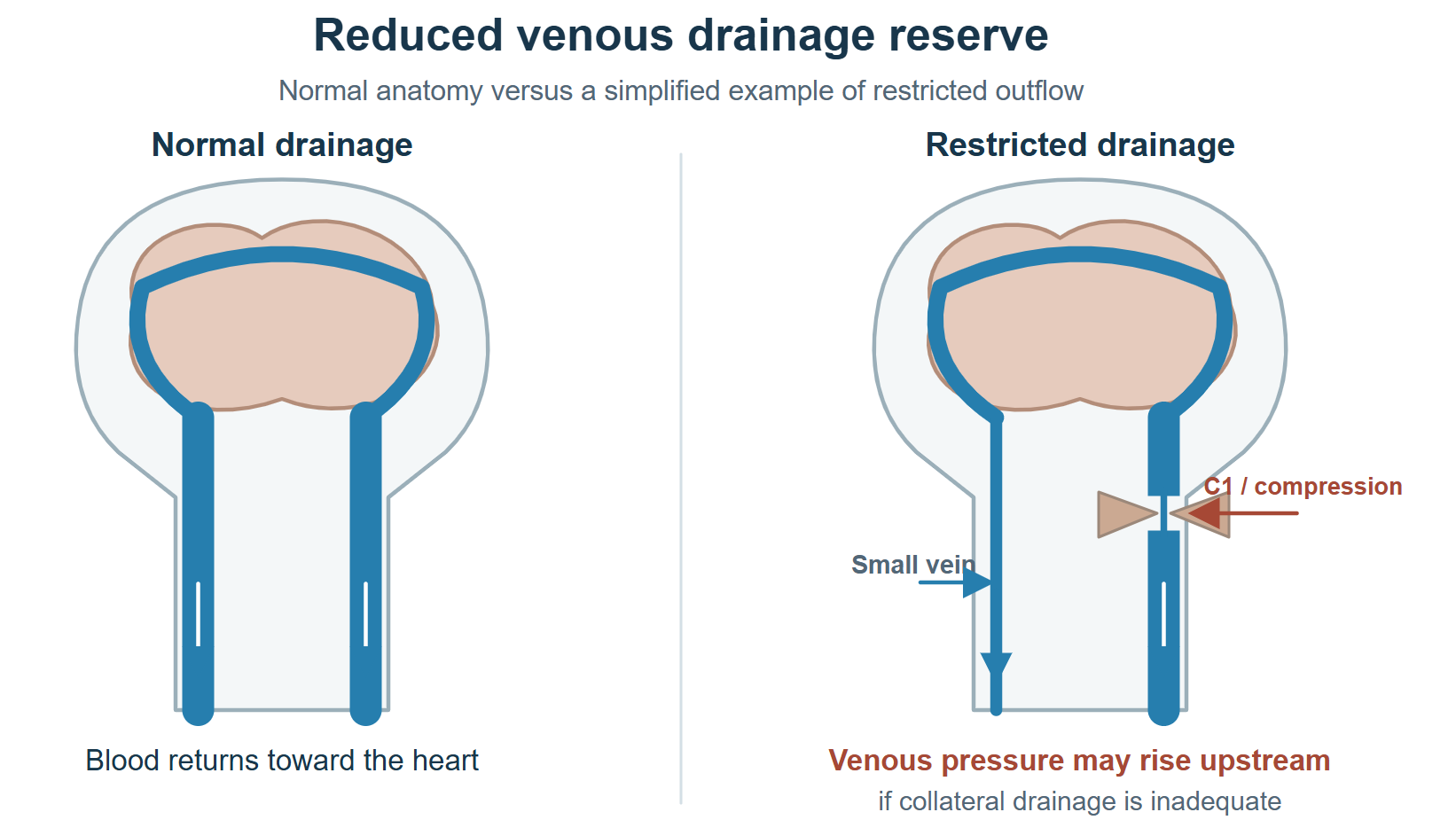
A thin vein on one side and an obstruction from C1 on the other vein caused Melissa’s cerebrospinal fluid pressure to rise. (ChatGPT produced image)
Any doctor will tell you they usually don’t.
But my situation wasn’t usual. I had put too much stress on the system. So when I jumped down from the bed my truck after bending and loading heavy items a year later (again, pressure triggers), the system gave out.
I felt a strange jolt through my spine.
The next afternoon, someone asked me where I worked, and I couldn’t answer. Like I’d forgotten where I laid my keys.
I did not feel especially horrible the instant the leak opened, likely because it relieved the too-high pressure on my system.
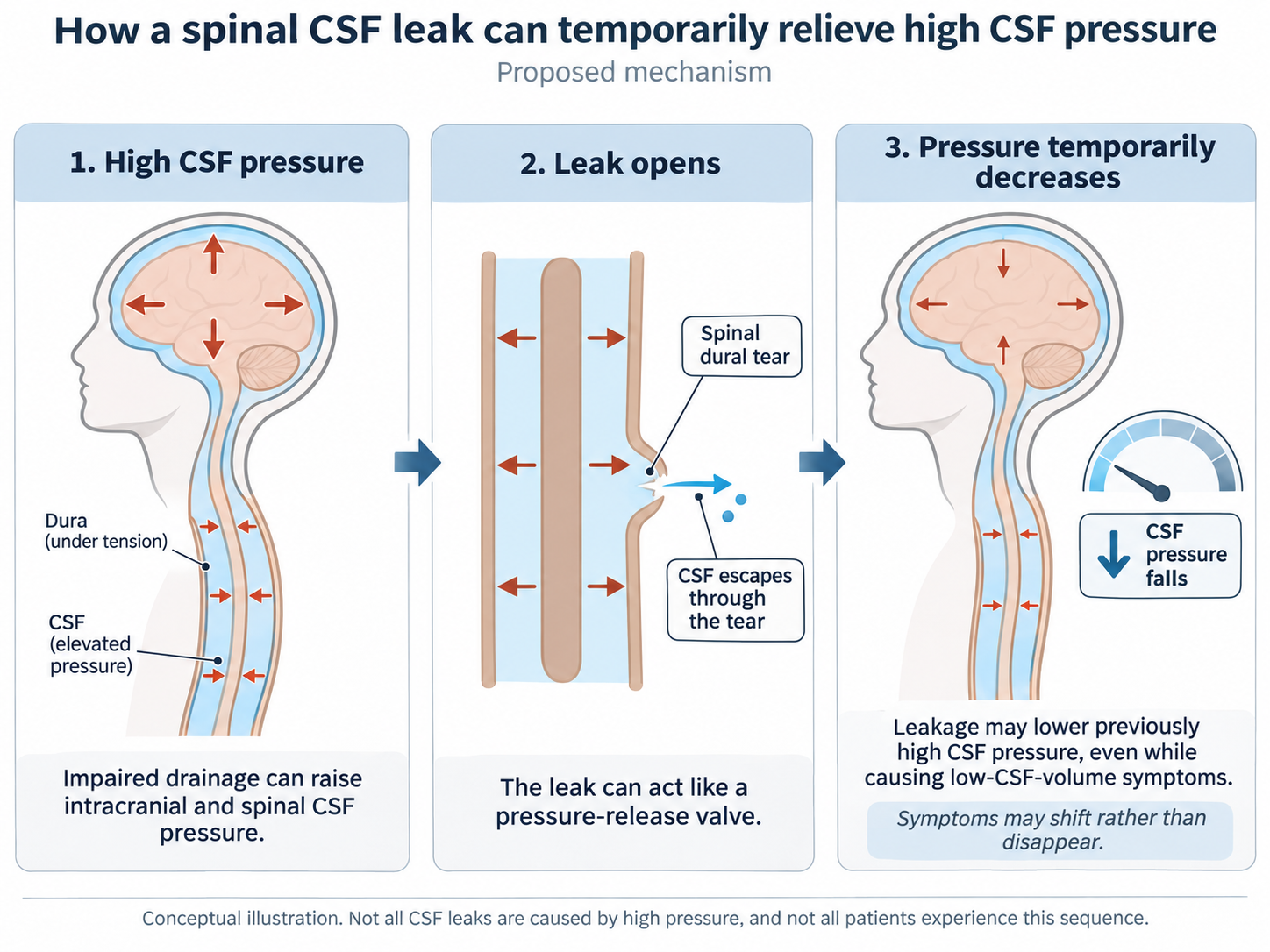
How a cerebrospinal fluid leak relieved Melissa’s high intracranial pressure. (ChatGPT produced image)
I didn’t get the classic leak-head pain. In fact, I might never have known. Leaks can happen with any pressure event, even something as minor as a sneeze. Head pressure also rises during illness, which could be important in cases with illness or inflammation onset.
I had brain fog. Fatigue. Vague feelings that something was off. Less vague feelings that I was definitely not right. I went to the doctor; he shrugged. Things worsened over the following days, months, years. New symptoms all the time. I learned the word comorbidity. Got told I was probably just depressed.
COVID happened. Everyone was sick. Medical care became harder.
I ended up bedbound, the picture of severe ME/CFS. My chief symptoms had initially been fatigue and cognitive issues, and strange, ever-changing symptoms and neurological weirdness that felt very hard to pin down. I did not fit the profile, but 17 doctors and 3.5 years in, I found a possible answer online:
Spinal CSF Leaks Without the Classic Orthostatic Headache.
My MRI was normal; my opening pressure was normal. (This can happen when cerebrospinal fluid leaks are present; e.g., the leaks can reduce the CSF pressure.) Most doctors would stop there. But we had dragged my body to a leak specialist who properly understood the condition.
A CT Myelogram found several large lumbar area leaks, with more higher up. Leaking for a long period had visibly worsened my connective tissue, and pushing through with exercise, physical therapy, and the wrong medical treatments had made everything worse. One leak had become many.
My leak symptoms looked like this:
- Cognitive issues (memory, attention, complicated thinking)
- Exercise intolerance/post exertional malaise
- Orthostatic intolerance (worsening symptoms when upright)
- Severe weakness, fatigue, and heavy limbs
- Pain (teeth, face, head, neck, shoulders, coat hanger, back, limbs, ribs, feet)
- Tinnitus (ears ringing), pulsatile tinnitus (whooshing in ears)
- Light, sound, scent, temperature, and movement intolerance
- Vision issues
- Pallor, skin changes
- Nausea, low appetite, food sensitivities, gag reflex, gut motility issues
- Sleep (initially sleeping up to 20 hours per day, later only 4 hours per day)
- Pressure behind eyes and in head and neck
- POTS (tachycardia, shortness of breath, etc.)
- Plus an ever-changing variety of neurological weirdness, gait changes, random puffiness, nerve sensations, chills, low fevers, mood changes, watery nose, irritated throat, auditory processing issues, problems reading blocks of text or focusing, not being able to hold up head, tingling in face and limbs, problems communicating, swallowing, and more.
Leak testing is specialized. It is critical to find a doctor knowledgeable in spinal CSF leaks.
My leaks were patched, my symptoms gone. I could walk again. Life was great—I even wrote a Heath Rising post about it.
But I was on a medication to lower my intracranial pressure, which is sometimes necessary post-patch. Restrictions after the procedure include taking it easy, with no bending, lifting, or twisting–the exact triggers for high-pressure events.
I hadn’t realized that closing the leaks had worsened the underlying high-pressure condition (intracranial hypertension/IH).
Once my system was back under stress, my cerebrospinal fluid pressure – no longer relieved by the leaks -became elevated. I was not out of the woods. I wrote a Health Rising post about it.
It cannot be emphasized enough how both leaks and high cerebral fluid pressure look similar to one another and to other chronic conditions. I only knew because of * the ordeal. * Because none of the treatments offered me a true cure. Maybe I was in denial. But had I accepted the many incorrect diagnoses from many otherwise adequate doctors, I would still be in bed.
What’s more, high intracranial pressure is a symptom driver in many other chronic conditions. Most people are never told how to recognize or manage those symptoms, or offered any treatment at all.
My life had changed for the better. When my pressure found equilibrium, I had no symptoms at all. And it no longer felt like a mystery or illness once I understood how my symptoms were related to neck position, activity, and sodium. But life doesn’t allow anyone to live stress-free, physically or otherwise.
I still needed help.
Venous Compression Found
My leak testing had revealed vascular compressions, yet every neurologist refused to look further into the possible cause for the intracranial hypertension they were treating. Even the more commonly acknowledged transverse sinus stenosis was dismissed. (Note that many people have some degree of internal jugular vein compression and do not experience symptoms. Note also that I had two contributing factors: an abnormally small jugular vein and a pinched vein by the C1 vertebra as well.)
I had to find new specialists. It took 3.5 more years, and it ended up with my having a successful internal jugular decompression surgery done.
Internal Jugular Decompression Surgery
The internal jugular veins run deep inside the neck on both sides and provide the major pathways for the blood to drain from the brain back to the heart. (When we hear about blood vessel compression, it almost always involves the veins, not the arteries, because the thin veins lack the thick musculature that lines the arteries.)
The internal jugular veins can become compressed in several ways: by the uppermost vertebra in the neck (C1) (my case), by a bony projection at the base of the skull called the styloid process, and even by neck muscles or enlarged lymph nodes.
Venous compression increases venous pressure. Increased venous pressure then reduces the pressure gradient that allows cerebrospinal fluid to drain into the venous circulation. As a result, the brain continues producing CSF, but drainage may become less efficient, increasing intracranial cerebrospinal fluid (CSF) pressure.
Researchers have proposed that elevated CSF pressure stresses the dura—the tough membrane that encloses the brain, spinal cord, and cerebrospinal fluid. Over time, in susceptible individuals – perhaps those with connective tissue issues – this can cause the dura to bulge or rupture, producing a cerebrospinal fluid leak.
That’s apparently what happened to me and explains why fixing the leaks didn’t fix the entire problem. The leaks were gone, but my internal jugular vein was still compressed – and producing high intracranial fluid pressure. I needed to do something about the compressed internal jugular vein to get my intracranial CSF pressure down.
My Surgery
My surgery was a success. Different kinds of surgery relieve different causes of internal jugular vein compression. My surgery included “decompression of the internal jugular vein by shaving down part of the C1 vertebra; styloidectomy (removing or shortening the elongated styloid process producing my Eagle syndrome), and then “resection or mobilization of surrounding structures”.
It is explained below:
Here’s what the symptoms of increased intracranial pressure looked like for me:
- Fatigue
- Sensitivity to light, sound, and smells
- POTS (increased heart rate, heat intolerance, SOB, etc.)
- Vision changes
- Motion intolerance
- Face, tooth, jaw, neck, shoulder, and back pain, and head and neck pressure.
- Tinnitus, pulsatile tinnitus, and a sensation of thumping and fluttering in the neck.
- Brain fog, word-finding, memory, concentration, alertness, reaction speed, and ability to communicate or have longer conversations.
- Exercise intolerance, occasional dizziness, eye pressure, nausea, and more.
They were made specifically worse by head tilting, bending, squatting, lying flat, sitting straight upright, exertion or lifting/straining, crying, compression garments, and standing in place. They were made generally worse by increased sodium intake, Vitamin A foods, stress, and illness.
I also had other symptoms, including a poking sensation in my throat (Eagle Syndrome). Importantly, decompression surgery relieved symptoms that are not commonly associated with vascular compression.
I also had hiccups for 5 years.
These symptoms are all gone.
Internal Jugular Decompression Surgery is not for everyone. Those who move forward go through extensive testing, the risks of which can include stroke, coma, and death. The surgery itself could cause nerve damage or vascular injury. And bodies are complicated; surgery is not always successful, and sometimes follow-up procedures are required. You shouldn’t trust a surgeon who isn’t specialized in this condition, and there are very few of them.
Many structures are in that area of the neck, including lymph nodes (which can swell during illness), blood vessels, and nerves (including the vagus nerve). It takes a surgeon who understands the condition — what symptoms each of those structures can cause — and knows how not to make things worse.
Most people with vascular compressions or IH do not need surgery. It can usually be managed with lifestyle changes or medication. But knowing what’s happening makes all the difference in treatment and symptom management. Misdiagnosis can make the situation so much worse.
The science is changing quickly, revealing that many common assumptions and testing methods for these conditions are wrong.
Myths and Misconceptions
To clear up a few of the myths and misconceptions:
- Spinal CSF leaks do not always present with a headache. Neither does intracranial hypertension. (Mine did not.)
- It’s possible to have both conditions at the same time: low volume (spinal CSF leaks) and high pressure (IH). (I did.)
- Opening pressures on a lumbar puncture are not always reliable. (Mine was not.)
- POTS symptoms can be caused by spinal CSF leaks or compressions. (Mine was.)
- A normal MRI does not rule out a spinal CSF leak. (Mine was read as normal.)
- The orthostatic aspect of leak symptoms can change or disappear over time. (Mine did.)
- Lack of papilledema does not rule out IH. (I did not have optic nerve involvement.)
- Weight is not the only cause of IH, and losing weight does not always improve symptoms. (I have always been thin.)
- You do not have to have a connective tissue disorder to have leaks or IH. (I only had hypermobility in my hips and neck.)
- Leaks are not always self-limiting, meaning they don’t always resolve on their own. (This is critical, given that many spinal CSF leaks are caused by lumbar puncture, epidural, or surgeries.)
- Recurring leaks could be indicative of high intracranial pressure.
- Intracranial hypertension is on the increase ,and IH can contribute to leaks.
It is honestly stressful how much outdated info is out there. Spinal CSF leaks are misdiagnosed at rates over 90%, and many similar illnesses, some diagnosed by exclusion, dismiss leaks as a possibility without proper evaluation. A 2020 study found an increased risk of intracranial hypertension, craniocervical obstructions, and hypermobility in ME/CFS.
Migraine, headache disorders, sinus conditions, POTS, Chiari, dementia, movement disorders, post-concussion or whiplash conditions, depression, anxiety, the list of misdiagnoses is long. Intracranial pressure can also be a factor in ME/CFS, fibromyalgia, long Covid, sleep apnea, PCOS, inflammatory or autoimmune diseases, and more.
The interesting thing about intracranial pressure is that it does not rule out any of the other findings in these conditions; intracranial pressure changes only add to the cycle of connective tissue, mast cell, energy, and endocrine disruptions.
It’s long been understood that intracranial pressure must be maintained to protect central nervous system function, but these conditions are poorly understood. Most doctors are inadequate or dismissive when it comes to leak testing and treatment, and while many neurologists do treat IH, care is frequently lacking or biased.
Doctors who specialize in leaks and vascular compressions are few and far between, and many do not understand how they can affect one another—even leak doctors typically do not address high pressure beyond the occasional post-patch rebound.
Lack of access, both physical and financial, can make finding the right specialists difficult. But in many cases, lifestyle changes and medications can be implemented now, while awareness, treatment options, and the number of available doctors grow.
- More links, research, and resources can be found on my Intracranial Information, Pressure and Resources website.