




Geoff’s Narration
The GIST

The elephant in the room. Despite our woes with it, the NIH represents too much opportunity to be ignored, or discarded.
When it comes to medical research funding, the NIH is, and always will be, the elephant in the room – the one organization that cannot be ignored, rejected, given up on, or, with regard to diseases like long COVID, ME/CFS, fibromyalgia, and postural orthostatic tachycardia syndrome (POTS), left to its own devices.
It’s very simple. Whatever the NIH’s faults, it remains the singular medical research establishment in the world. Its $47 billion/year budget is more than 3x China’s spending and 8x Germany’s. It presents a resource like no other.
This blog is going to take on four different disease groups (ME/CFS, long COVID, POTS, and post-infectious diseases), and it’s going to be very hard on the NIH. It’s crucial, though, that we not get so drowned in upset that we take our eyes off the ball. Our upset stems in part from how great the opportunity is in contrast to how little it’s been realized. One study found that to be commensurate with its disease burden, ME/CFS NIH funding would need to increase twenty-five-fold or more. Dozens of diseases that are less impactful and/or prevalent than ME/CFS, fibromyalgia, or POTS receive much more money.

That is hard to swallow, but we must not forget the enormous possibility that the NIH presents for these diseases, and in general, what a gift it is. The US has poured an enormous amount of money into medical research. We just have to find a way to get at it.
THE GIST
-

The elephant in the room. Despite our woes with it, the NIH represents too much opportunity to be given up on.
This blog puts the elephant in the room in the medical research field – the mighty NIH – under the microscope. Whatever the NIH’s faults, it remains the singular medical research establishment in the world. Its $47 billion/year budget is more than 20x the size of any other country’s effort. It presents a resource like no other. Despair is not an option. Neither is ignoring it.
- It looks at how ME/CFS, long COVID, POTS, and post-infectious diseases are faring. The picture is not a pretty one. With the exception of long COVID, all these diseases are being horribly underfunded. Based on its impact, ME/CFS, for example, should probably be receiving 25x more funding than it is.
- This blog, though, is not about despair. It’s about being clear-sighted about the challenges facing us – and how we can overcome them.
- ME/CFS Science projected last year that, absent some action, funding levels for ME/CFS could drop significantly. Of course, they already have! One research center was closed, and ME/CFS funding is now about about $10 million – significantly lower than it was pre-pandemic.
- Funding across the NIH was hit hard during the first year of the Trump administration, and ME/CFS was no exception. Work on several ME/CFS grants stopped; grant reviews and grant awards plunged. A major grant opportunity for ME/CFS disappeared altogether.
- Given all the work that had gone into supporting ME/CFS (the Research Roadmap, ME/CFS NIH conference, the completion of the intramural project, the sterling performance of the Research Centers), not to mention the disease’s close connection to long COVID (which has received ample funding), it was shocking to see funding decline so dramatically.
- Two years of advocacy efforts, however, have provided new hope. They succeeded in getting Congress to force the NIH, for instance, to produce an implementation plan for the Research Roadmap. The Research Roadmap, which, partly due to the pandemic, took six years to complete, is an NIH-directed effort that agreed that ME/CFS is underfunded and listed strategic areas to focus on.
- Once the Roadmap was completed, the implementation phase – what grants to produce, which areas to focus on, etc., – should have started, but it didn’t, forcing #MEAction and #NotJustFatigue advocates to go to Congress to force the NIH to produce the implementation plan, which it is now doing.
- At the same time, Solve M.E., #MEAction, and #NotJustFatigue banded together to urge Congress to allocate $50 million to fund the Roadmap. We’ll know at some point how successful they were. I talked with Elizabeth Ansell of #NotJustFatigue about her long-standing case of severe ME/CFS and the advocacy efforts underway (See the blog).
- Three major ME/CFS grants on low-dose naltrexone, the blood-brain barrier, and mold that were recently awarded suggest that ME/CFS funding will probably remain very low, but stable, this year.
- Long-COVID funding (the RECOVER project) also remains stable, but a long-term funding issue remains. Congress provided the initial funding for the RECOVER project. When the money began to run out, the NIH pumped about $600 million into the project but the money came from unused COVID-19 funds – not from the NIH’s coffers, so to speak.
- That kind of money will not be available again, indicating the RECOVER project and all long-COVID funding may require Congressional support to continue. Long COVID’s long-term fate at the NIH is unclear.
- Efforts to increase POTS funding at the NIH over the past ten years have produced several outcomes (Workshop, Report, etc.) but no increased funding. POTS still gets roughly $2 million/year in funding, or about 5x less than ME/CFS.
- Post-infectious disease funding at the NIH is essentially nonexistent. One funding opportunity, which provided no guaranteed funding or number of grant awards, and imposed strict requirements, simply indicated that the NIH was not interested in post-infectious disease research. Not surprisingly, it was a nothing burger and produced only one grant award. Instead of helping to build a field, it flopped.
- Lyme Disease is one post-infectious disease that has made it at the NIH. Funding was not dissimilar to that given to ME/CFS, but it organized its efforts, focused on advocacy, and, in 2019, managed to become a “line-item” in the NIH budget. Since then, funding has soared. Last year, Lyme and tick-borne illnesses received over $200 million in federal funding.
- So, it can happen! The takeaway is that the NIH is highly resistant to funding ME/CFS-like diseases, and we can’t expect it, acting on its own, to change its spots. The only course of action is going to Congress, which is what Solve M.E., #MEAction, and #NotJustFatigue recently did with their $50 million Research Roadmap ask.

Health Rising is not a 501 c (3) non-profit
Oh No! A Funding Collapse for ME/CFS?
In December of last year, ME/CFS Science’s devastating post, “NIH funding for ME/CFS keeps falling“, provided a wakeup call. We knew that funding for the NIH-funded ME/CFS research centers was down by about 50% and that one research center had been dropped – that was bad enough – but ME/CFS Science’s perceptive reporting pointed out that funding for individual investigators might be about to take a big hit as well.

For a while, it looked like ME/CFS funding might be about to collapse.
ME/CFS Science found that funding was actually lower than the NIH reported. Going project by project, ME/CFS Science could find only $10 of the $13 million the NIH reported ME/CFS received in 2024. Then, after Ian Lipkin’s ME/CFS research center was temporarily defunded, ME/CFS Science was able to find only $7.4 million in funding for 2025. Adding Lipkin’s renewed funding brought the new total to $9.4 million, but Lipkin’s work was grounded for much of the year.
Those were the lowest funding levels in over a decade, but they looked like good times when ME/CFS Science looked forward to what was happening in 2026. With five grants projected to end in 2025, and only two newly funded projects, unless some new grants showed up, it looked like ME/CFS funding at the NIH was about to take an even bigger hit.
Nobody could have foreseen this. Indeed, a couple of years ago, it seemed like good times were finally coming. ME/CFS, after all, turned out to be very similar to a disease, long COVID, which is getting quite a bit of funding. Plus, a CDC report dramatically increased ME/CFS prevalence, an ME/CFS Conference took place at the NIH, the massive ME/CFS Research Roadmap (8 reports, 8 webinars, 156 page report) was completed, and while the Nath Intramural study had been truncated, it still validated a surprising number of findings. Indeed, the relative success of the project indicated that, far from being some sort of impenetrable, wastebasket disease, ME/CFS could be successfully researched.
The NIH said it wanted proof that ME/CFS could be successfully studied, and with the Intramural study, it got it in spades. It said it wanted directions it could pursue, and it got them in the Roadmap, yet instead of rising, ME/CFS’s already low funding appears to have fallen rather dramatically.
This is not due to a decline in researcher interest. A Freedom of Information Act (FOIA) request indicated that the CFS SEP (which oversees ME/CFS grants) received 11 applications in 2022, 19 in 2023, 10 in 2024, and 18 in 2025.
The decline is due to a combination of factors. Some of it is just bad luck. The rest is clearly due to the NIH’s decades-long resistance to funding ME/CFS research.
Bad Luck
ME/CFS seemed poised for a breakthrough in 2025, but all plans were derailed by the chaos that occurred at the NIH during the first year of the Trump administration.
The massive cuts to the NIH that the administration proposed, the large job losses imposed by DOGE, and the big drop in the number of grants funded all played havoc with any diseases trying to move forward with the NIH, let alone a neglected disease like ME/CFS.
With the NIH basically refusing to move forward with or review any new grants for much of the first half of 2025, the number of new grants awarded plunged by 20%, and the grant success rate dropped to its lowest level in 30 years. The NIH (smartly) resorted to an accounting tactic to hold its budget steady at almost $50 billion in 2025: it paid out the full total of its multi-year grants all at once, rather than funding them year by year.
ME/CFS got hit in a number of ways. The funding loss caused by the elimination of one ME/CFS research center was supposed to have been made up with a major ME/CFS grant opportunity. That was slated to show up at the end of 2024, but the chaos over the next year at least temporarily derailed it.
The good news is that grant applications for ME/CFS, while still nothing to crow about, have increased recently. A Freedom of Information Act request indicated that the NIH received 13, 19, 10 and 18 grant applications during 2022, 2023, 2024 and 2025.
Note that the problem for ME/CFS is not that reviewers are rejecting ME/CFS grant applications wholesale. The last time I looked, the grant success rate was roughly normal. The problem is that getting researchers into the field requires guaranteed NIH funding.
ME/CFS Grants Show Up
The year is not done, and more grants may be approved later this year. Thus far, though, three major ME/CFS grants have been awarded. I believe that would bring us near our recent totals.
LDN Clinical Trials Grant – Jarred Younger won a rare clinical trials grant to assess the efficacy of LDN in 150-225 people with ME/CFS. Fifty people will also undergo advanced neuroimaging and blood tests of neuroinflammation, neurodegeneration, and oxidative stress in an attempt to find biomarkers that track with success and to learn how LDN is doing what it is doing.
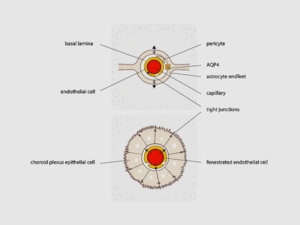
Great timing! A blood-brain barrier grant. See the orange (tight junctions) surrounding the blood vessels.
The Blood Brain Barrier Grant – A major (RO1) grant, “Blood-Brain Barrier Integrity and Immune Dynamics in Neuropsychiatric Sequelae of Post-SARS-CoV-2 onset ME/CFS versus Pre-Pandemic ME/CFS Patients“, is being funded. The five-year, 300-person project will assess the integrity of the blood-brain barrier (BBB) in pre-pandemic ME/CFS and post-pandemic ME/CFS patients.
This is a timely grant! The author, Alba Azola, who works with Peter Rowe at Johns Hopkins, believes that damaged endothelial cells lining the blood-brain barrier are allowing immune cells to enter the brain and produce neuroinflammation. This is the kind of grant that makes me yearn for more.
The Mold Grant? – Then there’s the big surprise. The last thing I would have thought the often stodgy NIH would have funded would have been a mold grant, but the multi-year, 200-person Nathanson grant “Stratification of ME/CFS by mycotoxin exposure” coming to Dr. Klimas’s group is going to do just that. This is a major grant which will assess mycotoxin levels, gene expression, immune analyses, etc.
While these are good grants, they still leave us considerably below our peak 2021 levels and obviously well below what a disease of this size and impact deserves.
Like Lazarus rising from the dead, the biggest opportunity in years, however, has shown up.
Back from the Dead: the ME/CFS Research Roadmap Gets New Life

With implementation, or the planning stage of the Roadmap in limbo, advocacy orgs pushed hard – and the implementation stage of it has begun.
The ME/CFS Research Roadmap presented the greatest opportunity for ME/CFS since Solve M.E. tried and failed to get Congress to take over funding for ME/CFS approximately 10 years earlier. If that effort, which was also years in the making, had succeeded, I have no doubt that, with long COVID highlighting the need for more post-infectious disease funding, ME/CFS would be getting tens of millions of dollars more in funding now.
I don’t think most people realize how big of a deal the ME/CFS Research Roadmap Initiative potentially is, and what it took to create it. It’s actually been in process for 7 years.
NIH Research Roadmaps have been around for about 20 years. They mainly involve pan-institutional diseases or areas that don’t fit neatly within the heart and blood, neurological, or immune institutes. The NIH creates these Roadmaps when it recognizes that business as usual isn’t working.
They give the NIH guidance on grant packages to produce, what centers to create, what technologies to focus on. Once implemented, they provide a coordinated, multi-year plan, and they’ve been effective in accelerating research.
The ME/CFS Research Roadmap, though, has been a different animal from the beginning. It’s the first roadmap produced for a disease that lacks institutional support and receives low funding. Other roadmaps (Brain, Pain strategy, Alzheimer’s) were built on top of fields with ample funding but which needed cross-institutional support to maximize their potential.
Instead of accelerating a field like the other roadmaps have, the ME/CFS Research Roadmap is essentially trying to repair/ build a field that the NIH has officially recognized is underfunded, and has recognized it’s underfunded for a long time, and yet, has done little about it.
Step-by-Step Process
Creating the ME/CFS Research Roadmap was a step-by-step process taken within the NIH, and the fact that it happened at all is due to the now departed NINDS Director, Walter Koroshetz.

The Research Roadmap for ME/CFS is a step-by-step process that began in 2017 and is still ongoing.
(Koroshetz publicly supported ME/CFS, regularly attended the patient meetings, conferences, etc., supported the Trans-NIH Working Group, increased NINDS funding for ME/CFS, and got the Research Roadmap going. He was easily the most involved NIH Director ever, and it’s too bad that he’s gone.)
First, a Working Group composed of NIH staff, ME/CFS experts, and patient/advocates had to be created. That group had to create a report demonstrating that barriers to ME/CFS research exist and recommending that a strategic planning document (the Roadmap) be produced. The NINDS Council approved the document in Sept. 2019.
A couple of months later, COVID hit, and work on the Roadmap stopped before it got started. It started up again in 2023 and ultimately resulted in a massive effort that produced 8 separate reports and webinars, as well as a 148-page final report. It was approved in May 2024 by the NINDS council.
Now came the implementation phase, which would lay a coordinated plan that included such things as grant packages, research centers, working groups, clinical trials, etc.
But nothing happened. The Roadmap received zero funding. No implementation plan was produced. No grant packages, new centers, clinical trials, or new working groups were announced. Vicky Whittemore told me that, in part, this was due to staff cuts produced by DOGE. It appeared that the Roadmap was dead and gone – until advocates from MEAction and NotJustFatigue resurrected it.
The Elizabeth Ansell / #NotJustFatigue Interview
I talked with Elizabeth Ansell, the creator of the spectacular #NotJustFatigue website, about the Roadmap and her organization. Elizabeth has had a severe case of ME/CFS for ten years, and at one time was unable to speak or respond to speech.
There was no sudden crash, just a gradual decline punctuated by viral infections. She had worked with ABC and Showtime prior to getting ill, and promised herself that if she got well enough, she would contribute. She is still bedbound, and it took her six and a half years to produce #NotJustFatigue, but it is a beauty. It’s a visually evocative website that resonates emotionally.
#NotJustFatigue has created a film, a series of short impactful videos including “You could be next”, “You have no idea how serious this is”, “Get out of my office”, “It not hysteria, it’s sexism”, as well as a nifty ME/CFS history, and provides regular advocacy updates. She said many people have written how the videos have helped them communicate about this disease. Elizabeth regularly engages in advocacy from her bed and has used the videos to quickly get Congressional staffers up to speed on ME/CFS.
She told me that two years of behind-the-scenes efforts talking to Congressmen and their staffers (and 7,000 persons signing #MEAction’s letter) resulted in a Feb. 2026 Labor-HHS-Education appropriations bill, which included language directing NIH to “provide a detailed implementation plan for the ME/CFS Research Roadmap to the Committee within 180 days of enactment“. That is due by August of this year, and Vicky Whittemore and company at the NIH are working on it.
The implementation plan does not mean the NIH will fund the plan. If the past is prologue, in fact, it’s hard for me to imagine the NIH doing anything other than dropping it in a dusty file cabinet somewhere.
That’s why, in March of this year, #NotJustFatigue, #MEAction, and Solve M.E. made a coordinated push for $50 million in the 2027 appropriations bill to fund the Roadmap implementation plan. #MEAction also secured a meeting with NIH Director Bhattacharya to discuss implementing the roadmap. That was supposed to happen on May 13 but has been postponed, and apparently rescheduled.
Time will tell. $50 million is a nice chunk of change for a disease that’s barely getting $10 million/year, but Elizabeth regards it as just a start. The good news is that our advocacy orgs are aligned on getting funding for the Roadmap passed, we will soon have an implementation plan, and, if funding doesn’t happen this year, they’re going to keep pressing on it.
There’s no giving up on the NIH and its $45 billion budget. At some point, it’s going to crack.
Long COVID at the NIH
Forty years ago, I was naïve enough to believe that if I could go from a healthy, vital young man to a shadow of myself, there MUST be a large team of researchers working hard to figure out what happened. I see the same statements today from long-COVID patients.

The NIH threw a lifeline to the RECOVER project. The only catch – it came from unused COVID-19 funds it may have had to use up.
It’s not true. Yes, some researchers are working hard, but tackling a disease requires large, concentrated, and persistent efforts, and that’s never come close to happening in ME/CFS. Thanks to Congress, it did get started in long COVID.
Yes, the RECOVER project has been a huge disappointment. It’s basically confirmed every negative critique about the NIH: that it’s a stodgy, conservative organization. It’s still getting funded though, and that’s saying something.
After the RECOVER Initiative blew through its $1.5 billion stash, the NIH plowed $600 million into the program to save it. The NIH, it seemed, had changed its spots. Now it was giving hundreds of millions of dollars to long COVID.
Or was it? The NIH didn’t have to do the hard work of reallocating funds from other diseases to long COVID. Almost all of that money came from unused COVID-19 funding. This wasn’t necessarily, then, an example of the NIH saying that “we now view long COVID as a priority”. It may have been more the NIH finding a way to use up unused COVID-19 funding. In fact, because COVID-19 was no longer a priority, long COVID may have been one of the only ways the NIH could use that money. (If the NIH doesn’t use its money after a period of time, it loses it.)
Basically, the RECOVER program lucked out. The money should keep the RECOVER program going, albeit at a lower level, through 2029. RECOVER will have to find another way to fund its programs shortly.
Words Will Get You Exactly Nowhere

Don’t fall for the NIH’s soothing words of concern. Instead, follow the money.
The latest iteration of long COVID and ME/CFS at the NIH looks sinkingly familiar. NIH Director Bhattacharya and DHHS Director Kennedy have said all the right things about ME/CFS and long COVID. Bhattacharya has publicly emphasized that ME/CFS and long COVID are real, historically neglected conditions. He’s even agreed that both groups of patients have been “gaslit”. He stated that he assured long-COVID patients that the NIH was going to find an answer.
Similarly, in his confirmation hearings, RFK Jr. noted that he has a son with long COVID and explicitly pledged to direct long-COVID research funds toward potential treatments and diagnostics “with enthusiasm”. In Sept, 2025, RFK Jr. hosted a long-COVID roundtable, which endorsed increased biomarker/diagnostic work, mechanistically informed clinical trials, and stronger pharma engagement, and announced he was creating a long-COVID consortium.
Researchers and advocates left the event excited about the progress they expected to happen. Eight months later, nothing has happened. Kennedy hasn’t even fulfilled his easiest promise – the creation of a long-COVID consortium to help guide research and clinical trials.
A consortium, of course, is a far cry from what the field really needs: a state-of-the-art biomarker/diagnostics long-COVID effort that includes large, multi‑site cohorts employing multi‑omics (proteomics, metabolomics, autoantibody profiling, viral sequencing, etc.) to look for molecular signatures. Basically, it would do what the RECOVER Initiative could have and should have done and alone had the money to do.
It might cost $50 million/year for five years but it could break the back on long COVID. That seems like a lot of money, but that’s the kind of money that the $46 billion/year NIH regularly ponies up when it’s serious about something.
I wrote, in a letter to the long-COVID community at the beginning of the pandemic, urging them to never, ever trust the NIH’s heartfelt protestations about long COVID. The NIH has NEVER in the past 40 years said a single negative thing about ME/CFS. It’s always said that it’s a serious disease. And it’s always behaved as if it is not.
Unless statements from NIH leaders are backed up by real action they’re just window dressing designed to mollify the patients. It’s an old and tired phrase, but it’s true – follow the money. That’s the only thing that matters.
We have good people at the NIH who would like nothing better than to see ME/CFS and long COVID succeed. The problem is that they’re caught within a system that actively pulls against supporting these diseases.
That’s why Congressional advocacy is critical.
POTS and Dysautonomia at the NIH
Postural orthostatic tachycardia syndrome (POTS) is in the same boat. Despite the fact that at least 1-2 million people in the US have POTS (the number has surely risen since the pandemic), getting the NIH on board with POTS has been like giving a cat a bath. It will seemingly do anything to avoid supporting it. The NIH won’t even take the trouble to break out POTS funding.
Dysautonomia International has been trying. It’s July 2017 Lobby Day and October Congressional briefing led Congress to formally recognize POTS as a disabling, under‑researched condition and stated that it “expected” the NIH to “stimulate the field”.
Seemingly working as slowly as humanly possible (but probably at its normal pace (lol)), the NIH produced a POTS workshop in July 2019, which generated priorities for future research, better studies, better prevalence figures … the whole shebang.

The NIH agreed POTS is a serious and underfunded disease. Ten years later, funding remains about the same.
Seven months later, a Workshop report was given to Director Collins, and the official 21-page report was published in a Journal about two years later, in June 2021. The Report agreed that POTS was serious, needed more research, etc. – things we’ve heard so many times regarding ME/CFS – but crucially, as we’ve seen many times in ME/CFS, it did not produce a funding target. Doing that in an NIH-produced report would have produced some obligation for the NIH to take action, and that was a bridge too far for it to cross.
Dysautonomia International subsequently produced two larger journal reports from the Workshops and explicitly asked for $50 million over 5 years.
Three years later, in 2024, Congressional testimony indicated that the NIH was still spending less than $2 million/year on POTS. In 2024, the NHLBI Institute produced a “Notice of Special Interest” (now expired) which explicitly invited POTS researchers to apply for grants. It highlighted how prevalent and disabling POTS is, and how it overlaps with ME/CFS and long COVID. It too, did not, however, provide any funding.
Funding remains low. In fact, NIH POTS funding levels, adjusted for inflation, may be even lower than they were 10 years ago. The NIH simply refuses to “support the field” in a meaningful way. (We’ll know it’s supporting the field in a meaningful way when funding increases.) It still does not even provide funding levels of POTS research.
This does not mean that progress has not been made. Getting the NIH to hold a Workshop on a disease it had virtually ignored, writing an official report, and securing a Notice of Special Interest are all steps forward. POTS now has visibility at the NIH.
Notice, though, how hard it’s been to get the NIH to move on POTS. One would think it would be easy. POTS, after all, unlike ME/CFS, has biological-based diagnostic criteria, making it harder to pretend that it’s not a real disease. Prevalence figures indicate that it affects many people, including many people with long COVID. The RECOVER project has even aimed large clinical trials at it. It’s gotten a lot of publicity due to its connection with long COVID.
Like ME/CFS, like fibromyalgia, like long COVID, though, POTS remains stuck at the NIH. My belief is that the NIH is BUILT – not intentionally – but still built to resist the entry of new diseases into its pantheon. These are often disabling, complex, “invisible”, and prevalent diseases such as ME/CFS, FM, and irritable bowel syndrome, which do not usually kill, and which mostly affect females.
Without Congressional action, we can expect the NIH to continue doing what it’s been doing for decades.
The Doomed NIH Post-Infectious Grant (and Field?)

Seizing an opportunity, Germany is committed to being a leader in the post-infectious disease field.
Take the latest and greatest – post-infectious diseases. One might think that the NIH would be eager to jump into a new field, and show that it’s not the stodgy, stick-in-the-mud institution that so many people accuse it of being. Who, after all, wants to get left behind?
As noted in an earlier blog, Germany has reportedly promised to fund post-infectious disease research to the tune of $500 million over 10 years. Its goal is to be a leader in this newly emerging field. If it even comes close to that, its goal will surely be achieved.
Its biggest competitor would be the NIH, but the NIH is once again, oh so consistently, asleep at the wheel.
The NIH has several ways to show researchers that it’s serious about a field: first, it commits to a certain amount of funding to a major grant opportunity, commits to funding a large number of grants, and gets buy-in from the Institutes. That gives researchers confidence that the months they spend writing a grant application will not be in vain.
The one NIH post-infectious grant opportunity (PAR‑25‑116: “Towards a Better Understanding of the Neurological Effects of Infection-Associated Chronic Illnesses” did none of those things. It provided no funding, did not commit to funding any grants, and got little buy-in from the Institutes/Offices. Plus, it required a twist – mechanistic research – which put a further burden on researchers entering into a new field. Plus, the rules were changed in mid-game by the Trump administration. The institutional support from the NIH for this weakest of grant opportunities consisted of the three NIH Institutes/Offices who supported it (NINDS, NIMH, OD).
Instead of starting to build a field, the NIH effectively communicated the following message: “We’re not interested in this field”. That message was received. The one post-infectious grant opportunity proved to be a nothing burger. As far as I can tell, PAR-25-116 funded one grant. (Ironically, it did happen to be an ME/CFS grant…:))
Lyme Disease Makes it Over the Hump!

Lyme Disease’s focus on Congressional advocacy worked. Lyme and tick-borne illnesses now get about $200 million a year in funding.
Lyme disease appears to be the only post-infectious disease to make it at the NIH. Its trajectory demonstrates what might have happened had Solve M.E. been able to convince Congress to create a line item for ME/CFS within the NIH around 10 years ago.
That line item has made all the difference. Line items have been described as the holy grail for advocacy groups because when Congress produces one, it commits NIH to spending a specific amount of money on a disease. They explicitly tell the NIH that Congress is not happy with how the NIH is spending its money, that it’s on the watch, and the NIH is on the clock. With a line-item, a disease is no longer at the mercy of biases at the NIH. Now it has political protection.
I have no doubt that, given ME/CFS’s association with long COVID, ME/CFS would have $50 million/year in NIH funding if Solve M.E. had been successful.
Something like that, after all, happened with Lyme disease.
In the mid-90s, Lyme Disease funding at the NIH was in the pits, and Lyme advocates were doing pretty much what ME/CFS and POTS advocates are doing now: getting specific language into appropriations bills, urging the CDC and the NIH to do more. By the late 1990s, Lyme was receiving about as much money as ME/CFS is now, and it slowly crept up to $15-20 million by the early 2000s.
In 2019, a 501 (c) (4) organization, the Center for Lyme Action, was created specifically to lobby the federal government. In 2021, Lyme and tick-borne illness funding at the NIH became a line item in the appropriations bill, and total federal funding shot up to $82 million. The next year, NIH/CDC funding more than doubled to approximately $153.5 million by 2022. Last year, total US government funding for Lyme and tick-borne illness exceeded $200 million.
So, it can happen.
Conclusion
The only answer – Congressional action.
The conclusion is not pretty, but we have to be clear-eyed about what we’re up against. History shows that, left to its own devices, the NIH is not going to do anything significant for these fields. It will say nice things about them, it will communicate its sincere concern, it will create reports, it will even agree that they need a lot more funding: it simply won’t provide it.
For me, there’s some comfort in knowing that we’re all (ME/CFS, fibromyalgia, long COVID, POTS, etc.) in the same boat. (Doesn’t it suggest that we should be working together?)
At some point, I imagine the NIH will surprise us, but the message from this blog, and it can’t be repeated too many times, is that the only remedy is Congressional action, and that’s why we need to support groups like Solve M.E., #MEAction, and #NotJustFatigue, focused on that.
Here’s hoping they can secure $50 million to support the Roadmap Initiative in the 2027 Appropriations bill. That would be a game-changer. We should know soon enough.
Health Rising’s Donation Drive Update

Health Rising is keeping an eye on the federal funding that drives so much research. If that supports you, please support us.
Thanks to everyone who has brought us to almost 45% of our goal. Research/treatment blogs may be more appealing, but ultimately, I would argue that nothing is more important than being kept apprised of, and taking action on, our status within institutions like the NIH.
ME/CFS and long COVID appear like they’re on the verge of major breakthroughs, but the kind of studies needed to readily produce those breakthroughs need to be large, expensive, and comprehensive ones, and if that’s the kind of study you want, the NIH is the place to go. That’s why, for all the angst and upset surrounding that organization, we can never give up on it. Thankfully, our advocacy organizations have not, and neither has Health Rising.
If being kept informed of the situation – good or bad – with the federal funders that drive so much medical research is important to you, please support us.



Thank you for this detailed history and evaluation, Cort. I hope the people holding the purse strings at NIH read it and take action. ME/CFS happens for no known reason to hard working, health conscious people. Take funding away from smoking, alcohol illness that is caused by choice behavior and research this illness that is devastating and which none of us know how to have avoided.
Surprised you didn’t mention that Paul Chung at NIH is researching a drug that works on the mitochondria, as a potential treatment for ME/CFS.
https://www.prnewswire.com/news-releases/new-research-funding-from-solve-me-advances-innovative-mecfs-and-long-covid-studies-toward-treatments-302769071.html
I mean Jay Chung.
It’s not an NIH-funded study, but it sure is good to see that:). Its always uplifting to see new NIH researchers deciding to spend time on us for one thing. Thanks for the link!
“Mitochondrial stabilizer IVO-21 as therapy for ME/CFS”
Dr. Jay H. Chung (National Institutes of Health) is testing a low-cost pill medication called IVO in preclinical mouse models to see if it boosts cellular energy and reduces inflammation—mechanisms believed to drive symptoms such as fatigue and brain fog. Dr. Chung’s study could pave the way for a safe, accessible treatment that addresses the root causes of this complex disease.
Between them, Paul Hwang and Jay Chung at the NIH might be onto something. I thought Hwang’s study on WASF3 was one of the more interesting and compelling studies in the ME/CFS field over the past several years.
Thanks for this overview Cort. I strongly agree that Congressional action is necessary, and I believe that protests will somehow need to occur. They played a big role in creating the political will in Germany. I discuss this more in my blog post:
https://open.substack.com/pub/viralpersistence/p/without-protests-iaci-patients-wont?utm_source=share&utm_medium=android&r=6rc6a
Also, while NIH is indeed the biggest medical funder, it’s not quite 20x! I analyzed governments’ Health R&D budgets here:
https://substack.com/@siebepersists/note/c-268285515?r=6rc6a
Note that this is adjusted for purchasing power – a dollar in Europe goes father than in the US! Also note that US works only through grants and needs to pay all overhead through that, while other countries cover overhead (partially or wholly) through general funding streams. So below the line, a Dutch or German $1mil grant gets you about the same as $2mil in the US.
Thanks for that. I don’t how I got that so wrong! Dollar to dollar it’s about 8xs Germany’s spending which is the highest in Europe. I fixed the blog 🙂
I agree about the protests and am also happy to read about patient organisations banding together – I think that was also a success factor in creating political awareness in Germany.
Liegend-Demos (lying-down protests) are now a regular thing in Germany creating media attention https://media0.faz.net/image/w1800/c7aa58a6678d/w2920h1959x30y23/202403/1.9558128/liegenddemo-aktion-fuer-me-cfs.webp
and accompanying the first parliamentary debate on ME/CFS in 2023 was a protest creating powerful images with (army) cots representing ME/CFS patients in front of parliament: https://de.wikipedia.org/wiki/Datei:MECFS-Feldbetten_vor_dem_Bundestag_-_Foto_Maria_Wagner.jpg , https://www.mecfs.de/erste-bundestagsdebatte-zu-me-cfs/
Hi Siebe, some time ago I wrote down my own analysis of what I thought were success factors for creating political awareness for ME/CFS in Germany. If you’re interested in reading, let me know how I might email it to you. Or I could post it here (though that would be quite a long post – but why not…)?
Yes please!
sieberozendal@gmail.com
If what we can do is donate and contact congress… is there a draft letter we can use as a starting point to send to our representatives? Hopefully it has links to factual statistics to show how severe and widespread ME CFS is.
I have long believed that much of the inertia and lack of support is because these diseases affect many more women than men. A couple of days ago, Melinda French Gates published an opinion piece in the NY Times about lack of support for women’s medical needs. I don’t believe she understands the impact of autoimmune diseases as “women’s diseases” – but perhaps if she were educated on that, she could be a useful and effective advocate? Just a thought. https://www.nytimes.com/2026/06/04/opinion/menopause-women-health-care.html?searchResultPosition=1
Haven’t posted in a long time. I’m 86 now and been sick since 1984. Had the honor of working with Dr. Lapp and his support group in Charlotte, NC. … since disbanded. I do ok when I’m not pushed. I may write a small book some day… or not… I love the title %notjustfatigue.
Good luck with raising funds and pray that Trump doesn’t get involved in this. He’ll kill it in a second. I’m moving to a newer senior facility soon so my email address will likely change. My son’s email is reneerick@outlook.com. Their’s may not change.
Hi Nancy, glad to see you on here. I believe we may have had a mutual friend that suffered from this dreadful disease.
Her name was Anita and used to live in Charlotte. I recall the impact you had in her life prior to her death. My name is Sandra from Alabama . It would great if you could write your life story in a book and I would buy it. Best regards
Thanks for mentioning her – she could be an enormous help….
It was hard to read the truth about NIH, but didn’t surprise this decades old CFS sufferer. Cort, in all this, you are our truth teller. You shine light on what we would never know . Thank you . We just keep trudging on and never give up!
Thank you
In the Netherlands, the government has made nearly 33 million euros available for research into ME/CFS for the period from 2021 through 2031.
In April 2011 the NIH held a 2-day Chronic Fatigue Syndrome State of Knowledge Workshop at which a presentation was made entitled, “Elephants In The Room.” That presentation informed the audience of the impediments to Chronic Fatigue Syndrome research other than financial. Thus, while this current blog is similar in title, the subject matter is substantially different.
The Elizabeth Ansell videos are perfect descriptions of the real experience of ME/CFS. They are short, authentic, and raw. I’m going to show them to the important people in my life. Thank you Elizabeth.
Cort, this is an important distinction between acknowledging a disease and actually investing in understanding it. The comparison with Lyme disease is particularly interesting: once sustained advocacy led to a dedicated funding line, research funding changed dramatically.
The ME/CFS Research Roadmap seems like a potentially important opportunity, but as you point out, a roadmap without implementation and funding can remain just a document. The proposed $50 million for implementation could be a meaningful step toward turning years of planning and advocacy into actual research.
I also agree with your broader point that ME/CFS, long COVID, POTS and other post-infectious illnesses have much more in common than their funding structures suggest. Coordinated advocacy across these communities could make a real difference.