




Geoff’s Narration
The GIST

Few people thought Amatica could produce a 1,000-person gene expression study … but it’s happening.
Until one is committed, there is hesitancy, the chance to draw back — concerning all acts of initiative (and creation), there is one elementary truth that ignorance of which kills countless ideas and splendid plans: that the moment one definitely commits oneself, then Providence moves too…
A whole stream of events issues from the decision, raising in one’s favor all manner of unforeseen incidents and meetings and material assistance, which no man could have dreamed would have come his way.
Whatever you can do, or dream you can do, begin it. Boldness has genius, power, and magic in it. Begin it now.“ William Hutchinson Murray

Two ME/CFS/long-COVID patients founded Amatica.
What really excites me about Amatica is its boldness. With its vision of gathering 1,000s of samples, it’s aiming big, and the time is ripe for bold visions. The ME/CFS and long-COVID fields have produced and will continue to produce scintillating results, but without major studies involving large numbers of participants, they will move forward at a pace unacceptable to anyone with these diseases.
Enter Amatica’s founders, Nicholas Boyd-Gibbons, a neuroscientist specializing in RNA transcriptomics and genome engineering, and Jack Hadfield, an aerospace engineer turned systems biology researcher. They understand the urgency patients feel because they are both patients.
They recognized that the field wasn’t lacking good researchers or good ideas – it was lacking data at a level that had never been collected before – hence their website’s declaration: “The right research-grade gene expression and protein data has never been collected at scale for these conditions.” Amatica

Amatica’s goal is to produce that scale, and I talked with Nick about their recent breakthrough in doing so.
THE GIST

Whatever you can do, or dream you can do, begin it. Boldness has genius, power, and magic in it. Begin it now.” William Hutchinson Murray
- What really excites me about Amatica is its boldness. With its vision of gathering 1,000s of samples, it’s aiming big, and the time is ripe for bold visions. The ME/CFS and long-COVID fields have produced and will continue to produce scintillating results, but without major studies involving large numbers of participants, they will move forward at a pace unacceptable to anyone with these diseases.
- Enter Amatica’s founders, Nicholas Boyd-Gibbons, a neuroscientist specializing in RNA transcriptomics and genome engineering, and Jack Hadfield, an aerospace engineer turned systems biology researcher. They understand the urgency patients feel because they are both patients.
- Amatica’s goal is to produce studies the scale of which ME/CFS and long COVID have not seen before. The scale needed (thousands of participants) to ferret out the subsets we know are littering these diseases and target treatments to them.
- I talked with Nick about Amatica’s recent breakthrough, which will allow them to accelerate their work dramatically.
- Major support from a long-COVID donor at a tech venture capital firm is allowing Amatica to cut test prices for patients and healthy controls by more than half, hire a computational biologist and machine learning researcher, and biobank more kinds of samples.
- With the NIH continuing to neglect diseases like ME/CFS and FM, and failing miserably in its one serious attempt at long COVID (RECOVER project), these fields are left with two possible avenues of significant support: philanthropists and venture capitalists.
- Venture capitalists provide an intriguing opportunity to fill in a major gap in these fields: diagnostics. Venture capitalists look to the future to provide what’s missing now.
- With tens of millions of people in the US alone afflicted with heterogeneous, complex, difficult-to-treat chronic diseases, the opportunity to disentangle that mess, show who belongs to which subset, and then target treatments to them is immense.
- Given that, it’s no wonder that Nick told me that Amatica – which was formed early last year – has already been visited by 20 venture capital firms. One major firm wanted to join the current funding round but was too late.
- Amatica currently offers gene expression assessments that determine which genes are most highly turned on or off. Amatica then uses three different kinds of pathway analyses to determine which biological pathways have been activated (or inactivated).
- Amatica’s latest gene expression batch appears to be tracking with what we know. Long COVID and ME/CFS are closely related but different. The same general themes (stress hormones, mitochondria, red blood cells, antiviral signaling, etc.) have emerged in their analyses as we’ve seen in the research.
- Amatica is relying on patient support; i.e. you must buy the gene expression test in order to participate in its research.
- The good news, though, is that its new funding is allowing it to to reduce more than half the cost of the old test.
Everyone who gets the tests receives:
-
- Complete Gene Expression results explained.
- 1,500 Biological Pathways assessed – you will find out which biological pathways your gene expression results suggest have gone bonkers and which subgroups you belong to.
- Treatment Response – Advanced AI looks for signals that can predict which treatments you will respond well to and which you should avoid or be very careful about. (I don’t know if this is being done yet.)
- Ongoing Evolution – As Amatica’s database grows, you will get more precise insights into your health: which biological pathways are off, what subgroup(s) you belong to, what treatments might/might not work for you, etc.
- No yearly subscription fees – Once you join the program, you will get the insights it provides for the rest of your life.
- Contribution – By providing your samples, you are also helping to build a database which will contribute to our understanding of ME/CFS, long COVID, and other diseases.
- More samples – If you provide permission (I did), your blood will be biobanked for proteomics, metabolomics, epigenomics, whole genome sequencing, and extracellular vesicle assessments in the future.
- The prior gene expression test was about $1,000 (plus the blood draw and shipping). It’s now available for $500 off for the first 500 people who order it. That brings it to $495 for one test, $895 for two tests, and $1395 for three tests. (Longitudinal test results are particularly important for research.)
- The phlebotomist will come to your house. The price of the blood draw and shipping is now included for people living in the US, Canada, and the UK. Instructions for booking a blood draw are included. If you live in the US, the phlebotomist will handle shipping.
- People in other countries may have to pay for a blood draw. Enter your country in the order form to see what applies to you. Amatica says, “We can connect you with our partner mobile phlebotomists and support every step of collection and shipping.”
- People who already bought the test will get a free second test. The test is available worldwide.
- You can request that a healthy control you know get the test, and their kit is free. (I suggested my twin brother.) I bit the bullet and bought a test – and will report on my results.
You can order the test here
Health Rising is not affiliated with Amatica in any way, and
does not receive funding from test purchases,
Support Health Rising and Keep the Information Flowing!
Health Rising is not a 501 c (3) non-profit
The MEGA Studies
It takes a special kind of group to produce these mega studies. DecodeME aside, federal funders are hardly going to splurge for them. It’s taking patient groups and patient support to do them.
Look at the Open Medicine Foundation. It had kicked around the idea of a mega biomarker study before, but then last year decided to go for it and began the first part of a multi-year 1,000-person ME/CFS and long-COVID biomarker study. (The first part has been funded.)
Similarly, the Park Pagliuci Fund donated $10 million to the PolyBio Research Foundation to support the Long COVID Cure Initiative (LCCI). It will, among other things, build the infrastructure needed for accelerated, more targeted clinical trials and support the long-COVID VIPER biomarker project.
These are the kind of big initiatives that will produce breakthroughs.
Defeating Heterogeneity

You defeat heterogeneity by having enough samples and using analytic techniques to uncover subsets.
Nick and Jack are living examples of the variety of ME/CFS/long-COVID patients. Nick has extreme physical PEM – he can’t walk more than about 2 or 3 meters and is taken around by a wheelchair – but his mind is absolutely clear, and he can do loads of cognitive work.
Amatica’s 1,000-person gene expression cohort is the size they believe is needed to generate enough statistical power to stratify ME/CFS/long-COVID patients and find the right treatments for them.
Jack, on the other hand, has lots of neurological symptoms, extreme muscle weakness, and MCS. He works most days from his phone in a dark room.
Big Step Forward
With major support from a long-COVID donor at a tech venture capital firm, Amatica has taken a big step forward. The new funding will let it cut test prices for patients and healthy controls by more than half, hire a computational biologist and machine learning researcher, and biobank more kinds of samples.
The donor, who also invests in precision medicine, became interested when Nick, who has worked with stem cells, described his stem cell success with something called “visual snow syndrome”.
Venture Capital to the Rescue?

Could philanthropists and/or venture “assistants” fill the need that federal funders like the NIH won’t?
ME/CFS, in particular, needs all the funding it can get; until recently, I had not thought of venture capital. The more I thought about them, the more they made sense.
We’ve relied on an old boys’ club we can’t get into at the NIH for way too long. The difference between the NIH and venture capital is that the NIH really doesn’t care how many people a disease affects. If it did care about disease impact, it would include assessments like disability-adjusted life years (DALYs) in its grant scores, and diseases like ME/CFS and FM would get a lot more money than they do now. At the very least, the NIH would promote these neglected diseases by providing substantial grant packages.
Instead, these diseases are left to the whims of committees that, so far as I can tell, are dominated by the big disease groups.
Venture capital firms – which Vinod Khosla, who has supported ME/CFS, prefers to call “venture assistance” firms – on the other hand, care a lot about underserved communities because they provide an opportunity. VC firms, of course, also contain people with ME/CFS/long COVID, who are either sick or have sick family or friends. For their own self-interest, they want to speed things up.
As Nick asked – why wouldn’t venture capital be interested in this group? With approximately 14 million US adults affected, a huge opportunity to produce diagnostic tests that uncover subsets and then guide the appropriate treatments to them exists.
If you consider that between one in 50 and one in 200 people in the US have ME/CFS, one person on the block where I grew up probably came down with ME/CFS. Functionally blasted by the disease, most of them disappeared from work and their social circles and are now living out of sight.
Nick believes ME/CFS – whether caused by the coronavirus or another bug or something else – is probably much more common than we know. (Nick considers himself a COVID-triggered ME/CFS patient.) Post-infectious diseases present a huge opportunity for anyone who can figure them out.
With its immense funding and the tens of thousands of samples it’s gathered, the NIH’s RECOVER project could have produced something like what Amatica is doing as a side project years ago. If it had, we might be well on our way to diagnostics that ferret out subsets in long COVID and targeted treatments.
Interest Growing

Interest seems to be growing.
Amatica, interestingly, didn’t do investor outreach. Not long after they went public last year, though, investors began coming to them. Over time, they’ve been contacted by perhaps 20 investment groups.
Someone from a massive venture capital firm focused on investing in major US health tech companies came to them as they were closing their new deal.
Nick said he was knowledgeable and fascinated by long COVID, and told them that if the funding round was still open, he’d love to join in (!)… Unfortunately, the funding round was closed for now.
Target Identification…Missing
A key part of the drug trial process – which Nick explained is called target identification- has been almost completely missing in ME/CFS and long COVID.
Nick envisioned using Amatica’s massive database to match biological signatures to treatment results; i.e. match the rapamycin, LDN, IVIG, respondents to their molecular signatures. The next step would be creating what might be relatively cheap tests to determine which treatment might work for you.
The field is already moving this way. Clinical trials like the Open Medicine Foundation’s LDN and pyridostigmine drug trial are actively searching for biological signatures that can: a) tell them which patients are likely to respond; b) what is happening biologically in these diseases; and c) what other drugs might help.
Studies like that will help us get off the “treatment roulette” wheel, as Jack calls it, that patients have been on for decades. (Think of all the thousands of dollars each of us has spent going down the wrong tunnels.)
Amatica hopes to do this on a massive scale as it builds its various databases, assesses treatments, and then links them to molecular findings.
Good Early Results
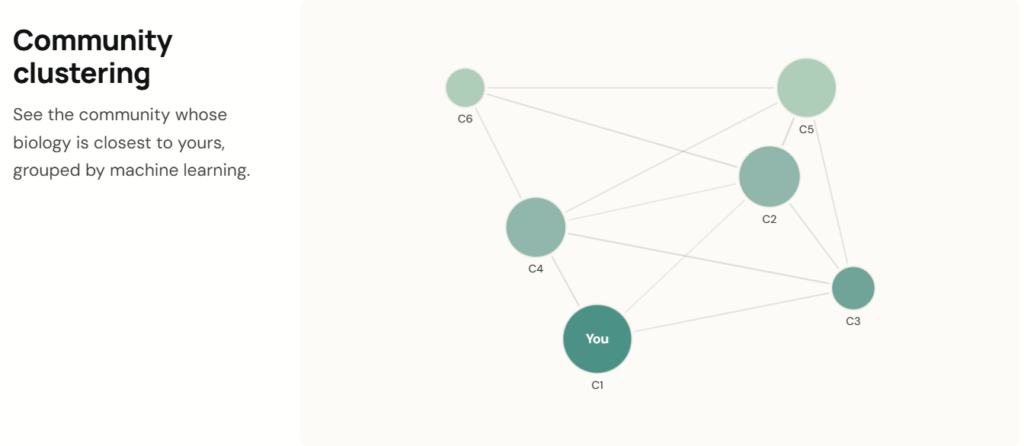
One result will show where you fit – gene expression-wise – in your community.
Gene expression assessments, as one would expect, determine which genes are most highly turned on or off. Amatica then uses three different kinds of pathway analyses to determine which biological pathways have been activated (or inactivated).
Amatica’s latest gene expression batch also appears to be replicating what PrecisionLife’s genetic work found. Both groups found significant overlap between ME/CFS and long COVID, as well as differences.
One piece of good news is that the same biological systems are popping out no matter which pathway analysis Amatica uses.
Plus, the pathways their data is finding make sense with what we know: they include things like stress hormone/cortisol response, mitochondrial protein processing, red blood cell and heme regulation, protein making and mitochondrial import, natural killer cells, antiviral signaling, neutrophil-lymphocyte balance, RAC cell signaling, RAS signaling, and the B cells, antibody production, and dendritic cells.
During our talk, Nick mentioned a graph that I couldn’t find a way to share. Not that these are quite preliminary results. The long COVID group has a lot of people who also had ME/CFS.
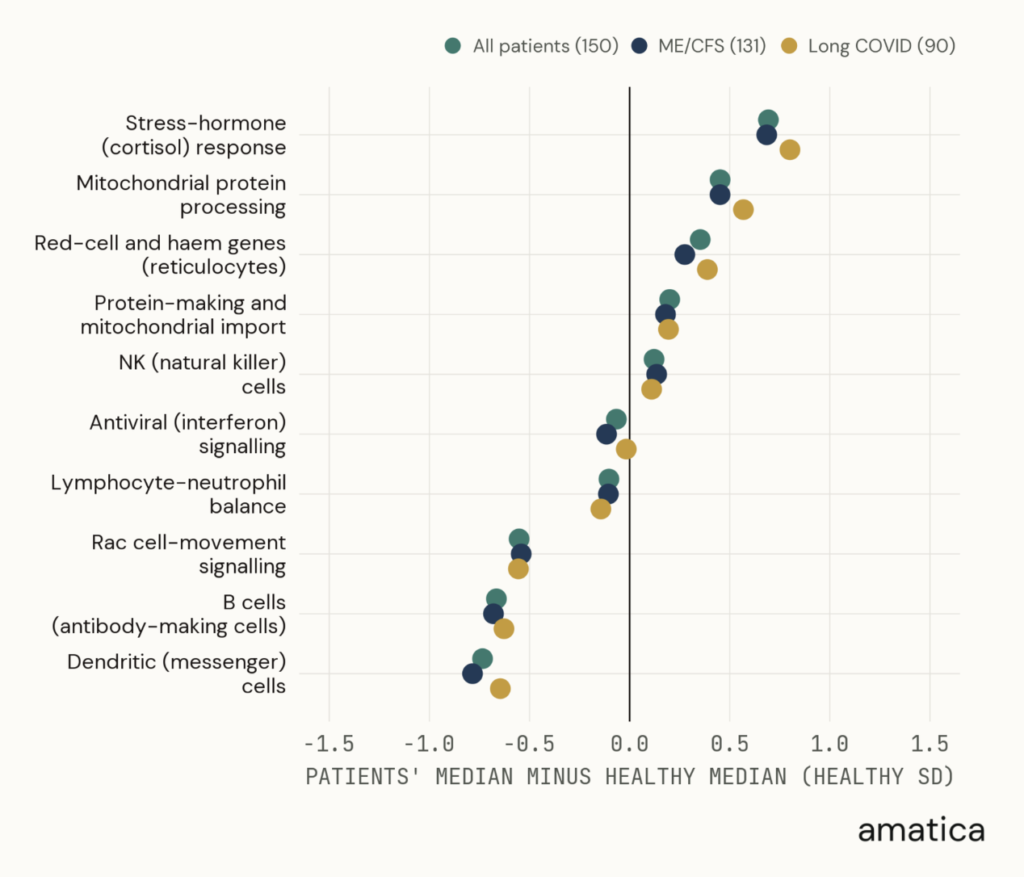
. If I understand it correctly, it’s showing a quite close relationship between ME/CFS and long COVID. The same general themes show up in the same way.
Genes associated with stress hormones, mitochondrial protein processing, red cells, etc., are overexpressed in both diseases, while genes associated with neutrophils, and particularly B-cells (which kill extracellular invaders) and dendritic cells (which carry viral antigens to T-cells) are dramatically underexpressed.
The differences in ME/CFS and long COVID lie in the degree. In some cases, ME/CFS gene expression is slightly higher than in long COVID; in others, it’s slightly lower, but in no cases do we see a dramatic difference.
(The number of all patients does not equal the number of ME/CFS plus long COVID patients because some patients fell into both categories).
Note that this is all from 149 patients, and the big data sets await. Nick mentioned finding really strong signals in the kynurenine pathway. On that note, Lenny Jason’s group at DePaul just got a major NIH grant to study the kynurenine pathway, the coronavirus, and EBV in ME/CFS and long COVID.
They currently have enough funds to subsidize a few thousand samples.
The Future

Amatica envisions diagnostic tests within 3 years.
Amatica will add new sample types to its mix, assess new samples, hire new people, and refine its data analytics.
They plan to continue their Series A funding on a 9-18 month timeline. At that point, they’ll be looking for investors to help them expand their team again, and assess the proteomics, metabolomics, etc. on the thousands of samples they’ve collected.
Once they’ve identified, say, a 500-person cohort with muscle weakness, they can bring in researchers to assess muscle biopsies, examine neuromuscular junction functioning, brain-muscle imaging, or what have you.
They hope to have approved, validated, and insurance-covered diagnostics within three years.
- Check out an early report from Amatica
Amatica’s RNA (Gene Expression) Test
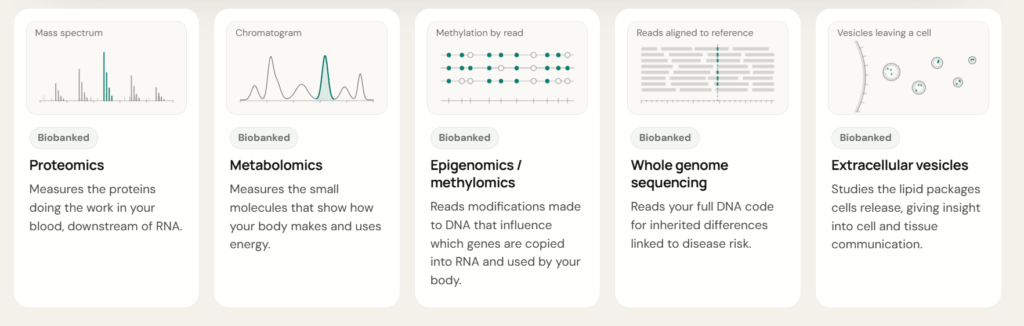
If you agree, Amatica will also collect a variety of biosamples for future testing.
Gene expression tests are really good at telling us what biological pathways have been activated/turned off in an illness. They might tell us, for instance, that our immune cells are in an inflammatory state and antiviral pathways have been turned on; i.e., the body appears to be responding to an infection.
Just like PrecisionLife’s genetic data doesn’t tell us everything, neither do Amatica’s gene expression tests. They provide one slice. They can’t tell us if the highly expressed genes are producing the next step – proteins – or if those proteins are being used. Even if a gene is highly expressed, the RNA it produces must be translated into proteins, which must: a) be produced properly; b) get to their assigned location; and c) be utilized.
That requires taking the next “omics” step – assessing things like proteomics and metabolomics to paint a fuller picture – which is why Amatica is collecting those samples now as well.
Everyone who gets the tests receives:
- Complete Gene Expression results explained.
- 1,500 Biological Pathways assessed – you will find out which biological pathways your gene expression results suggest have gone bonkers and which subgroups you belong to.
- Treatment Response – Advanced AI looks for signals that can predict which treatments you will respond well to and which you should avoid or be very careful about. (I don’t know if this is being done yet.)
- Ongoing Evolution – As Amatica’s database grows, you will get more precise insights into your health: which biological pathways are off, what subgroup(s) you belong to, what treatments might/might not work for you, etc.
- No yearly subscription fees – Once you join the program, you will get the insights it provides for the rest of your life.
- Contribution – By providing your samples, you are also helping to build a database which will contribute to our understanding of ME/CFS, long COVID, and other diseases.
- More samples – If you provide permission (I did), your blood will be biobanked for proteomics, metabolomics, epigenomics, whole genome sequencing, and extracellular vesicle assessments in the future.
Reduced Cost

Amatica’s mission.
As noted, Amatica has received support that allows it to dramatically reduce the price of the test – and reach its goal of a thousand samples more quickly.
The prior gene expression test was about $1,000 (plus the blood draw and shipping). It’s now available for $500 off for the first 500 people who order it. That brings it to $495 for one test, $895 for two tests, and $1,395 for three tests. (Longitudinal test results are particularly important for research.)
The phlebotomist will come to your house. The price of the blood draw and shipping is now included for people living in the US, Canada, and the UK. Instructions for booking a blood draw are included. If you live in the US, the phlebotomist will handle shipping.
People in other countries may have to pay for a blood draw. Enter your country in the order form to see what applies to you. Amatica says, “We can connect you with our partner mobile phlebotomists and support every step of collection and shipping.”
People who already bought the test will get a free second test. The test is available worldwide.
You can request that a healthy control you know get the test, and their kit is free. (I suggested my twin brother.) I bit the bullet and bought a test – and will report on my results.
You can order the test here
Health Rising is not affiliated with Amatica in any way, and
does not receive funding from test purchases,




Compelling, but I have some concerns.
Data sets are very important. But how does this work get integrated into the field, and how does it get used by other researchers?
It seems like the time it will take for this to have any effect on matching patients to treatments will take many years.
These guys may be patients but they also have research backgrounds so I assume the findings, when they come, will show up in medical journals.
Yes, it will take a while, but getting diagnostic tests that characterize the subsets that are present in these diseases in three years would be a huge step forward. That is essentially what we need. We’d presumably understand what mechanisms produce them and target treatments accordingly.
Hopefully everything goes well. You’re definitely right that having diagnostic tests in three years would be a game changer.
By the way, any word on what’s going on with the nanoneedle? I thought that was back on the table.
I was just thinking of them. I will try and set up a talk with them – thanks for the reminder 🙂
How about people in remission, or partial or full recovery – do they want samples from them?
Cort, did you see my comment on your previous post on Paul Hwang’s latest WASF3 findings?
No!I will look 🙂
Whoa! That’s a biggie – thanks for the tip!
Hi, I’m curious how this “slice” compares to what Precisionlife is doing. From a patient persoective, is there benefit in doing both tests? Or is there one that is more likely to yield actionable data?
If I had the money, I would get both. PL brings insights from genetics, and Amatica from gene expression. PL comes at the genes from a complex, biological pathway and mechanisms viewpoint that they’ve honed in many diseases over a decade or so. That’s pretty powerful stuff. They feel they’ve already identified many subsets and potential treatments. That said they appear to be providing more basic data than Amatica. Even so I would like to know which pathways my genetics is setting me to possibly fail. It’s interesting that both are finding cosimilar pathwayus.
I bought Amatica’s test and I’ll see how precise it is. I suspect that Amatica’s may be more actionable in the end because they’ll be updating it as they get more information and plan to throw metabolomic, proteomic, epigenomic and more in there. I assume they will be integrating them all together and providing the insights that accrue from that. It’s hard to pass that up!
Great guys and obviously, much like Mr and Mrs Precison Life, they obviously have and authentic interest in our illness and want to help us.
They are however both essentially start-up business models and will ultimately profit greatly from their findings should those findings link into possible pharmaceutical. The words “venture capital” alert to this. As I said in response to the recent PL interview, these companies need our samples to build their data. Therefore, our samples constitute the intellectual property upon which their businesses will be built.
Why should we be paying them? They should be paying us for our samples!
🙂 In a world where these diseases were universally seen as a fantastic opportunity they probably would be. Even when research or drug studies pay for samples, i.e., for participation in the study, the pay is pretty meager.
At least with PrecisionLife and Amatica you really do get something back. I remember a study I was in where I had to threaten going to the NIH simply in order to get my test results. Once I did that – they came right away.
The payoff, when it comes, could be great, though. 🙂
So these organizations are at their core “businesses”, right? They provide great updates to us all and simultaneously benefit from promotion amongst our community and our uptake to their businesses, with our data. Wonder if Health Rising could respond (speak back to them in business speak) and ask them both (PL and Amatica) to offer a promotional voucher code for Health Rising members to receive additional discounts??
Limited time….buy one get one freee……folds up and slides under the bed…
(You can tell no doubt I spent my working life in sales)
That would be nice! They haven’t suggested that and I didn’t think to ask. It’s a great idea, though! HR is supporting their work.
EXACTLY !!!
Hi Cort, This is very exciting. I would love to see the visuals about Amatica’s results so far, which weren’t shown in the video due to technical issues. Are you able to get those visuals and share them with us? Thank you!
Trying to get them 🙂
I spent the day at the NIH RECOVER TLC conference In Bethesda, Maryland. It was sponsored by FNIH and NIAID. The researchers today almost unanimously spoke to the heterogeneous patient populations, and the problems with sorting them out. Tomorrow is the second day and I’ll let them know about this interview and this rapidly evolving diagnostic tool.
Thanks Cheryl, I don’t know why its taken them so long to emphasize this but at least they have. I’d be particularly interested in how they chose to tackle it. 🙂
Yes, larger studies are important (sufficient “statistical power” — AKA, the ability find influences that exist, at optimal, causes/mechanisms) — but unless the data-set is fairly uniform, variability remains a problem.
First narrowing down “types” of ME/CFS would seem a prerequisite to constructing solid studies (e.g., about mechanisms)
I am sorry, but i am thinking it gives us non-funded hope again. This because, in what sense is this intellectually different from what has already been done, except for bigger? There is no exceptional biological thought/approach behind it that makes this effort special as it is a random screening. Can you convince me otherwise?
i agree. Perhaps this will provide better insight into the processes underlying ME/CFS, POTS, and Long COVID. However, the activation or deactivation of genes could also be a protective response rather than the actual cause of the disease. Stress and environmental factors all influence gene expression. While it is good that this is being investigated, I doubt that an accepted, objective test will emerge from it within three years. Even if this large-scale study yields concrete findings, a great deal of further research would still be required—and, typically, there is no funding left for that. Furthermore, research models in which patients pay for their own tests and research activities are generally not held in high regard within the scientific community.
Your points are valid, but they miss the main goal: treatment response. We don’t have to understand every detail of the biology before we start offering help. Discovering which therapies benefit specific subgroups will actually work backward to illuminate the underlying mechanisms, showing us how the activation or deactivation of particular genes drives the disease.
The current/past traditional research relies on small institutional grants that evaluate only twenty to fifty patients at a time. In conditions with extreme biological heterogeneity like ME, tiny sample sizes reduce meaningful patterns to statistical noise. Scaling up to a thousand or more participants solves this by giving computational models the statistical power to uncover subtle five-to-ten-percent subgroups that would otherwise remain completely invisible.
Amatica approach like decodeME will reshape future research by allowing us to design clinical trials targeted at the precise patient subsets most likely to benefit. That means we avoid losing effective treatments in the noise of a mixed patient cohort, while simultaneously generating sharper insights into the disease’s core biology.
I’ve been wanting to take part in this for over a year now and it’s great to see the reduction in price for the testing. I’m waiting on some inheritance to be able to take part, so hopefully will be able to take part in 2027. I’m in the UK so hope I can take part?
Yes, I saw somewhere in Amatica’s materials that they do offer the testing in the UK and already have some participants from UK. Sorry, I am not finding the link to that as I search for it now.
Hi Chris, thanks I saw Jack had done a post on X to say it’s open to UK. Just waiting on getting funds together if it’s not too late by then!
I’ve been thinking about this illness a lot, for many years and also now. I’ve had it for 35 years (first 2-3 years ‘moderate’, since then ‘mild’). My daughter has had it for 3 years (mild-moderate).
I just keep coming back to inflammation being the central factor. Its effects are so wide ranging and insidious. There’s more than enough evidence to be confident chronic low-level inflammation is important.
Inflammation affects so many things that are implicated in the illness:
– Hepcidin / iron
– Lipids
– Metabolism
– Mitochondrial dysfunction
– Catechols
– Muscle function and strength
– Hormones
So for me the key question really is: what is perpetuating the inflammation?
I’ve long thought there’s just some kind of ‘inflammation switch’ that has somehow been turned on in this illness.
More recently, I’ve become more open to the idea that latent viruses have been reactivated.
And that there could be a vicious cycle happening. The viral reactivation promotes inflammation, and the inflammation feeds the viral reactivation. Over time, the immune system exhausts itself, and this further fuels both viral reactivation and inflammation.
The jury is still out for me on viral re-activation. I’m very interested to see how Polybio’s study with the anti-viral Truvada in Long Covid goes. Will it meaningfully improve symptomology? And will it meaningfully shift biomarkers in parallel?
In the mean-time, I’m backing my hunch – my daughter and I have started an anti-inflammatory diet, along with anti-inflammatory foods and supplements – high bioavailability curcumin, and very high quality and high-polyphenol extra virgin olive oil.
One of the big issues with anti-inflammatory supplements is that they usually have poor bioavailability – and I really think this is a big reason why many ME/CFS patients often get little or no benefit. This includes curcumin. Apparently the bioavailability of high polyphenol extra virgin olive oil is good, so let’s see.
I will also add – inflammation is at the source of ER stress, and ultimately Paul Hwang’s findings on WASF3.
Matthias….are you adding pepper to take with your curcumin?
I was too sick years ago to recall what really happened to me.like most I recall the day I fell ill . I remembered that I got sick in a motel room out in the middle of timbucktoo that had well water.
I also recalled that 2 weeks after I developed an ulcer.
Diet is paramount to keeping my illness at bay. After aprox 2 weeks of trying to return to what some call a “normal” diet, the inflammation returns.
I recently started zinc carnosine…gamechanger.
NAC,ginger,moringa leaf extract,and a few other suppliments are key for me.
What i am trying to figure out is why my lymph nodes keep popping up from a stressor.i recently started doing foot soaks with salt,Epsom salt,baking soda…sure enough I get this lymph node the size of a golf ball on the bottom f my feet that went away the next day.i got covid 4 yrs ago and the exray showed hundreds of lumps on my lungs which they thought were blood clotts,…turned out to be lymph nodes. Something in the blood?
Drinking cabbage juice is another huge anti inflammatory weapon for me.
Matthias…im taking these and other suppliments mainly as biofilm busters.
Have you looked into biofilm?
My best friend growing up is head of microbiology in my home city.He claims its impossible to break up biofilm but im finding people that claim otherwise.
Yes theres a lot of quackery on Facebook but also some legit people that are fed up with the medical industrial complex that are pushing forward on their own.me being one of them. I dont have decades to wait.
Simply taking one single dose of ivermectin completely changed everything for me.
Years ago I used to doctors were
God only because my wife worked at a teaching hospital for 35 years.
The medical mafia even set up a website called ” quackwatch” to fight off the alternative practitioners
After the f**show of covid19 ive completely did a 360 on who the real quacks are.
Go into a hospital now ,you may never come out alive.
Only docs I follow now is the independent medical alliance formerly the FLCCC
Not taking pepper with the curcumin. A research paper I read pretty much concluded that pepper does nothing to help curcumin absorption.
I am taking theracurmin, which uses curcumin in nanoparticle form.
Only been on it 5 days but it’s already helping with the PEM.
It’s not cheap, but it’s a waste of time and money to buy the cheaper stuff with poor bioavailability
Matthias, Do you know what Truvada is used for? It is an AIDS prevention and treatment drug and can have some very serious side effects like lactic acidosis.
Yes I am very aware of its use in HIV. It shows antiviral activity against other viruses that *may* be reactivated in ME/CFS. It is generally considered safe, risks are known and can be monitored.
I, at least, am grateful that Polybio are at least trying it.
We will see
https://polybio.org/projects/a-clinical-trial-of-repurposed-hiv-antivirals-in-longcovid/
Artesunate would be a much better candidate to study.
Artesunate acts as both a potent antimalarial and an antiviral agent.
While it is globally recognized and FDA-approved as a critical, first-line drug for treating severe malaria, extensive laboratory research and clinical studies show that it possesses broad-spectrum antiviral properties.
1. Primary Role: Antimalarial
Artesunate is a semisynthetic derivative of artemisinin, a compound extracted from the sweet wormwood plant (Artemisia annua). It is highly effective at rapidly clearing Plasmodium parasites from the bloodstream. Intravenous artesunate is the preferred standard of care for saving lives in cases of severe malaria.
2. Secondary Role: Antiviral Activity
Beyond its antimalarial capabilities, researchers have found that artesunate inhibits the replication of several types of viruses. It does this by disrupting host cell signaling pathways and cellular mechanisms that viruses rely on to multiply.
• Human Cytomegalovirus (HCMV): It exhibits strong activity against cytomegalovirus.
• Respiratory Viruses: Studies have shown it has potential antiviral efficacy against SARS-CoV-2 (COVID-19) and Influenza A, especially when used in combination with other drugs.
• Other Viruses: Research has also explored its impacts on certain herpesviruses and the Ebola virus.
I guess I missed the excellent coverage Cort did of artesunate in a prior Health Rising https://www.healthrising.org/treating-chronic-fatigue-syndrome/drugs/artesunate/
The words “venture capital” indicate the investors are in it for, among other things, a money making opportunity. Given that consideration, how much restriction will be put on information the data analytics reveal? I would think they’d keep the good stuff quiet so as not to risk losing their edge when it’s time to develop and sell real diagnostic tests. Release of information before patents are secured could diminish the ROI. I hope they make great progress, but I’m not holding my breath for anything seriously useful to the ME/Long covid population anytime soon.
These patient turn into researchers,some of them like the older lady …i think her name is Selin get well but dont divulge how they got well.Same with the blonde woman from polybio. She claims she took an experimental drug that pulled her out but wont divulge what she took. Gotta make one wonder why they refuse to keep this a secret.
….sorry…meant to say ” keep it a secret”
I’m so very pleased for your work. I’d like to stay in the know and help on this front.
Well I bit the bullet and paid for my Amatica test! The new investor bringing the price down to $500 made it possible for me. I was waffling about “Is it worth the $500??” but then last night I was trying to exercise and feeling so weak and shaky that I thought, “What the hell… if this even has a chance of helping me and other people, then it’s worth doing!” I’m excited!
You have a twin brother?? OMG, aren’t you the verposter child and dream patient for comparative genetic and epigenetic research!?!
P.S. very glad to see research going into gene expression, as you know I feel there should be more epigenetic research into ME/CFS.
However, repeated tests should test crash state vs. baseline, as I presume these might be vastly different in terms of gene expression. Do you know if Amatica asks this information for their samples`?
the very
The Gist is a great service to severe patients.
Good to hear. I’m sure it is to many people. Sometimes when I look back at past blogs I go straight to the GIST 🙂
Cort, if you’re a twin, you should really talk to Amatica specifically and directly about you having a twin brother, and the possibilities that would offer for a twin study beyond what they’re currently doing – in particular in case you’re a monozygotic twin then I believe this is kind of considered the Gold Standard for epigenetic research.
I agree. I was a bit surprised when they asked for a healthy control friend to send a test to that they didn’t inquire if the friend was a family member. Maybe it doesn’t fit in their plans right now. I did let them know that my “friend” was a twin. 🙂
Maureen Hanson appears to have looked at a pair of discordant ME/CFS monocygotic twins 10 yrs ago https://pmc.ncbi.nlm.nih.gov/articles/PMC5058431/ Are you monocygotic, too (if that isn’t too personal a question, otherwise pls just ignore)? If I were healthier, I’d try to find such ME/CFS pairs of twins and write emails to epigenetic researchers 🙂
After watching the Canadian Allison inquiry, and some of the testimonies, am more of the belief that I was vaccine injured from my childhood vaccines
I’ve just read everyone’s comments, and, as usual, I feel woefully uninformed. Our collective knowledge is impressive. Thank you, Cort, for this piece and to everyone for sharing your knowledge and perspective.
I went ahead and signed up for the study because (1) I’m curious about my own genetic and epigenetic make up in relation to having ME/CFS, and (2) because it was something I could do that might make a tiny contribution to moving the science forward. My sister is my control person, although, as many have pointed out by now, they don’t ask the relationship of your healthy control.
One more thing, about antivirals: Ever since Montoya did his studies (so long ago now…), I’ve been taking 3 grams of valacyclovir daily. As far as I know, I haven’t had any ill effects from this, and if I don’t take it, my glands swell and I have a sore throat–more misery. I’m thankful for this bit of help.
I’ve lived through 37 years of this illness, the first 12 as very severe and now low moderate… and although I understand caution, I am finally optimistic for the future… The bad old days were BAD. There was so little interest in M.E and it was a subject that was actively avoided by anyone who wanted a credible carer in research. So Im hopeful that there may actually be a sea change in my lifetime now. THREE YEARS to wait for a test? That’s no time at all. I think the M.E community is very lucky to have these chaps working so hard and I really wish them well. I like the proactive funding approach too because how else are we going to get anywhere?! We have to be creative in moving the dial towards the good stuff. Some things won’t work out but let’s try every which way until we get somewhere. Thanks Cort it was a great interview. I’ve signed up for the test too.
It’s so true. Compare this to ten years ago, and it’s a real sea change. Thanks for the reminder! 🙂