


How close these diseases are matters. A close fit would mean a treatment helps both diseases. Very different diseases would require very different treatment approaches.
So much for the ME/CFS community depends on the answer to the question: “How close a match is ME/CFS to long COVID?” Symptomatically and physiologically, the two diseases look quite similar. If ME/CFS or other complex chronic diseases are a physiological match or even a partial match for long COVID, then effective treatments for long COVID should translate to these diseases.
Before the ME/CFS/Long COVID question, though, we had the ME/CFS / fibromyalgia question. Both diseases include core symptoms such as exercise intolerance, fatigue, postexertional malaise, pain, and cognitive and sleep problems. Both (as well as long COVID) largely fit the “nociplastic” category of diseases, characterized by fatigue, widespread pain, cognitive issues, poor sleep, sensory sensitivity, etc.
The differences appear in the severity of the core symptoms that characterize each disease. People with FM can exercise more but have more pain, while fatigue and postexertional malaise are more severe in ME/CFS.
One might think that, given their similar symptom sets, researchers would have repeatedly explored and contrasted these diseases. Nothing could be further from the truth.

Different Historical Roots

Two similar appearing diseases ended up being studied separately.
Despite showing up at a similar time in the scientific arena and producing similar symptoms, ME/CFS and fibromyalgia have largely been studied separately.
Historically, ME/CFS, with strong roots in Epstein-Barr virus research, was first considered an immune disease, with metabolic and autonomic nervous system components gaining attention later.
Fibromyalgia, on the other hand, was considered a musculoskeletal disease driven by central sensitization and was typically seen (albeit often reluctantly) by rheumatologists.
The initial ME/CFS criteria focused on fatigue, postexertional malaise, and other symptoms (cognitive, sleep, etc.), while the initial FM criteria focused on widespread pain and tender points and ignored other symptoms.
Over time, different ecosystems, i.e., different researchers, different NIH Institutes/Centers, different journal publications, different terminologies, locked the two diseases into separate silos. While the symptomatic similarities were recognized when it came to research, the two diseases hardly spoke to each other
Several FDA-approved drugs to treat central sensitization (pregabalin (Lyrica) – 2007, duloxetine – 2008, milnacipran – 2009), as ineffective as they sometimes were, only deepened the focus on the pain pathways in the brain and spinal cord. Relatively successful FM exercise studies widened the apparent gap between the two.
Over time, though, the diseases have merged to some extent. The inclusion of fatigue, unrefreshing sleep, and cognitive problems in the more recent diagnostic FM criteria brought FM closer to ME/CFS, and vice versa. Small fiber neuropathy, orthostatic intolerance, autonomic nervous system dysfunction, metabolic problems, and neuroinflammation have shown up in both diseases.
It should not be forgotten that FM researchers were digging into the muscles and finding abnormalities long before ME/CFS researchers were. Likewise, given the muscle pain in FM, it made sense that FM researchers would be the first to uncover evidence of widespread small fiber neuropathy. Further research uncovered virtually the same findings in ME/CFS and long COVID.
Similar core brain regions (insula, anterior/mid-cingulate cortex, prefrontal cortex, thalamus, limbic structures, and brainstem) appear to be affected in both diseases.
It’s hard to escape the possibility that these are spectrum diseases that share key physiological similarities that diverge somewhat.
THE GIST
- It’s kind of the eternal question. ME/CFS and fibromyalgia live in different parts of the NIH, are largely studied by different researchers, and are often treated by different doctors – but symptomatically, they are so similar.
- Yes, ME/CFS has more exertion intolerance and PEM, and fibromyalgia has more pain, but both are complex diseases affecting the brain and body, and both produce problems with fatigue, sleep, cognition, and sensory stimulation.
- One would think researchers would be eager to study them together. After all, insights into one disease could very well inform the other. Why not employ some efficiencies of scale?
- As it turns out, they have rarely been studied together. That oddity dates back to their beginnings. Fibromyalgia was originally defined wholly by pain sensitivity, while ME/CFS was defined by fatigue, post-exertional malaise, sleep, cognitive problems, etc.
- As much as many of them disliked treating FM patients – who rarely responded to their treatments – rheumatologists became the FM specialists, while general practitioners and sometimes immunologists gathered in the ME/CFS patients.
- Pain researchers focused on FM, while ME/CFS’s early roots in Epstein-Barr virus led immunologists to study it. FM researchers focused on the brain and muscles, while ME/CFS researchers plowed into cytokines and pathogens.
- As our understanding of fibromyalgia has evolved, it’s moved closer to ME/CFS. The recent FM criteria now include things like fatigue, sleep, and cognitive issues. Small fiber neuropathy, orthostatic intolerance, autonomic nervous system dysfunction, metabolic problems, and neuroinflammation have shown up in both diseases. FM is no longer simply considered a brain disease, and the brain has shown up in spades in ME/CFS.
- A rare ME/CFS and FM study offered some insight into how close these two diseases are. The study focused on epigenetics, which examines how our gene expression changes over time. It turns out that stressful events like infections, illnesses, trauma, etc. can turn on or off which genes are being expressed. It’s as if a new genetic being emerges over time.
- The study uncovered two epigenetic axes: one that included mostly ME/CFS patients with PEM and cognitive issues. The epigenetic changes in this group affected things like aerobic energy production, fatty-acid metabolism, and neuroendocrine-immune regulation.
- The second epigenetic axis contained both ME/CFS and FM patients. The epigenetic changes in this group, interestingly enough, fell heavily on immune genes. The genes that may have been turned on or off were involved in several immune pathways that are currently being targeted in long COVID trials.
- Long thought of as a nervous system disease, fibromyalgia appeared to have a strong immune component as well. Indeed, some studies suggest that inflammation – which does not show up on standard tests – may be tweaking the nerves in the body and causing pain.
- The findings suggest that an inflammatory core may underlie both diseases, but that ME/CFS may get an extra epigenetic hit that affects energy metabolism.
- In the brain, we find almost the same regions affected. It’s possible, though, that they’re affected differently. An ME/CFS brain lacks energy, while in fibromyalgia the pain processing regions of the brain are highly activated.
- Jarred Younger has an explanation for the brain findings: inflammation affects slightly different parts of the brain. If Younger is correct, any treatment that reduces inflammation in the brain could help both ME/CFS and fibromyalgia patients.
- All that’s needed is for similar biological pathways to show up in both diseases, and here’s where long COVID comes in. Since Long COVID is getting the vast majority of clinical trials, it may be the key player. If similar biological pathways are showing up in ME/CFS, FM, and long COVID – and they are showing up – then an effective long COVID treatment should be applicable to ME/CFS and FM.
- We find ME/CFS and FM relying on long COVID for help because these two diseases share another similarity – horrid funding from the National Institutes of Health (NIH).
- Both ME/CFS and FM are complex, multisystemic diseases; both largely strike females; both mostly produce disability rather than death; both lack objective biomarkers (such as lesions, autoantibodies, tissue damage); both are prevalent; and both have been virtually ignored by the NIH for over 40 years (2025 funding: FM – $15 million/year; ME/CFS- $12 million/year).
- Migraine, POTS, chronic tension headache, IBS, endometriosis, interstitial cystitis/bladder pain syndrome, vulvodynia, temporomandibular disorders fit a similar template. All have largely thwarted efforts to find substantial tissue damage, and most feature problems with sensory processing, autonomic nervous system dysregulation, immune activation, small nerve fiber damage, mast cells, connective tissue issues, and a dysfunctional stress response.
- The NIH’s unwillingness to support these diseases produces a vicious circle: poor funding and small studies yield interesting but fragile results but the larger, more expensive studies needed to validate the findings and uncover objective markers rarely appear. That leaves these heterogeneous diseases vulnerable to claims that they lack rigorous biology which results in them being underfunded.
- Absent large, well-funded studies, it’s virtually impossible for these fields to escape this vicious circle. They continue to produce scintillating findings, but those findings never make the impact needed to get them over the hump and receive the funding their size and impact indicates they deserve. They become permanently stuck on the fringes.
- The NIH recognizes this. A 2024 report, “Advancing Research on Chronic Conditions in Women,” stated that when diseases predominantly affect one sex, women tend to lose out. The report specifically identified ME/CFS, migraine/headache, and endometriosis among the most underfunded female-dominant conditions.
- Both migraine and long COVID, though, provide some hope. Despite being dramatically underfunded, once migraine researchers got the biology right, a new generation of more effective drugs (anti-CGRP) showed up.
- Given Long COVID’s similarities to ME/CFS, fibromyalgia, and others, research and treatment gains should feed into these diseases. Time will tell.
Support Health Rising and Keep the Information Flowing!
Health Rising is not a 501 c (3) non-profit
The Epigenetic ME/CFS and Fibromyalgia Study
A rare comparative ME/CFS/FM study “Epigenome-wide profiling identifies distinct DNA methylation architecture underlying ME/CFS and fibromyalgia symptom burden” recently cropped up which may help explain why these diseases are so similar and different at the same time.
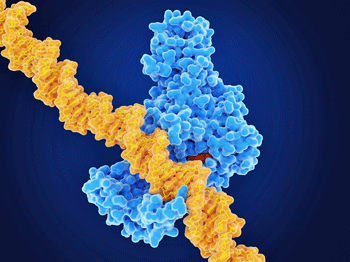
In epigenetics changes to methylation turn on or off genes after stressful events.
This paper explores one of the more intriguing angles of ME/CFS and FM, given that both can be triggered by a stressful event such as an infection, illness, injury, or period of stress. During these times, dramatic epigenetic shifts can occur, which alter our gene expression. You could almost say that a new genetic being arises; one with a new package of turned-on and turned-off genes.
Epigenetic studies have been done but, as so often happens, different genes have been turned on or off in different studies. The authors have a reason for this, which appears to align with PrecisionLife’s finding that ME/CFS and long COVID are highly polygenic, suggesting that many different genes in different combinations contribute to these diseases.
The authors proposed that most epigenetic studies cannot detect the many small epigenetic changes that have occurred. They used something called “unsupervised dimensionality reduction’ – which meant they didn’t tell the program who had ME/CFS or FM – and “region-based analysis,” which looked for regional epigenetic changes rather than changes to a single site. They focused their study on immune cells (PBMCs)
Results
Neither Separate Nor the Same
A symptom analysis made sense with what we know: people with FM scored higher on pain, pain catastrophizing, and central sensitization scores, while people with ME/CFS had lower activity levels and more trouble with PEM and cognition.
The epigenetic assessment identified two methylation axes (PC5 and PC6): one focused on people with ME/CFS and the other on people with ME/CFS or FM.
The ME/CFS axis – PC5

Genes that possibly impacted energy levels characterized the ME/CFS only group
PC5 consisted largely of people with PEM and cognitive issues and separated ME/CFS patients from FM patients and healthy controls. This finding made sense given the lower activity levels of the ME/CFS patients and suggested that epigenetic changes may have contributed to them.
The pathways and loci that were dysregulated seemed all of a piece. Pathways involving calcium signaling, PI3K-Akt, PPAR, arachidonic-acid metabolism, and neuroactive-ligand signaling, and loci such as NAPRT, HIF3A, and OXT (metabolic stress/hypoxia/neuroendocrine regulation) were also enriched.
PI3K-Akt, PPAR signaling, and arachidonic-acid metabolism form an immune–metabolic–lipid signaling network. Interestingly, a recent review, “Dysregulated Resolution of Inflammation After Respiratory Viral Infections: Molecular Pathways Linking Neuroinflammation to Post-Viral Neuropathic Pain—A Narrative Review,” proposes that viral infections activate the same pathways the epigenetic paper suggested are altered in ME/CFS. These can result in innate immune activation, the production of danger signals, oxidative stress, mitochondrial dysfunction, neuroinflammation, and ultimately chronic pain.
The inability to resolve the initial inflammatory surge results in nervous system sensitization that persists long after the virus has been cleared. The fact that we see a similar assemblage of factors – innate immune activation, inflammation, oxidative stress, mitochondrial/metabolic dysfunction, lipid dysregulation – popping up again and again in research papers is encouraging.
These findings make sense with previous ME/CFS findings, which suggest that reduced aerobic energy production, fatty-acid metabolism, NAD+, and neuroendocrine-immune regulation play a role.
PC6 – The ME/CFS/FM Axis or… Inflammation Axis

Is inflammation the tie that binds in ME/CFS and FM?
PC6 was found in people who had lots of issues with pain (pain impact, widespread pain, temporal summation (rapid increases in pain intensity) but also experienced sleep disturbance, post-exertional malaise, and cognitive symptoms. PC6 separated both patient groups from healthy controls but could not distinguish the ME/CFS patients from the fibromyalgia patients; i.e., this was a core ME/CFS and FM group.
Notice the heavy immune representation in this group. Pathways associated with cytokine–receptor signaling, NF-κB, JAK-STAT, TGF-β, Notch, and immune-checkpoint regulation were all enriched in the ME/CFS+FM group.
This may be good news for ME/CFS and FM as several long COVID clinical trials are aimed at these pathways (Bezisterim – NF-kB, Bariticinib, Abrocitinib, Upadacitinib + Pirfenidone – JAK/STAT). Two of the JAK/STAT trials are so large they could, if I understand correctly, immediately lead to FDA approval for long COVID.
We’ve always thought of ME/CFS as being an immune disease, but these epigenetic findings suggest that fibromyalgia – long thought purely in terms of the nervous system – is an immune disease as well. Inflammation – probably a different kind of inflammation than is traditionally seen – may play a significant role in FM.
Indeed, some studies suggest that localized inflammation tweaking the peripheral nerves could kick off the pain sensitization cycle in the brain in FM. Likewise, inflammation in the brain could dysregulate pain-inhibitory and pain-enhancing pathways.
Conclusion
In the end, this epigenetic paper suggests that ME/CFS and FM share a substantial chronic multisystem biology focused around immune regulation, pain, sleep, cognition, and autonomic symptoms, but people with ME/CFS may get an extra epigenetic hit to their mitochondria/metabolism, which results in more less exercise tolerance, more PEM, and worsened cognition.
Note that this paper could not demonstrate that these epigenetic changes are actually modifying our biology. Not all epigenetic changes matter where the rubber meets the road – in altered protein levels. (Proteins do the work in the cell). This study suggests the potential is there, but different studies would be required to demonstrate they’re having the effect they could be having.
Two Similar but Different Brain Diseases?
Many of the same brain areas (anterior cingulate cortex, insula, prefrontal cortex, thalamus, brainstem) have been affected in both ME/CFS and fibromyalgia, but how they are triggered may be different.
The recent Bedard study Health Rising covered found that in people with ME/CFS the brain failed to recruit more brain regions during a handgrip test. While several possibilities exist, one explanation is that ME/CFS brains lacked the energy to successfully complete the handgrip stress test. Interestingly, a long COVID study showed a major energy deficit in the anterior cingulate cortex.
ME/CFS and Long COVID brains may, then, have a low-energy problem.
In fibromyalgia, something different may be happening. Even a small amount of stimulation can overactivate the brain’s pain-processing areas. The same pathways (insula–cingulate–brainstem) are in play in both diseases but may produce different results: more PEM and exercise intolerance in ME/CFS and increased pain sensitization in FM.
Jarred Younger believes inflammation in slightly different parts of the brain produces the somewhat different symptoms in these diseases. In our interview, he noted that slightly different areas of the cingulate cortex are affected in ME/CFS and FM.
Younger suggested the cingulate cortex may be the “hub” region for all these diseases. Because it affects everything from pain processing, effort, motivation, and autonomic nervous system regulation to attention, problems in the ACC could emphasize pain in FM, maximize effort in ME/CFS, while contributing to the other factors (fatigue, sleep problems, cognition) in both.
These core similarities are exactly why all these diseases – from ME/CFS to FM to long COVID, etc. – should be studied together and why they need a place in the National Institutes of Health that fosters that.
The Last Overlap – the Vicious Circle: How NIH Neglect Haunts Both Diseases

Poor funding has kept ME/CFS, FM and similar diseases from moving forward rapidly.
The most unwelcome similarity involves the disdain these diseases have historically met at the National Institutes of Health (NIH). They fall into a category of diseases the NIH has mostly chosen to ignore – and probably secretly wishes will just go away.
The problem is that they are just too prevalent.
A pattern is clear. Both ME/CFS and FM are complex, multisystemic diseases; both largely strike females, both mostly produce disability rather than death; both lack objective biomarkers (such as lesions, autoantibodies, tissue damage), both are prevalent; and both have been virtually ignored by the NIH for over 40 years (2025 funding: FM – $15 million/year; ME/CFS- $12 million/year).
Despite the fact that these diseases are prevalent (ME/CFS – @3 million; fibromyalgia – @$5 million; migraine – @ 35 million) and cause a lot of disability and economic pain (ME/CFS – @ $20 billion; fibromyalgia -@ $20-30 billion; migraine – $80-100 billion), NIH has never been willing to put the money into these diseases that their prevalence and economic costs indicate they should be receiving.
The fact that migraine, a common, female-predominant disease that is not controversial, still receives less than 10% of the funding from the NIH that its burden of disease suggests that it should, says it all.
Migraine, POTS, chronic tension headache, IBS, endometriosis, interstitial cystitis/bladder pain syndrome, vulvodynia, temporomandibular disorders fit a similar template. All have largely thwarted efforts to find substantial tissue damage, and most feature problems with sensory processing, autonomic nervous system dysregulation, immune activation, small nerve fiber damage, mast cells, connective tissue issues, and a dysfunctional stress response.
Not all female-dominated diseases receive poor funding. Breast cancer, multiple sclerosis, rheumatoid arthritis, lupus – all receive ample funding. They all also have common objective markers, which makes them easier to study than diseases like ME/CFS, FM, and migraine
The NIH’s unwillingness to support these diseases produces a vicious circle: poor funding and small studies yield interesting but fragile results but the larger, more expensive studies needed to validate the findings and uncover objective markers rarely appear. That leaves these heterogeneous diseases vulnerable to claims that they lack rigorous biology.
The NIH then fails to fund them because they lack… “rigorous biology.” The NIH then goes to patient groups and tells them to fund the needed studies. The same lack of “rigorous biology” (i.e., large, validating studies), however, prevents buy-in from philanthropists, keeping the diseases stuck.
Absent large, well-funded studies, it’s virtually impossible for these fields to escape this vicious circle. They continue to produce scintillating findings, but those findings never make the impact needed to get them over the hump and receive the funding their size and impact indicates they deserve. They become permanently stuck on the fringes.
The NIH recognizes this. A 2024 report, “Advancing Research on Chronic Conditions in Women,” stated that when diseases predominantly affect one sex, women tend to lose out. The report specifically identified ME/CFS, migraine/headache, and endometriosis among the most underfunded female-dominant conditions.
Funding, however, has continued at its petty pace. Fibromyalgia seems to be in particularly bad shape with few efforts to uncover its physiological basis underway. A search of the NIH’s Reporter program found a mishmash of mostly unexciting treatment and exercise studies.
They included “Affect intervention” (psychology), vagus nerve stimulation, neuromodulation, auricular (ear) stimulation, exercise, exercise, vibrational spectroscopy, pain variability, the gut, metformin, and an animal model. Except possibly for the spectroscopy study, none made a serious attempt to get the physiological roots of FM. It’s as if the NIH has given up trying to understand FM.
Both migraine and long COVID, though, provide some hope. Despite being dramatically underfunded, once migraine researchers got the biology right, a new generation of more effective drugs (anti-CGRP) showed up.
Given Long COVID’s similarities to ME/CFS, fibromyalgia, and others, research and treatment gains should feed into these diseases. Time will tell.