




Geoff’s Narration
The GIST
It’s like déjà vu (all over again :)). Two years ago, almost to the day, Health Rising reported on three severely ill long-COVID patients who – poof! – rapidly recovered after being given a monoclonal antibody by Dr. Klimas (!). That kind of success is rare, indeed. We see symptomatic improvement from various treatments – but rapid and often full recoveries – that’s another story indeed. Could a fix for long COVID be present?
Last week, in “Exploring the Effects of Pemivibart Monoclonal Antibody Infusion in Long COVID: A Case Series Offering Initial Clinical Insights“, John Baratta’s team at the University of North Carolina’s COVID clinic reported on another three long-COVID patients who underwent dramatic recoveries after receiving a different monoclonal antibody.
The drug used, Pemivibart or Pemgarda, is not FDA-approved for any use but can be used in people who are immunocompromised in certain situations. Like other monoclonal antibodies, Pemgarda binds to the viral protein that latches onto cell cell, thereby preventing viral entry. Pemgarda appears to able to neutralize a wide range of Omicron-lineage coronavirus variants.
Check out the cases.

THE GIST
-

Monoclonal antibodies could be a large part of the answer for a significant subset of long- COVID patients.
It’s like déjà vu (all over again :)). Two years ago, almost to the day, Health Rising reported on three severely ill long-COVID patients who – poof! – rapidly recovered after being given a monoclonal antibody by Dr. Klimas (!). That kind of success is rare, indeed. We see symptomatic improvement from various treatments – but rapid and often full recoveries – that’s another story indeed.
- This time, a different monoclonal antibody (maB), Pemgarda, was used. These mABs prevent the coronavirus from infecting a cell by binding to the receptor that latches onto and enters the cell.
- Three case studies were provided. In one, a 70-year-old formerly very athletic woman was taken down by the coronavirus, and was unable to do even small household tasks without crashing.
- Her brain fog, breathlessness, and fainting resolved within three days of getting Pemgarda. It took her more complex system – PEM – all of a week to disappear. Two months later, she reported that her symptoms had resolved and that she had resumed weightlifting and running.
- A 63-year-old man had gone from being physically active to having difficulty doing household tasks. Four years after coming down with long COVID, he was given Pemgarda for the immune suppression associated with his psoriatic arthritis. Within a week, his PEM had resolved, and he was able to resume wood chopping. His reprieve, unfortunately, lasted only a couple of weeks, but there was hope that a new infusion could help. (Pemgarda usually lasts for a couple of months…another infusion is then needed.)
- A 57-year-old woman who had already been diagnosed with asthma, insomnia, chronic inflammatory demyelinating polyneuropathy, and Sjogren’s syndrome came down with long COVID. She experienced severe fatigue and PEM, exertional breathlessness, dysautonomia, sleep disturbances, chest pain, brain fog, and frequent migraines.
- Numerous treatments failed to do much, and 4 years after coming down with long COVID, she received Pemgarda for the immune suppression she had. Citing her dramatically improved energy and cognitive function after being on the drug, she reported feeling “resurrected from the dead”.
- Because these drugs target the coronavirus (or fragments of it) these success stories suggest that the ability of the virus to persist in some form is driving the illness in at least a subset of long-COVID patients.
- While Pemgarda has been very helpful for some people with long COVID, the FDA’s restrictions limit its availability to emergency use for patients with immunocompromised systems. A new group, SPEAR, which features prominent doctors and researchers in the long-COVID field, is working to increase its availability and to stage large multicenter trials of Pemgarda and other monoclonal antibodies.
- The AER002 trial, which used a different monoclonal antibody, failed, however. Still, with the formation of the SPEAR group, the success (thus far) of two monoclonal antibodies, and the production of new monoclonal antibodies, the monoclonal field in long COVID is heating up.
- Nancy Klimas’s nicely-sized (n=100), placebo-controlled, randomized, blinded, two-arm phase II Sipavibart trial was underway as of this summer and should report back pretty quickly (finish date 12/2026).
- While people with ME/CFS and FM wouldn’t benefit from these coronavirus-targeted monoclonal antibodies (mABs), they could conceivably benefit from Epstein-Barr virus-targeted antibodies, which are under development.
- Plus, the mAB trials present yet another attempt to treat long COVID using strong immune drugs – the kind of drugs ME/CFS doctors have wanted to use for years. One successful immune drug long-COVID trial should open the door to similar trials in ME/CFS.
- All in all, the monoclonal antibody field appears quite promising. SPEAR is laying the groundwork with the FDA for clinical use and produce the kind of studies that could make monoclonal antibodies an option for people with long COVID.

Donation Drive Update

Health Rising jumped on this finding fast.
Thanks to the hundreds of people who have quickly brought Health Rising to a third of its goal!
Health Rising was immediately on top of the first long-COVID monoclonal antibody case series. Within days of this new series being published, we were on top – not just of it – but also provided (as we do) an overview of the monoclonal antibody field and its prospects.
We don’t just report on a finding (what would be the fun of that?), we report on what it means for the field. If you appreciate that kind of coverage, please support us.
Case I – a Formerly Athletic 70-Year-Old Completely Recovers
Case I involved a 70-year-old woman with a history of allergies who experienced ongoing breathlessness, along with PEM, dysautonomia, digestive issues, syncopal episodes, and intermittent cognitive fog.

A 70-year-old was able to resume her running and weight lifting.
This woman took care of herself and, despite her age, was the last kind of person one would think would succumb to a virus. She had been very physically active, running 3 miles a day (at age 70!) prior to contracting the virus. With the development of long COVID, though, even mild household activities produced severe “crashes,” plus she reported experiencing constant heart palpitations, breathlessness, fainting, and brain fog.
Basic medical evaluations (basic blood work, inflammatory markers, and rheumatologic screening), were, not unsurprisingly, “unremarkable”. None of the treatments (low-dose naltrexone, N-acetylcysteine, physical/occupational therapy, breathwork, yoga, and increased salt intake) tried provided “durable relief”, until that is, she took Pemgarda, in Feb. 2025 – almost a year after her initial infection.
Her brain fog, breathlessness, and fainting resolved within three days of the infusion. It took her more complex system – PEM – all of a week to disappear. Two months later, she reported her symptoms had remained resolved, and she was engaged in her usual exercise regimen (weightlifting, tai chi, running).
Then, in early April 2025 – about 2 months after her first infusion – she experienced two episodes of near fainting and heart palpitations. (Pemgarda is expected to last a couple of months.) A second pemivibart infusion in July 2025 resulted in “further improvements”. Her cardiologist noted that her dysautonomia symptoms “remarkably improved after receiving an infusion of mAbs.”
Case 2: Four Years of Long COVID Disappear…for Awhile
A year and a half after the SARS-CoV-2 virus appeared, a 63-year-old man developed the usual COVID-19 symptoms (fever, cough, shortness of breath, myalgias, arthralgias, loss of smell, and altered taste), and later, the usual long-COVID symptoms (chronic fatigue, PEM, brain fog, shortness of breath, arthralgias and muscle pain, paresthesias (tingling sensations), headaches, muscle twitching, and depression/anxiety).

Another person was able, at least temporarily, to resume his normal tasks, including wood chopping.
Too much exertion resulted in low-grade fevers, muscle twitching, tremors, headaches, and debilitating fatigue and brain fog, and he went from being very physically active to needing to sit and rest for most of the day. Ultimately, he required assistance with daily living tasks. Neither low-dose naltrexone nor bupropion was helpful.
Over time, his symptoms worsened overall, significantly decreasing his function and quality of life, and he appeared to develop psoriatic arthritis, which turned out to be a boon as it got him access to more serious meds.
The immunosuppression associated with his psoriatic arthritis enabled him to receive Pemgarda. The idea apparently was that if he encountered the coronavirus again, he would be better prepared to battle it.
Instead, his world immediately changed. Within a week, his PEM had disappeared, and he got back to doing some of his old activities (including wood chopping). The reprieve lasted approximately 2.5 weeks, until the fatigue, headaches, fevers, and joint pain returned; he hoped to receive another infusion.
Case 3 – A Very Complex Patient Responds
The 3rd case presented the biggest challenge. This time, the patient, a 57-year-old woman, had already been diagnosed with asthma, insomnia, chronic inflammatory demyelinating polyneuropathy, and Sjogren’s syndrome. Her immune system was clearly not in good shape.

A woman with a complex case of long COVID reported feeling “resurrected from the dead”.
In May 2021, following a COVID-19 infection that landed her in the hospital for a month, her medical problems mushroomed. Her long-COVID symptoms included severe fatigue and PEM, exertional dyspnea, dysautonomia, sleep disturbances, chest pain, brain fog, and frequent migraines.
Numerous treatments including ivermectin and multiple supplements (alpha lipoic acid, bromelain, dandelion, ginger root, magnesium glycinate, N-acetylcysteine, nattokinase, omega-3 fatty acids, a multivitamin, probiotics, resveratrol, selenium, turmeric, vitamin B12, vitamin C, vitamin D3, vitamin E, vitamin K2, and zinc) did not help. Taking the Pfizer vaccine six months later only made things worse as she developed irritable bowel symptoms.
Once again, a medical diagnosis for another disease made the difference. She was given Pemgarda not to help with her long COVID but to help with the immunosuppression the hydroxychloroquine treatment for her autoimmune disease had caused.
The first day after the infusion went poorly with severe gut and generalized body pain, but as time went on, her symptoms improved dramatically. Citing her dramatically improved energy and cognitive function, she reported feeling “resurrected from the dead”. She was now able to socialize with friends and walk on the treadmill. Six weeks later, she reported that her residual symptom was sleep dysregulation and stated, “I am still doing incredible.”
The Key – Viral Persistence
Since Pemgarda is specifically designed to attach to a part of the spike protein of the coronavirus, its success indicates that the coronavirus, or pieces of it, must have been driving these patients’ illness. (Since these cases are not placebo-controlled, we can’t rule out placebo effects, but they seem unlikely, as these patients had already tried numerous treatments without success.)
One theme that has emerged in the monoclonal antibody (mAB’s) recovery case series is that when these drugs work, they appear to work very rapidly and produce dramatic effects quickly. Another is that they’ve worked even in long-term patients who’ve been ill for 4-5 years.
Bureaucracy Hampers Treatment Options
Note, though, how slowly the medical field works. Despite the fact that it’s been five years since long COVID came on the scene, two of these patients had had LC for 4 years before they got access to these drugs, and then only because they were considered immunosuppressed.

Because Pemgarda is only authorized for “emergency use”, most long-COVID patients don’t have access to it.
In a Sick Times interview, “The Bureaucracy is Killing Long COVID“. Marc Elia, Chairman of Invivyd, the company that develops Pemgarda and other monoclonal antibodies, criticized the FDA’s slow pace in making these powerful drugs available. Elia has a personal interest in getting access to monoclonal antibodies. A former endurance athlete, he developed autonomic dysfunction, intrusive tinnitus, exercise intolerance, and severe sleep disturbances after a mild COVID-19 infection.
Because the FDA deems the current vaccines “adequate, approved, and available” options to treat COVID-19, it will not rapidly authorize novel medicines for COVID-19; i.e. people with long COVID who are not immunocompromised are apparently not eligible to try Pemgarda. For the FDA, the status quo is apparently fine. That may be changing, though.
But first, a bump in the road.
A Bump in the Monoclonal Antibody Road
Michael Peluso’s 36-person, randomized, double-blinded, placebo-controlled monoclonal antibody trial, UCSF AEROO2, failed. With its monoclonal antibody matched to the coronavirus variant present, the trial looked set for success but didn’t work out.
That was a surprise, but as Betsy Ladyzhets reported in her superb Sick Times article, “No “easy home runs”: Early Long COVID trials of Paxlovid and monoclonal antibodies failed, but the treatments still have potential“, patient selection is important, and we still don’t know how to identify patients likely to respond to these drugs. Ideally, we would target patients with LC who harbor viral reservoirs and determine how effective the treatment is at depleting those reservoirs and improving their symptoms. A lot of work is going into that area, but it’s not yet possible to do that.

While many questions (dose, duration, type, patient subset) remain regarding mABs, the field is moving forward.
We also don’t know the best dose for these drugs. Moreover, Dr. Klimas aptly noted, if the entire coronavirus is still present, one drug is unlikely to do the trick. If it took several drugs to take out or at least suppress HIV, one drug may not do the trick in long COVID. Perhaps one monoclonal antibody will work in LC patients with viral fragments, but not those harboring the whole virus.
Right now, it appears that about a third of long-COVID patients have persistent coronavirus (whole virus or fragments) or evidence of COVID-19-associated immune activation. Again, major efforts are underway to determine the extent of viral persistence in long COVID, its effects on symptoms, and how to measure it.
So we have two case series, one from 2023 and one from 2025, suggesting that monoclonal antibodies may be the ticket for some long-COVID patients, and one 36-person trial that failed. All told, three different monoclonal antibodies have been assessed – and that appears to be just the beginning.
Monoclonal Antibody Field Heats Up
“We believe that monoclonal antibodies are key to managing the ongoing burden of endemic COVID-19 disease in all forms.” Marc Elia, Invivyd

SPEAR is attempting to clear the way for FDA approval and produce rigorous, multicenter, monoclonal antibody trials. (Image Ajax the Great from Wikimedia Commons)
Monoclonal antibodies appear to be a growth field. Betsy Ladyzhets reported that a Pemgarda LC trial is underway and Invivyd, whose motto is “Tenaciously Working to Fight Viral Threats“, recently announced the formation of the aptly named SPEAR (Spike Protein Elimination and Recovery) group that will “structure and guide anticipated clinical monoclonal antibody (mAB) long COVID trials”.
The group, which includes such notables as Michael Peluso, Amy Proal, Akiko Iwasaki, and David Putrino, intends to launch “collaborative, multi-center translational clinical research on Long COVID, including post-vaccination syndrome (PVS), as soon as practicable, including use of next-generation monoclonal antibody candidates”. (Invivyd’s next-generation mAb for long COVID is called VYD2311.)
Clearly encouraged by Invivyd’s focus on monoclonal antibodies, Michael Peluso stated, “For the first time in years, there is a company with the capability to explore this space using active, broadly neutralizing monoclonal antibodies…(that) we hope will lay the groundwork for future efficacy studies that could deliver real therapeutic options to patients who have waited far too long.”
Marc Elia went even further stating, “We believe that monoclonal antibodies are key to managing the ongoing burden of endemic COVID-19 disease in all forms, and as previously disclosed, we will be meeting with the FDA early in 3Q to discuss rapid approval pathways for COVID-19 mAbs.”
Plus, Nancy Klimas’s clinical trial is already underway…
Nancy Klimas’s Sipavibart Trial
Like Baratta’s report, Dr. Klimas’s case series reported seeing dramatic recoveries in some long-COVID patients. Her nice-sized (n=100), placebo-controlled, randomized, blinded, two-arm phase II Sipavibart trial took a couple of years to get going but was underway as of this summer and should report back pretty quickly (finish date 12/2026). It does not appear that this study will dig into the participants’ biology, but it will assess over a dozen symptom scores.
Klimas told the Sick Times that “I think we picked the right product, I think that we have the right group, that we’re measuring the right stuff, and we’ll know from this study if it’s worth pursuing or not,”
Like Pemgarda, Sipavibart is considered a preventive treatment and is approved for use in immunocompromised individuals. If you live in South Florid, this is a trial you probably want to be in. (You do not have to be immunocompromised). Contact them at 954-262-2286 or LongCOVID@nova.edu.
If you’d like to volunteer to participate, please complete the survey – https://redcap.link/NSULongCOVID – and a member of our team will reach out to you
ME/CFS and other Post-Infectious Illnesses
Because a variety of viral triggers may be present – and some people don’t have a viral trigger – ME/CFS, fibromyalgia, POTS, and other diseases face more of a challenge when it comes to producing pathogen-directed monoclonal antibodies. Studies finding EBV reactivation in long COVID has triggered more interest in this very complex virus.
Monoclonal antibodies to Epstein-Barr virus (EBV) have been and are being developed, but most are used in research and are not available for public use. They should appear over time, though, and may be helpful in diseases such as ME/CFS, which have long been associated with EBV.
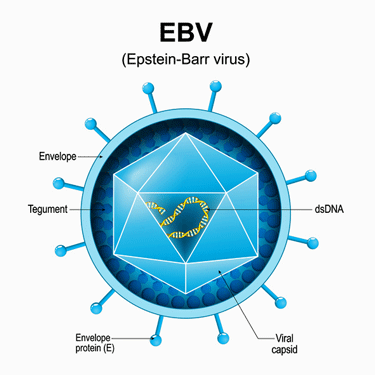
Monoclonal antibodies are being developed for EBV.
Finding a subgroup of patients with active replication will have its challenges, but it is doable. It would probably require identifying patients with high levels of quantitative EBV DNA as well as proteins and genes associated with EBV reactivation, which are linked to symptoms.
If EBV is messing with cells without replicating, or is producing proteins like EBV dUTPase that tweak the immune system, a monoclonal antibody that interferes with EBV replication might not work. (A monoclonal antibody against EBV uATPase could be developed).
Rituximab is a broad-spectrum monoclonal antibody that should have shut down some EBV replication, but failed to produce a positive result. (Rituximab is used to shut down EBV in other diseases.) It’s possible that a more EBV-specific mAb is needed in ME/CFS. It’s also possible that something went wrong with the big Rituximab trial. A Japanese Rituximab trial that will address some of the possible shortcomings of the first Rituximab trial is underway.
Serious Diseases Need Serious Drugs
Monoclonal antibodies present another positive step in the evolution of treatments for long COVID, and potentially, other post-infectious diseases. The ME/CFS field and ME/CFS patients have long been plagued by an inability to give serious immune drugs a try. Long COVID, with its baricitinib, bezisterim, monoclonal antibodies, and other immune drug trials, is overcoming the barriers that held up those drugs for ME/CFS.
A successful immune drug trial for long COVID should open doors that have long been closed in ME/CFS. It’s crazy that a disease that produces significantly lower functionality than heart disease or kidney disease hasn’t gotten a shot at these drugs. Serious diseases need serious drugs.
Promising Field
Despite the AERO clinical trial failure, the monoclonal antibody situation in long COVID seems nothing if not promising. (Note that Peluso, who led the failed AERO trial, is part of the SPEAR group and is excited about the future monoclonal antibodies hold.)
Time will tell how fast it can move, but the SPEAR effort is exactly the kind of thing we want. We want companies and researchers to become sufficiently interested in a treatment to invest substantial resources in it, and that’s what SPEAR is doing. SPEAR is laying the groundwork with the FDA and in the clinical field to produce the kind of studies that could make monoclonal antibodies an option for people with long COVID.
Donation Drive Update
Health Rising jumped on this finding fast.
Thanks to the hundreds of people who have quickly brought Health Rising to a third of its goal!
Health Rising was immediately on top of the first long-COVID monoclonal antibody case series, and within days of this new series being published, we were on top – not just of it – but provided (as we do) an overview of the field.
Being quickly on top of breaking news AND putting it in its context is our goal. If you appreciate that kind of coverage, please support us.




Two important pre-reqs from my observation:
– Patients who are hypoimmune seem to fare better than hyperimmune
– Patients Long COVID variant has to be subsceptible to the monoclonal antibody in question – https://covdb.stanford.edu/susceptibility-data/table-mab-susc/
These considerations don’t seem to appear in the case study, probably because the patients weren’t tested.
I don’t remember anything about matching the drug to the variant present. That said, Pemgarda is effective across quite a few variants.
I agree on both points. There is a test called the Attomarker test which can determine if one is hypo immune or hyper immune response type. Also, Pemgarda seems to have a much higher FC effector function vs Kavigale which is available in the EU. Hyper immune responders that have undergone immune modulatory treatments prior to Kavigale infusion have had good outcomes; but there always is a risk. Rescue PLEX could be a standby for this. No easy answers in all of this, but even the hyper immune responder like myself needs to find a way to lower the antigen burden it seems
Pemvibart worked for me too – 4.5yr covid long hauler. It gave me ~8-10 weeks of remission each time, definitely wears off though.
Good to hear! They mentioned in the paper that the drug usually lasts a couple of months.
If these anti-bodies work against viruses but then the viruses come back it hints at suppressed herpes reactivation.
Not only in ME/CFS but also in LC it is backed by a lot of evidence that latent viruses play a central role. And lingering COVID not really. It’s just a beloved idea that nobody in the LC community wants to let go.
My opinion.
Thanks Cort. It is promising. I am in the Long Covid Barcitinib trial at Vanderbilt. Its Placebo based but I know I am on the medication. I have been battling ME/CFS for 20+ years and throw in Charcot-Marie Tooth and a return on IBS to complicate things more. I was doing decently for me prior to getting Covid on 12/31/24. That developed into LC and it has been a rollercoaster as I continue many different experiments. I started the study drug on 10/18 and I have improved to the point that I felt the best I have since I got Covid which has me functional yet still limited. Unfortunately, I jinxed myself by telling friends I was feeling better and several hours later developed a sore throat. I am hoping that I just picked up some infection at the moment which is knocking me back down and I can get back to feeling better again when my body is able to fend it off.
Interesting paper just published, clear evidence of immune activation + T Cell exhaustion in Long Covid. Seems to back up research findings for ME/CFS.
And trialing a JAK STAT inhibitor
https://www.nature.com/articles/s41590-025-02353-x
I know you’ve been at this a long time and have tried many things. Glad to hear you were able to get into the study and that it’s helped.Good luck with the sore throat!
All I have to comment is…
A cured patient = a customer lost
Follow that money train folks
CHOOOO…CHOOOO 🚂 $$$$$$$$$…all the way to the bank.
With all the new students coming out of big pharma university they’ll need a bunch of new diseases to TREAT
$$$$$$$$$$$$$$$$$
It’s like they reversed a few just to dangle a carrot in front of the rest of us millions just to show how powerful they are….kinda like how they deliberately make fuel prices fluctuate just to show we “can if they want to” attitude
It’ll be years before anything surfaces with the pace this is moving.
I may sound negative but the first 35 yrs has been nothing but lies and gaslighting and bullying for me
” they” did it with ms as well and look where ms is at.
The ms society has millions if not billions and the sufferes get next to nothing and most live on peanuts like my sister in law and continues to decline duspite being put on 15 different meds.
meanwhile in my own city a guy with ms completely changes his diet and puts his ms into remission for the last 2.5 decades. He starts to question the ms society and they litigate a cease and desist against him. His website is mshope
Gotta love rockerfeller medicine 💓
Get and read the book
“OSLERS WEB”
you’ll have a clearer picture of what’s really going on
Monoclonal antibodies for EBV?
NOW YOU’RE TALKING!!!!!
Please Cort, more news on this wherever possible.
I’d really like to LIVE again before I die.
Wayne, I absolutely love that line that sums it all up:
I’d really like to live again before I die
I’m so happy that there are so many trials under way. One of these has to breakthrough and move the needle. I don’t even need a cure right now, just get me ten percent better every two years.
I’m not surprised at all. I have found significant relief for ME/CFS with Remicade, which also lasts two months. If I stop taking it, I relapse, so I’ve taken it consistently for 10 years. side effect? … Lower immune system ability to fight infection. During this 10 year period I have had pneumonia twice.
Way past time to try these powerful immune drugs. Of course, you got Remicade through the back door – to fight something else. Thankfully, long COVID is bringing these drugs in through the front door for that disease and hopefully eventually for ME/CFS.
A serious disease needs serious treatments.
You’re absolutely right, but I feel my “something else“ was as a result of ME or a Manifestation of it
Good news and reporting!
A rather important detail here is that it is an antibody to receptors of human cells that is helping here. Blocking entry of the pathogen into the cell by providing antibodies to the point of entry (even if that is a receptor of our own cells) is, when dosed well, a valid strategy to stop an infection in its track.
When using monocolonal antibodies, it is quite doable to avoid auto immune problems despite the fact that antibodies to parts of the own cell risk to attract our own immune system to attack these cells. Dosing low enough helps with that: the more antibodies attach to a single (human) cell, the more likely the immune systems tries to clear that cell. After the theraphy, chances for the own immune system to keep producing that antibody are rather low since it didn’t produce it to start with.
THE question here is: does our OWN immune system use that trick in case of hard to clean pathogens too? Why is it important:
* Research such as above clearly shows antibodies to parts of the own cell CAN be as effective or more (compared to antibodies to the actual pathogen) to cure infection.
* Auto immune disease and antibodies to the own cells are known to be a fact of human existence.
* Many auto immune conditions are related to prior infections, including MS to prior EBV infection.
* ‘Easy solved infections’ should not need antibody production to parts of the own cells. Even if they would use it, the short duration IMO *could* keep the amount of cells producing that specific antibody small enough in order to NOT produce auto immunity.
* ‘Harsher infections’, including longer lasting ones, would IMO increase the chance of the own immune system to try riskier options and start ‘trying’ a variety of more risky approaches including producing antibodies to parts of our own cells that could block pathogen entry.
IF the human auto immune system would do so, an option I explore for a long time already, then it could help explain plenty about the relationship infection / potential auto immune disease / ME-CFS.
For example:
* EBV infection at young age is typically easily solved AND very rarely leads to ME/CFS after it.
* EBV at adult age seems to produce many cases of ME/CFS.
* The typical criticism is “EBV can’t be an important source of ME/CFS since 90+% of adults have been infected with EBV in their lifetime”.
=> The MAIN difference here would be: at young age it is a rather easy to resolve infection, at adult age it can be rather harsh and last for weeks or months. That would be enough for the immune system to start using more risky ways to try and block EBV, as it clearly is a harsh pathogen at adult age.
So with EBV infection at young age, there simply would not be a need to produce risky antibodies, but at adult age the body’s immune system may have to try this approach if it keeps failing to counter EBV. And longer duration of infection is IMO a very clear risks to keep ‘piling up’ both antibodies and cells producing these antibodies, strongly increasing risk for auto immunity (MS) or ‘chopping the legs underneath the chair of the immune system’ (ME/CFS) in order to prevent auto immunity developping.
Other ME/CFS research has show a variety of antibodies against different parts of the blood vessels too. This would be in line with ‘when desparate to find a single working way to finally stop this pathogen, throw a thousand things / antibodies at the wall and see what sticks’ hypothesis in this comment. Clearing all those failed experiments after the infection may be quite hard for the body to do. Some patients might succeed and symptoms linger and decline for weeks or months, others fail and get worse forever. The hypothesis hence would also offer a model as to why strong infections take a long time to recover from even if the pathogen is fully cleared.
=> Has anybody knowledge if the antibody for Pemivibart development was harvest from a human *that successfully HEALED FROM COVID* or not? Human sourced is not enough, since the antibody could come from a person that had unrelated auto immune issues. It needs to be HEALED and research found that an antibody against a receptor of his own cells was the cause of his successfull healing.
If not, a similar case of monoclonal antibodies to parts of the own cells and originating from humans *that cured from a disease by having said antibodies* in ANY disease would do.
I just need strong evidence of the precise source and that is hard to find. A SINGLE such well documented case would go a very long way to rewrite our understunading of (large subgroups of) post infectious illness cases.
Thanks in advance,
dejurgen
Note, this idea of ‘throwing a thousand antibody’s at the wall and see what sticks’ idea would also help explain the boatload of intollerances and sensitivities many of us have and why we often get sentitive to more and more things over time. That’s why I actually started exploring this idea. The number sensitivities I have and the low exposures they trigger at are just plain ridiculous.
I appreciate your research and logical arguments.
It’s what happens when large food particles enter the bloodstream
👆directed toward dejurgen’s comment
Interesting article – thanks! The quick and dramatic response seems hard to explain as placebo. It feels like an important signal that a subset of long COVID may have a treatable biological driver.
Even helping a subgroup would be great, and it’s encouraging to see serious immune targeted approaches being explored.
Just wanted to point out that deja vu describes when you feel as though something has happened before, but it hasn’t.
Such as walking into a house that you’ve never visited before and recognising the decor. It tends to be an odd or eerie feeling.
It happens to everyone occasionally as a “brain illusion”, but is also part of the prodrome for seizures.
https://epilepsyfoundation.org.au/understanding-epilepsy/seizures/seizure-phases/
Its opposite is jamais vu: when you see or experience something familiar but it feels as though it’s the first time.
Right!
Hello Cort,
I noticed that “Pemgarda” seems to have been spellchecked to “Pemgarden” a few times.
Cheers,
Sarah
Yes, indeed! Thanks for that. I found three of them and fixed it 🙂
Glad to see Ajax is helping out the FDA these days : D
Hi Cort, thank you for reporting! Monoclonal antibodies for EBV? Bring them on! 🙂
So, did I understand it right that SPEAR might possibly also look at the use of monoclonal antibodies in PVS? It’s not quite clear to me from the SPEAR quote.
I saw reports (e.g. here from Yale https://news.yale.edu/2025/02/19/immune-markers-post-vaccination-syndrome-indicate-future-research-directions ) that Iwasaki’s team showed spike protein circulating up to > 700 days after vaccination, though not in everyone with post-vaccine syndrome (PVS). A German news video mentioned that Covid infection was excluded in this study to their best knowledge and also showed the lab test of spike protein in both plasma/serum and immune cells of a German person with PVS. So I guess that’s what monoclonal antibodies would adress for PVS in SPEAR?
I also have a bit of postVac on top of ME/CFS, not having tolerated the Covid shots well at all and having had a couple new symptoms (like shortness of breath) since the vaccine.
I guess so. Thankfully, they’re digging into PVS. 🙂
My husband got Covid in December of 21. He has been unable to work or drive a car. He was in the hospital 72 days then in patient therapy for 65 days and now to the present out patient therapy. Would love to have him get the opportunity to get rid of the symptoms
thanks for plugging our study Cort! The contact RN has moved to a different position, but the way to sign up is through our registry link.
Effectiveness of Treating Post-Covid-19 Conditions (Long COVID) With the SARS-COV-2 Specific Monoclonal Antibody, Sipavibart
To learn more about the Long COVID clinical trials at the INIM, contact us at 954-262-2286 or LongCOVID@nova.edu. If you’d like to volunteer to participate, please complete the survey below and a member of our team will reach out to you.
https://redcap.link/NSULongCOVID
Thanks, Nancy! You guys are in the drivers seat! I fixed it. Good luck!
Monoclonal antibodies were available and used to treat COVID-19 long before Paxlovid was developed and authorized. Monoclonal antibodies were a primary outpatient treatment option earlier in the pandemic.
I have a colleague around my age who got Covid and took monoclonal antibodies. He is fine. I took Paxlovid and have Long Covid which is diminishing my life bit by bit.
There used to be labs near our home where you could get a monoclonal antibody infusion if you got Covid, but they all closed when Paxlovid was released.