

Geoff’s Narration
The GIST
The Second Generation Makes Progress…

Clinical trials are getting smarter. BioVie produced an “exploratory” trial which included an extensive assessment of possible biomarkers.
Last year, UCSF researcher and LIINC cofounder Dr. Michael Peluso compared first- and second-generation long-COVID clinical trials. The first-generation trials relied on educated guesses, were largely aimed at symptom relief, and mostly failed. That was no surprise to people with ME/CFS whose experience is that the standard batch of drugs often provides modest relief at best.
The second generation of drug trials tends to be smarter, more focused on the physiological aspects of long COVID, often attempts to uncover biomarkers, and are better engineered overall. Some are also considerably larger than the trials we in the ME/CFS community are used to.
Take BioVie’s long-COVID Bezisterim trial. The $13 million, 12-week, 208-person trial cost about as much as the entire NIH funding for ME/CFS last year. After the uber-conservative RECOVER initiative rather predictably turned down the opportunity to test a brand new drug (and bombed on all its treatment trials thus far), the Dept. of Defense took a leap and funded it – and, lo and behold, we have the best results of any drug trial thus far.

THE GIST
-

BioVie used this trial to identify subsets it could target in a larger, phase 3 trial.
Bezisterim is different. A new drug that has not been FDA-approved for any disease, Bezisterim reaches way up in a core inflammatory pathway to turn down inflammation – not just in the body but in the brain as well.
- BioVie, its manufacturer, scored when it secured a $13 million Department of Defense grant to test the drug in over 200 long-COVID patients.
- This trial was a little different than most. Acknowledging that long COVID is a highly heterogeneous disease, BioVie didn’t aim for a single endpoint; instead, it assessed 22 symptomatic endpoints. It also included over 400 biomarkers.
- The goal of the 12-week study was not simply to prove that Bezisterim helped people with long COVID, but to identify a subset of long-COVID patients likely to respond well in the next, larger drug trial BioVie hopes to hold.
- BioVie just announced the “topline” results; i.e., the most basic statistical findings from the trial.
- Given the heterogeneity in long COVID, it was not particularly surprising to see that when the entire long-COVID group was assessed, the drug failed to significantly affect any of the 22 symptomatic endpoints. That suggested that the drug would probably not be helpful for the long-COVID population at large.
- When the patients were divided up into more severe fatigue, more severe PEM, and more severe cognitive issues, though, things changed. This time the drug produced moderate “treatment effects” in symptoms like fatigue, PEM, cognition, global health, etc.
- Treatment effects refer to how likely a drug is to help a patient. In this case, when given to a patient, Bezisterim was moderately likely to help. We don’t know, however, how much the drug moved the needle on fatigue, or PEM, or other symptoms.
- It appeared that the sicker the long-COVID patient was, the better the drug did, and, in fact, Bezisterim produced similar findings in a Parkinson’s study.
- People involved in the study were happy with the results. Cuong Do, president and chief executive officer of BioVie, stated, “To my knowledge, this is the first time a drug candidate has shown the ability to help patients improve across these persistent long COVID symptoms.”
- Michael Peluso, a UCSF long-COVID researcher, stated: “There have been, at this point, a few dozen Long COVID trials of other agents, and really none of those have had results that are as consistent and as compelling as what I’m seeing here.”
- They are both correct. While the results we have suggest the drug is having a moderate effect, its ability to do so across multiple symptom domains seems notable – particularly with respect to past long-COVID trials.
- The really interesting question for me is what happens when BioVie adds in the biomarker results. Will it be able to identify an inflammatory subset that benefited significantly?
- Showing that tamping down an inflammatory marker led to significant improvements could be a game-changer not just for BioVie but for the long-COVID field as well, as it could compel other drug companies to take a chance on long COVID. (Lots of anti-inflammatory drugs are out there.)
- All 12 of BioVie’s advisory board counseled moving forward with a phase III drug trial and BioVie is in discussions with the FDA about that.

Support Health Rising and Keep the Information Flowing!
Health Rising is not a 501 c (3) non-profit
Interesting Drug!
Bezisterim, a newer drug, is not FDA-approved for any disease and is currently being assessed in three diseases: long COVID, early Parkinson’s, and Alzheimer’s.
It doesn’t fit common drug categories. Listed as an “anti-inflammatory and insulin sensitizing drug”, it has such wide-ranging effects that it could fit into several drug categories, including antiviral, nootropic, anti-dementia, antihyperglycaemic, and antiparkinsonian.
Bezisterim attempts to turn off or calm down a core inflammatory pathway called TLR-4. Once TLR4 senses a danger signal, it activates downstream inflammatory pathways such as ERK and NF-kB. These pathways then produce a broad array of inflammatory products (IL-1, IL-6, IL-8, TNF-α) of which TNF-α may be the most prominent.
Instead of suppressing the immune system as many drugs do, BioVie believes Bezisterim re-regulates – a potentially important factor.
BioVie believes Bezisterim’s superpower comes from its ability to rein in the low-grade inflammation produced by TNF-α. They believe that low-grade inflammation contributes to everything from insulin resistance, to production of the tau protein found in Alzheimer’s, to aging.
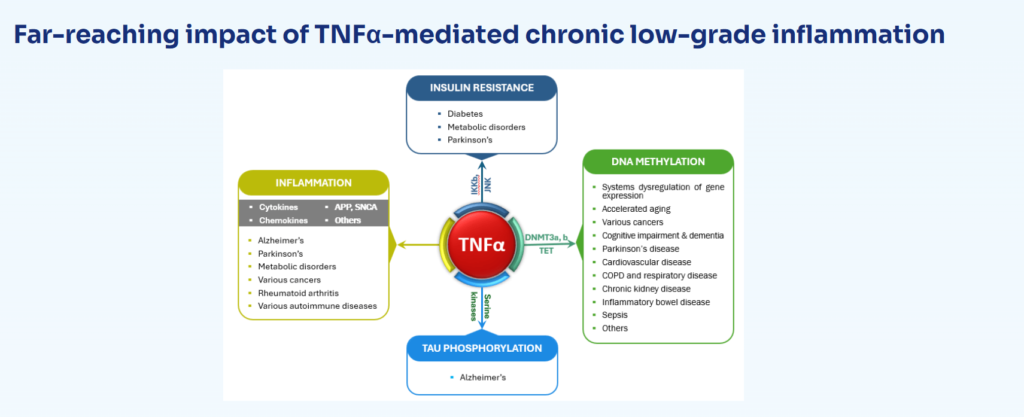
TNFα – the key driver of chronic low-grade inflammation?
Indeed, some researchers believe the inflammation in post-infectious diseases like long COVID and ME/CFS is maintained by a vicious circle caused by a chronically turned-on TLR4 pathway (TLR4 → NF‑κB → TNF‑α).
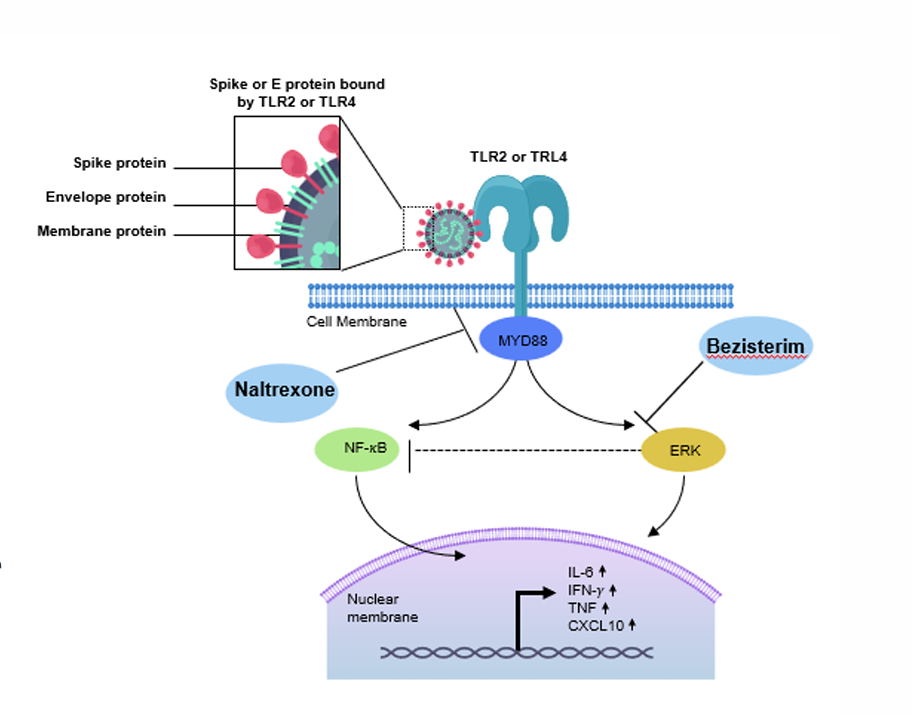
Notice how Bezisterim blocks “ERK” from telling the cells to produce TNFa and other proinflammatory cytokines.
TLR-4 upregulation has been implicated in long COVID, and studies suggest that a subset of ME/CFS patients may have elevated TNF-α levels. Bezisterim’s ability to reduce insulin resistance is another potential benefit given recent findings in ME/CFS and long COVID.
Bezisterim is the first TLR4-affecting drug to be trialed in these diseases. Note that the first illnesses BioVie trialed Bezisterim in (Parkinson’s, Alzheimer’s) involve neuroinflammation, which may play a key role in ME/CFS and long COVID.
A Different Kind of Trial – An Exploratory Long-COVID Trial
This trial was a little bit different. Most clinical trials aim for a single endpoint, like a pain or fatigue score, or a biological measure they need to hit for the trial to be declared a success.
BioVie entered the trial, though, recognizing that it didn’t know enough about long COVID to have a single endpoint. The disease is just too heterogeneous to do that right now, said Joseph Palumbo, MD, BioVie’s EVP of Research & Development and Chief Medical Officer:
“Research has demonstrated that Long COVID is not a single disease, but a complex and heterogeneous syndrome with multiple clinical and biological subtypes. A key challenge in clinical development is not only establishing efficacy but also identifying the patients most likely to benefit and understanding the drivers of that response.”
Subsets

BioVie used this trial to identify subsets it could target in a larger, phase 3 trial.
Instead of a single endpoint, BioVie assessed 22 different clinical outcomes. It also broke the patient population down into subsets (high fatigue, high PEM, high cognitive issues, high scores in more than one group).
The subgroup criteria are important. If I understand correctly, BioVie entered the trial with predetermined subgroup criteria; i.e., meeting a certain score or the median.
High Fatigue Group: BioVie determined that everyone with a score equal to or higher than the median (the exact middle score) would be in the higher fatigue group. The median PROMIS Fatigue score was 65, which means the healthiest person in the high fatigue group would experience something like this:
“I can shower, make breakfast, work or run errands, but I have to ration what I do; after a few hours I am markedly worn down, and doing several demanding things in one day is difficult.”
“Fatigue is present often enough and strongly enough to interfere meaningfully with getting things done, physical activity, sustained concentration, and social activity, but it does not by itself imply severe incapacity or inability to perform basic activities.”
This suggests that most people in the trial probably experienced significant fatigue.
High Post-Exertional Malaise Group – people in the top third PEM score. That ended up equaling DSQ-PEM ≥67.5. This is a little less clear but denoted people whose symptoms probably worsen quite substantially and repeatedly in response to exertion, and are among the most PEM-affected third of an already PEM-heavy long-COVID cohort.
Note that 90% of the study met the DSQ-PEM criteria. So virtually everyone in the study experienced significant PEM. The high PEM group simply had more PEM.
High Cognition Issues Group – equal to or above the median score (Cogstate Global Z ≤−0.108) – A Cogstate Global Z ≤−0.108 is not a particularly low score, which suggests that at least according to this test, people at the cutoff point were not noticeably cognitively impaired.
Biomarkers
| This was the most interesting part, and perhaps the most crucial part of the trial to me. To uncover biomarkers, identify subsets, and understand what the heck is happening in long COVID, the study included 400 markers of inflammation/immunity, neuroinflammation, neurodegeneration, proteomics, metabolic dysfunction, and DNA methylation (epigenetics). |
Essentially, the phase II trial was designed to pluck out specific long-COVID biological or symptomatic subsets that BioVie could successfully target in a big phase III study.
“Topline” Results
And now we have the “topline”, or early, results. The topline results contain the main statistical results. We didn’t get any of the biomarker results.
Not for Everyone
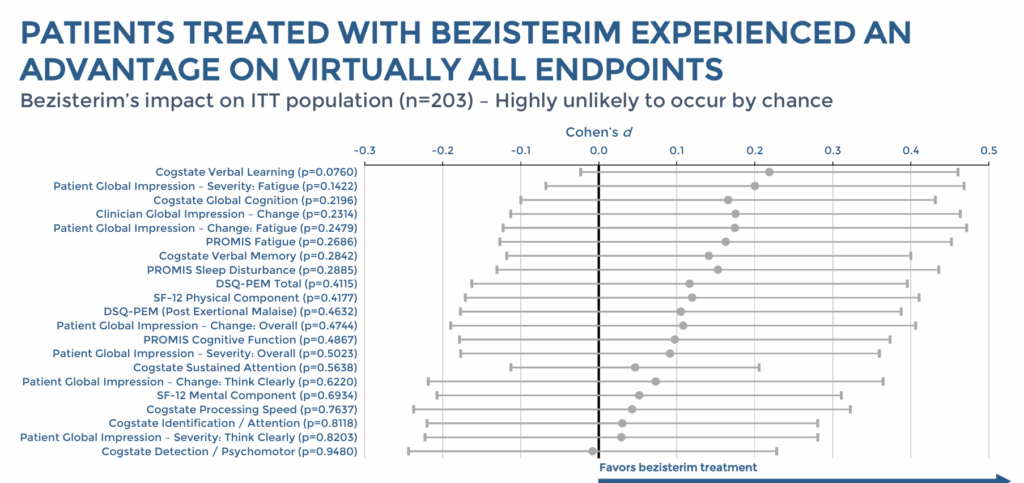
While some clinical endpoints trended toward significance, none of the 22 assessed were significant for the entire group. While this may sound bad, this is not really a surprise in a heterogeneous disease group. Steve Gardner of PrecisionLife believes it would be quite unusual for any drug to have success in an undifferentiated long-COVID or ME/CFS population. PrecisionLife’s genetic results alone suggest that the population is highly heterogeneous, and that different mechanisms drive the illness in different subsets.
For instance, PrecisionLife’s data suggest that inflammation/autoimmunity is a driver in a key subset of long COVID, but at least five other, often overlapping, drivers exist.
There is an interesting addendum, though. BioVie argues that although none of the 22 endpoints reached statistical significance, almost all trended in the right direction.
Better Luck with Subsets
When BioVie broke the long-COVID group down into 4 symptom subsets, Bezisterim appeared to do much better. While it didn’t blow the socks off any group, it did produce broader and more consistent results than we’ve seen before.
Note that if I’m reading this correctly, because BioVie only gave us Cohen’s D stats, we don’t know Bezisterim’s absolute effect; i.e., specifically how much it moved the needle on, say, fatigue. Instead, we have the “effect size,” which assessed how easy it would be to tell if a patient had taken Bezisterim by looking at their cognitive scores. When Bezisterim had an effect, it was in the moderate range.
The High PEM group (about 1/3rd of the participants): Bezisterim improved processing speed (key cognitive finding in ME/CFS), “global cognition,” clinician global improvement, patient global improvement, attention, PEM, and fatigue. A couple of other cognitive assessments came pretty close to significance. This drug, then, appeared to affect a broad array of symptoms. However, physical functioning and other symptoms did not improve significantly.
The Worsened Cognition Group (about 1/2 of the participants) significantly improved their scores on four cognitive domains (verbal learning, global cognition, verbal memory, processing speed) – a nice broad finding. Note that most objective fatigue, PEM, and quality-of-life measures did not significantly improve.
The Higher Fatigue Group (about 1/2 of the group): Again, we see the drug affect a broad array of fatigue measures, including PGI fatigue severity, PROMIS fatigue, PGI fatigue change, clinician global change, and PGI overall change scores. PEM and sleep scores improved but did not reach significance.
These also appear to be moderate-size effects, but as noted, we don’t have the absolute results; i.e., we don’t appear to know exactly how much these scores changed or how clinically impactful they were.
Conclusion – while the results appeared moderate, they also appeared broad; i.e., they appeared to impact a wide range of symptoms across the different groups. The drug’s ability to moderately improve fatigue, cognition, attention, global change, and PEM (in 2 groups) suggested it was having an impact.
Response
People involved in the study were happy with the results.
Penelope Markham PhD has a family member with ME/CFS.
Penelope Markham, leader of BioVie’s long-COVID team, stated:
“We think it’s fantastic data, we are very excited, and we will pursue Breakthrough Therapy designation,” (A Breakthrough Therapy designation from the FDA allows a phase III trial to proceed more rapidly.)
Cuong Do, president and chief executive officer of BioVie, said:
“To our knowledge, this is the first time a drug candidate has shown the ability to help patients improve across these persistent long-COVID symptoms,”
Ezra Spier, a long-COVID patient-researcher who’s been in the thick of clinical trials, stated:
“What really stands out to me about the data that have been presented today is that it shows a very clear direction toward improving key symptoms. It gives the community some hope, because we’ve been seeing trial fail after fail after fail. Seeing something that provides demonstrated impact, I think is really exciting.”
”Michael Peluso, UCSF long-COVID researcher and LIINC cofounder, who advised BioVie on the trial:
“There have been, at this point, a few dozen Long COVID trials of other agents, and really none of those have had results that are as consistent and as compelling as what I’m seeing here.”
Clues from the Parkinson’s and Alzheimer’s Trials
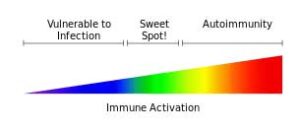
Bezisterim tamped down both neuroinflammation and systemic inflammation in Parkinson’s patients.
The Parkinson’s disease trial was much smaller but showed an interesting potential coherence with the long-COVID results, as the Parkinson’s patients with elevated inflammatory biomarkers at baseline did the best. The drug also produced broad reductions in neuro‑ and systemic‑inflammation biomarkers; i.e., it reduced both neuroinflammation and inflammation in general.
BioVie is now attempting to run a phase III trial focused on early Parkinson’s patients with elevated inflammatory markers.
A small (n=20) phase II Alzheimer’s study found the drug improved cerebral blood flow and functional connectivity, as well as several tau biomarkers. A 439-person, phase III study has been completed, but topline results have not been shared yet.
A Long-COVID Helper? Not a Long-COVID Killer
Thus far, we just have general subset scores. While people associated with the trial (Peluso, Do, Spier, Markham) were quite positive, none of them portrayed the drug as a long-COVID killer.
Right now, Bezisterim more looks like a potential “long-COVID” mover than a long-COVID killer. Spier said the drug “shows a very clear direction toward improving key symptoms”. Peluso’s exclamation that no other trial results have been “as consistent and as compelling” stands next to the underwhelming trial results thus far.
The drug’s ability to produce moderate effects across multiple symptom domains in people with more severe long COVID is more than we can say about any other long-COVID drug to date. This suggests that if you gave the drug to a person experiencing high fatigue who had long COVID, you’d have a moderate chance that that person would experience significant improvement.
Moving Forward
Ultimately, the trial was too small to tell us how effective Bezisterim was. Until we have the full results, we won’t know how clinically meaningful these treatment effects are. We know the drug had a “moderate treatment effect”; that BioVie had a moderate chance of knowing who got the drug simply by looking at their scores at the end of the trial.

What will happen when BioVie adds in the biomarker results?
A drug that could zero in on an illness would have a high treatment effect score; i.e., everyone who got the drug would improve. A drug that made little difference would have a low treatment effect score. Bezisterim was in the middle – not great but not terrible either.
That was when BioVie focused on predetermined (not necessarily optimal) symptom subsets. Remember that this trial was not designed to provide the final word on Bezisterim: it was designed to identify a subset or subsets that BioVie could target in a larger, phase III trial.
The really interesting question for me is what happens when BioVie adds in the biomarker results. Will it be able to pluck out an inflammatory subset that had a high effect score; i.e., it significantly helped virtually everyone in that group?
Note that, in Peluso’s view, Bezisterim doesn’t have to be a breakthrough drug to succeed; it just has to be successful enough to give drug companies the confidence to take a chance on long COVID. For instance, if drug companies saw that reducing an inflammatory marker with Bezisterim could affect fatigue, PEM, or cognitive scores, that might be very interesting to them, given the scores of anti-inflammatory drugs out there.
Honestly, I would be surprised if anyone happened on a long-COVID “killer” at this point. The best we can probably hope for in this second generation of trials is treatments that are helpful for a significant subset of people and perhaps quite helpful for a more selective subset.
It will probably take the “third generation” of clinical trials which specifically target biologically coherent subsets to get dramatic across-the-board improvements. If BioVie can biologically identify a subset of patients with X levels of inflammation whose cognitive scores, fatigue, PEM, etc., improve dramatically, that would fit the bill.
BioVie reported that 12/12 of its investigators and advisors, including David Putrino, Hannah Davis, Maureen Hanson, Timothy Henrich, and others, supported moving to the conclusive phase III trials. It believes the trial provided enough evidence to move forward with a larger phase III trial and is meeting with the FDA.