




Geoffs Narration
The GIST

While more study is needed, the connections appear to be piling up. If learning about them supports you, please support us 🙂
Talk about things being in the wind. Just about the time David Goldstein was providing evidence at the IACFS/ME conference that norepinephrine production in the brain was being slammed in ME/CFS and that the sympathetic nervous system was wobbly and underperforming, a neuroscientist, Jolien Hendrix, and her compadres in Belgium were coming to the conclusion that the same thing was happening, not in the brain but in the body.

Two recent papers/presentations suggest the sympathetic nervous system may be reeling in both the brain and the body.
Hendrix and company came to this rather startling conclusion not by an experiment but by a literature search; i.e. a finding that was apparently there in plain sight. The first systematic review to explore “biological evidence of adrenergic dysfunction in patients with ME/CFS and FM” was eye-opening indeed. (With no less than five ME/CFS/long-COVID papers published in the last year and more papers on chronic pain, these Belgian researchers have been active.)
Their recent paper, “Adrenergic dysfunction in patients with myalgic encephalomyelitis/chronic fatigue syndrome and fibromyalgia: A systematic review and meta-analysis“, provides a nice underpinning for Goldstein and Aregawi’s conclusion.

Note that whenever you see “adrenergic”, think sympathetic nervous system. The word adrenergic refers to adrenaline – which is now usually referred to as epinephrine. (Adrenergic is derived from a Greek word which means “drive away”.)
The GIST
- Talk about things being in the wind. Just about the time David Goldstein was providing evidence at the IACFS/ME conference that norepinephrine production in the brain was being slammed in ME/CFS and that the sympathetic nervous system was wobbly and underperforming, a neuroscientist, Jolien Hendrix, and her compadres in Belgium were coming to the conclusion that the same thing was happening not in the brain but in the body.
- The consensus view has been that the sympathetic nervous system (SNS), or “fight or flight” system, has been turned on and that the parasympathetic nervous system (PNS), or “rest and digest” system, has been turned down in ME/CFS. That makes sense given the “wired but tired” symptom which seems to signal that fight/flight is in full swing while the “rest and digest” system which helps us to rejuvenate is largely absent.
- When these researchers looked at what happened to the sympathetic nervous system during/after exercise, though, they found a different story. In healthy people, the sympathetic nervous system kicks in to speed blood and nutrients to the muscles. In people with ME/CFS, though, instead of engaging, it’s actually being inhibited.
- Why would the SNS turn itself down just when it’s really needed? Probably to protect itself. It turns out that the fight/flight is indeed in overdrive but it’s in overdrive all the time. The authors conjectured that it’s already so depleted that, when it’s time to turn on its engines, it ramps down to avoid blowing a gasket (so to speak). We’ve seen this pattern time and time again when it comes to exertion studies.
- This appears to fit very well with Bob Naviaux’s idea that the bodies of ME/CFS patients are in a “cell danger response” and are kind of hunkered down and trying to avoid any damage.
- The Goldstein/Aregawi’s low brain NE levels that we recently discussed appear to fit these findings really well. Because the main producer of NE in the brain – the locus coeruleus – has strong connections to sympathetic nervous system neurons, reduced production in the brain could translate into a compensatory effort in the body to boost sympathetic nervous system activity.
- Over time, that chronic activation could burn out the SNS in the body as well. In the end, we have two fight/flight systems – one in the brain and one in the body – that have both become depleted and exhausted.
- Because the sympathetic nervous system coordinates the exercise response, it’s possible that this strange depletion would translate to the many failures on the molecular level to respond either at all, or properly, to exercise that the Hanson group has found.
- Lots of connections appear to be lining up, but we must be careful: these are early studies and their findings need to replicated and explored further. Still, it was very good to see two independent research groups within a couple of weeks coming to much the same conclusion regarding the sympathetic nervous system – one in the brain and one in the body.
Donation Drive Update

The connections seem to be adding up!
Thanks to everyone who have brought us almost 30% of the way to our goal!
I love seeing possible connections show up, and this blog is full of them. The amazing thing is that these new connections have almost emerged overnight. First, there was the low norepinephrine in the brain finding, which could relate to the damaged hypothalamus found in the autopsy study and the sympathetic nervous system inhibition recently found in the body.
That’s all within the last 3 weeks (!). That’s what can happen, though, when you stay on top of these fast-moving fields – and that’s our commitment. If that supports you, please support us!
HEALTH RISING IS NOT A 501 (c) 3 NON-PROFIT
The Brain and the Body?
The authors got right to the point by reporting that prior reviews had “consistently highlighted sympathetic dominance in ME/CFS, evidenced by elevated heart rate and reduced heart rate variability”. The new review uncovered more evidence of sympathetic nervous system dominance (increased levels of adrenaline (norepinephrine) and increase B1AR expression at baseline).
Indeed, the consensus view has been that the sympathetic nervous system (SNS), or “fight or flight” system, has been turned on and that the parasympathetic nervous system (PNS), or “rest and digest” system, has been turned down in ME/CFS. Because the PNS regulates the SNS, the idea has been to try to plump up the PNS in order to calm the SNS and let the body rest and rejuvenate.

An increase in inhibitory factors after exercise suggests that the sympathetic nervous system may be shutting itself down in order to protect itself.
Something changed, though, when these researchers looked at what happened after exercise. ME/CFS patients posted a greater rise in a variety of adrenergic receptors (α₂A AR, β2 AR and COMT), and in the expression of the COMT gene, than healthy controls.
(Through their interaction with the outside environment, the receptors on a cell determine what the cell does; i.e., the activation of a receptor triggers the cell to do something. The cell makes certain actions more likely by increasing the number of receptors on its outside. The increased levels of these adrenergic receptors after exercise increases the likelihood of the sympathetic nervous system activity. The question is, what kind of activity?
In this case, the α₂A AR receptors inhibit the release of catecholamines (norepinephrine, epinephrine, and dopamine) and COMT actually catalzyes the degradation of catecholamines.
Exercise, then, appears to reduce levels of the neurotransmitters that run the sympathetic nervous system. The authors believe the cells in ME/CFS may be putting the brakes on the sympathetic nervous system (SNS) (at just the wrong time) because it was already over activated (e.g. the increased heart rate, reduced heart rate variability, increased adrenaline (epinephrine) and B1AR expression at baseline) prior to exercise.
Note that in healthy people, the opposite occurs: exercise triggers a temporary increase in catecholamines and sympathetic nervous system activity in order to drive oxygen and nutrients to the muscles.

Hendrix’s paper suggests a common theme – a near empty tank that has little or nothing left to give.
If these researchers are right, at the same time that healthy people are ramping up their SNS in order to be able to exercise, people with ME/CFS are shutting it down. It’s no surprise that people with ME/CFS have trouble exercising.
In fact, the SNS seems at odds with itself. At the same time it’s ramping down, it’s also increasing, possibly in a compensatory manner, B2 AR expression in order to squeeze as much use out of the catecholamines that are present.
The findings suggest that ME/CFS may be a high-drive, low-capacity norepinephrine system; i.e. the gas pedal in the SNS is pushed to the floor but the engine quickly poops out – something we’ve seen time and time again in exertion studies.
Hypothesis
At this point, this is a hypothesis, and the authors acknowledge that more work needs to be done to properly test it; they produce a mechanistic pathway designed to do that, which includes catecholamine metabolites, enzymes involved in catecholamine synthesis, and genetic/epigenetic factors.
They believe that the hyperadrenergic-POTS-leaning subgroup may be experiencing massive increases in NE, at times, and perhaps more compensatory upregulation of the inhibitory factors (α₂A/COMT). That group would have to be teased out in studies.
Incorporating the Brain Findings
Hendrix et al. clearly weren’t aware of the as-yet-unpublished Goldstein/Aregawi finding, which suggested that low norepinephrine brain production is present. That group came to this conclusion by measuring metabolites – one of the missing factors cited by Hendrix et al.
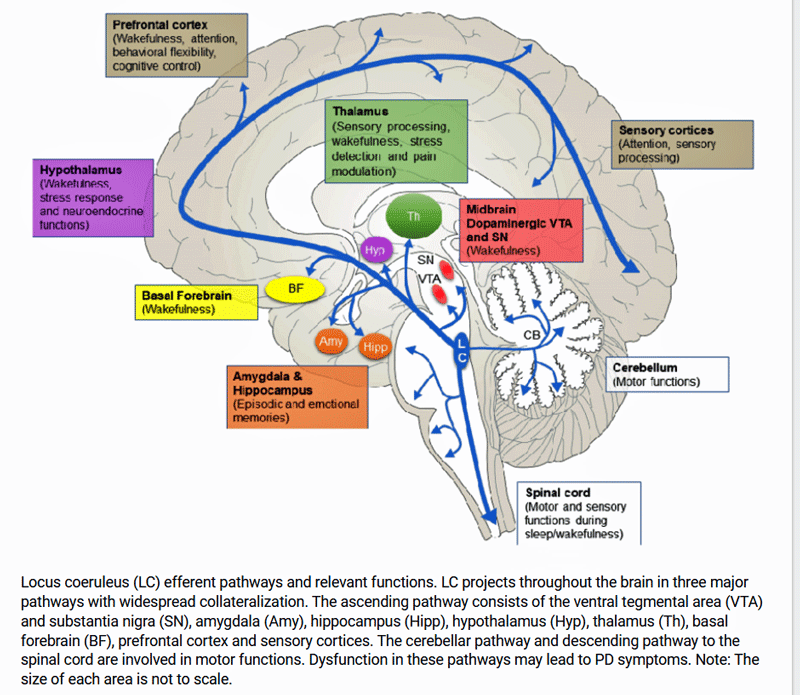
Check out how many areas of the brain, including the hypothalamus, that the locus coeruleus reaches. (Image Creative Commons: From-Locus-coeruleus-norepinephrine-Basic-functions-insights-Parkinsons-disease,-Bari-et-al-2020.-Neural_Regen_Res)
Goldstein/Aregawi’s low brain NE levels potentially match onto Hendrix et al.’s findings quite well. The main producer of NE in the brain – the locus coeruleus – has strong connections to sympathetic nervous system neurons and the hypothalamus and brainstem. (Note that the recent (unpublished) autopsy findings also implicated the hypothalamus.)
The “dirty signals” coming from the locus coeruleus produce mischief in the autonomic nervous system, activating it in maybe the worst possible way: not knowing which way to go, the system remains in a state of constant vigilance. Pain, fatigue, and orthostatic intolerance result.
Ultimately, the same problem (an overstressed, wiped-out SNS) shows up in both sites. In this scenario, reduced brain NE production likely initiates the process. Over time, a chronically activated SNS system in the body decides that enough is enough and automatically shuts down during exercise in ME/CFS to prevent damage. Those systems that can respond to exercise tend to do so in a pathological way.
This seems to fit nicely with Naviaux’s idea that a “cell danger response” is keeping the body stuck in a kind of protective, hibernation-like state.
Note that the (unpublished) autopsy studies also suggest that overstressed, burnt-out hypothalamus and HPA axis may be present.
The “Failure to Respond” Findings
The findings from the Hanson group suggest that, at the molecular level, many systems (metabolites, proteomics, gene expression) either fail to respond (urinary metabolites, extracellular vesicles, gene expression) or respond pathologically (plasma metabolomics, proteomics) to exercise. It’s possible that the sympathetic nervous system’s failure to rise to the occasion and provide a coordinated response to exercise may come into play.
The idea that fundamental systems such as the HPA axis (see autopsy blog) and the sympathetic nervous system are locked in a depleted but excited state is pretty compelling. We would expect, after all, that core systems need to have gone haywire to produce the kind of functional hit that occurs in these diseases.
All this needs to be tested. Hopefully, enough data has been reported that research groups will take this on. We need studies that incorporate all of this – the cerebrospinal fluid NE finding, brain imaging, adrenergic findings in the body, and multi-omics findings before and after exercise – to determine whether this scenario holds.
Time will tell. In the meantime, the connections seem to be mounting.
Donation Drive Update
The connections seem to be adding up!
Thanks to everyone who has brought us almost 30% of the way to our goal!
I love seeing possible connections show up, and this blog is full of them. The amazing thing is that these new connections have almost emerged overnight. First, there was the low norepinephrine in the brain finding, which could relate to the damaged hypothalamus found in the autopsy study and the sympathetic nervous system inhibition recently found in the body. Plus, it could also have something to do with the “failure to respond” molecular findings in ME/CFS.
That’s all within the last 3 weeks (!). That’s what can happen, though, when you stay on top of these fast-moving fields – and that’s our commitment. If that supports you, please support us!
HEALTH RISING IS NOT A 501 (c) 3 NON-PROFIT





Well described, this is the core of ME. The question remains: why is the alarm system activated and doesn’t turn off? Is it a false alarm, a function of the system itself, or is there a genuine emergency, such as a lack of oxygen and energy? Or bloodflow problems…..
…….or Gijs…is it heavy metals, mercury,aluminum, lead, glyphosphates…the list of toxins is very long in our world….and guess what….a lot of these toxins enter via our nose which a short distance later ,is connected to our 🧠
Yep, ” its all in our heads”
Our mercury amalgsm filings are very close to our brains.
Interesting that mercury amalgams got QUEITLY removed from the market…this after dr Murray Vimy
From Calgary Alberta inserted mercury amalgams in 🐑 sheep and after was able to measure the amount of mercury vapor being released. As the sheep continued to chew the mercury vapors being measured continued to climb.
There are people that end up in wheelchairs ….they have their dental amalgams removed and walk away from their wheelchairs.
We know from lead poisoning that people end up being the mad hatter.
All these new chemicals in our daily living environment that we never had decades also contribute to our lack of wellbeing. When the wind is from the east I can smell the hog barns that are 15 miles away. Whats roundup doing to us from farms that stretch not 25 miles but the entire length of my province of Saskatchewan,Canada
The smoking gun needs to come out
Absolutely! And there are no studies showing how combinations of these toxins effect us. Add pesticides, herbicides, etc. Even the supposedly “safe” ones may become deadly when combined with your list. Here’s a big red flag in most people’s back yard. Dogs are getting cancer and dying as young as 3yo! The average age for large breeds getting cancer is 5yo. Of course they are being fed human waste products combined with other toxic garbage, called commercial dog food, but still it’s obviously in the whole environment. 🙁
In my case, excessive airway and lung reactivity to polutants , pollen and likely the airway microbiome (the airways and lungs also have their own microbiome) very likely plays an important role here.
Adrenaline / epinephrine has two important airway properties: it is a very good bronchodilator and an excellent immunosuppressor in case of allergic reactions.
https://pmc.ncbi.nlm.nih.gov/articles/PMC4034018/
“Inhaled β2-adrenoceptor (β2-AR) agonists are considered essential bronchodilator drugs in the treatment of bronchial asthma, both as symptoms-relievers and, in combination with inhaled corticosteroids, as disease-controllers.”
https://pmc.ncbi.nlm.nih.gov/articles/PMC3666145/
“Anaphylaxis is an acute and potentially lethal multisystem allergic reaction. Most consensus guidelines for the past 30 years have held that epinephrine is the drug of choice and the first drug that should be administered in acute anaphylaxis.”
Increasing (nor-)epinephrine at rest and decreasing (from it’s high rest value, not necessarily compared to resting healthy controls) after exercise makes sense here:
* Asthma, an important airway disease, often is exacerbated a lot after exercise or after exposure to pollution or pollen (if one is allergic to them). But the combination, exercise in a air-polluted environment really puts the disease in full gear.
* At rest, one (including asthma patients) breathes a lot less deep then during and after exercise. That also means breathing in pollutants and allergens less deep into the (branched, hard to remove pollutants from that deep) lungs. Then, the chronic constriction of the airways and lungs may be releaved by β2-adrenoceptor (β2-AR) agonists (see above, standard asthma theraphy) or self-produced high resting (nor-)epinephrine levels in ME/CFS patients.
* During exercise, exercise requires much more air to be pumped deeper into the lungs. For people with exercise plus allergen induced lung hyperreactivity (asthma patients and potentially a large subgroup of ME/CFS patients), that risks breathing in a lot more of allergens / polutants much deeper in the lungs. As it is hard to remove them, that would risk very strong immune reactions for a long time (hours, days…?) in the lungs. If so, the body could try and prevent this by blocking breathing / extreme coughing (asthma) or (potentially) more mild bronchoconstriction and tanking any desire and energy for exercising (ME/CFS).
* So where healthy people have benefit being able to breath deeper by extra (nor-)epinephrine during and after exercise, the reverse may hold for people with excessive immune activation in the lungs. Then reducing (nor-)epinephrine and the strength of reaction to it may make sense.
One of my first (in hindsight) clear symptoms of my gradual onset ME/CFS was near 24/7 extreme pain in my lungs. With extreme I mean more painful then most high intensity accute pain I ever had before. Since me showing with my finger where it hurted the most followed the contoures of my lungs very well, my doctor sent me to an X-ray scan. There I got scolded for wasting his time “since there was nothing wrong with my lungs”. The more ill I became, the less energy I had but the more the pain in my lungs decreased.
When getting more severe and exclusion diagnosis for either ME/CFS or something else, no specialist (including lung specialist) or doctor ever discovered I had severe lung problems or an extreme reaction to pollen. I have to admit my case doesn’t behave identical to typical allergen induced asthma cases, but still I consider that a big failure. Why? because I had to learn myself I was very allergic to pollen and it very strongly affected my lungs.
I am gradually making progress (trying to avoid the classic medical approach due to having not that much trust in doctors failing to spot the problem being good at helping me in an atypical case) in reducing both exposure and sensitivy to airway and other sensitivities.
Now, for the first time in years / ever I frequently have clear and thin snot. I heared before it existed but hadn’t seen it myself. Normal colours for me where dark yellow or brownish-red yellow. (Pale) Yellow is the colour of pus, which contains plenty of death immune cells. And dark yellow and brown is obtained by mixing red (bits of blood) and yellow. So that indicates again excessive immune activation. And this year I have quite a few moments of (near) no (noticable, compared to the rest of my body) pain in my lungs. Now it is clear that for all my life even when I thought I had no pain in my lungs, I did still had it. It was just a baseline.
Other sensitivities may apply in part for this hypothesis too (mainly the immunosuppressant part). I have enough other sensitivites too, like digestive ones. So not all ME/CFS patients need (in my case very hard to discover) lung problems in order to have increased adrenergic baseline activation.
One can look at it that way: (nor-)adrenaline increases energy production while reducing (many parts of) immune activation. And this combo isn’t as weird as it seems. In a sense, (nor-)adrenaline are stress hormones. They provide emergency energy at a time of perceived danger. They do so by sending lots of energy / resources to the most vital organs in case of emergencies and reduce energy / resources sent to less urgent parts of the body. An activated immune system is a huge drain of energy, so (nor-)epinephrine reducing immune activation (and its energy consumption) is not a contradiction. The same holds for the other stress hormone cortisol.
Chronic stress hormone activation hence seems to point IMO to chronic immune (over)activation problems rather then ‘mental stress’. As to ‘why do we have so few energy despite so much energy providing stress hormone activation?’, I think if the problem gets even worse the next step for reducing immune activation kicks in. Reduce ATP production body wide in order to further deprive (mainly) the immune system from the energy needed for strong activation.
That is in line with the worst my gradual ME/CFS got, the less chronic pain I felt in my chest / lungs. It seems the immune system hadn’t got the energy to be so overactive anymore.
Addition. Suppressing so much parts of the immune system so strongly should be very problematic if it happend to ME/CFS patients. Things like infections and cancer should have free range. That counters many ME/CFS patients barely having any common infections anymore since ME/CFS onset.
The ‘solution’ to this contradiction? If the body doesn’t reduce supply of resources to the body much (we tend to have normal to increased blood sugar and breathing rates at rest) but by ‘creating’ mitochondrial dysfunction, then what actually might happen is that the mitochondria switch from mainly producing ATP to mainly producing moderate but consistant amounts of ROS. The body still provides (enough) resources for producing that ROS and allows the mitochondria to switch from their role as ATP powerhouses to the sort of last line of immune defence: mitochondrial immune defense.
In that way near all of the ‘classic’ immune system / innate and addaptive immune cells get deprived from ATP for strong immune activation but the mitochondrial immune system gets massively ramped up (at the cost of leaving us no energy for activities of life).
It’s a form of Dauer I’d say, inhibit from too strong chronic immune overactivation. And when looking for a source of such strong chronic immune activation, it may (under this hypothesis) be best looking at problems the immune system can’t deal with by simply activating stronger. That could be a near impossible to remove pathogen (like Herpes virus), a pathogen hidding and reactivating very well (Lyme disease?), a pathogen that is new to the entire human immune system (Covid, with possibly wrong antibodies), allergens (which keep comming back no matter how much the immune system removes them), the own microbiome (which will always be there / come back no matter how much the immune system tries; spaces like air and digestive tract won’t remain clear of microbiome, at ‘best’ / worst depleted of variety and balance) or …
Yes this! I’m going with your theory! Except for the “reactivating” part. I do not believe that viruses have to reactivate to kick the immune system into activation. Or at least reactivate enough to show up on testing. My EBV numbers are sky high but I’ve never shown reactivation. I likely had Lyme but was treated 14 years ago and never had a CDC pos test but all the symptoms of chronic Lyme triggered 10 years ago by another bite and untreated (for 6 months by Drs) Anaplasmosis. My theory expands yours to say the immune system recognizes “viral pieces” the same as live virus when they are released into body from areas they were hiding in. That constant immune activation for prolonged periods (Lyme cysts can last years before they die if they can’t replicate) is the cause of Dauer and the rest of this blog. Once the body clears the parts or learns to ignore them by calming inflammation throughout the body (diet, herbs, anti-virals/anti-biotics, detoxing metals & chemicals, anti-parasitics, etc.) the Dauer will disappear. Then the work of retraining and rebuilding begins. 🙂
Essentially aren’t we talking about connective tissue disorders creating mcas?
People can have connective tissue disorder or mcas without having ME/CFS, so they are not one and the same. The question then are:
* is the immune reaction mainly caused by mcas? (I can see it playing a role in many cases, but doubt it is the only immune thing going on)
* what makes this result in ME/CFS versus not doing so? E.g. how do chronic immune problems relate to very poor ATP production? How does that very low ATP production not cause life threathening problems like being very prone to infections or massive cell death resulting in lethal organ failure?
* are connective tissue disorders a core part of all mcas and ME/CFS cases or not? If so, are they cause, consequence or did it become a bit of both in a vicious circle?
As connective tissue problems are highly herotable, I believe it’s ground zero.
Did you read the deep dive on whotney dafoe postulating this idea too.
This idea of comorbidity, whilst a useful tool, can create false constructs.
My friend has heds because he passed the beighton score. I didn’t. But other than that, we have all the same symptoms of m.e. pots etc.
So I believe it’s about distribution of this tissue roubd the body.
Yes, there are factors that can lead to going from being hypermobile to m.e but I think it’s a matter of degree of expression in the tissue.
Like I said, the supposed demarcation line between me and my friend which results in doctors calling them different diseases is the beighton score.
But the symptoms are exactly the same. It’s like any spectrum disease, some are deeply affected others not.
But leaky gut, glial hyperactivity, blood delivery , strength of mitochondria etc etc are all directly related to the integrity of connective tissue.
It’s just my own feeling. I was glad to see onf suggesting a similar idea. Co morbid is 8n some senses a construct but useful tool.
In my opinion
https://www.frontiersin.org/journals/immunology/articles/10.3389/fimmu.2024.1369295/full
Interesting in depth dive into whitney dafoe. In the concluding remarks they postulate the link between m.e. mcas and eds but dint elucidate other than to say it needs research
It’s a question of degree and how the ‘ comorbidities ‘ cobstellate
So does this suggest that vagal nerve stimulation, encouraging the rest and digest system, may help with healing this problem?
It suggests that the SNS is turned on and tapped out. Improving vagus nerve functioning could help by reducing the stress on the SNS. It’s not the entire ballgame – something is still going on with the SNS – but if I understand it correctly, it could help.
The way I would describe my health problem beginning 30 years ago was that I had “ lost my fight or flight response—lost a normal fight or flight response”. Exertions, attempts to exert myself, led straight into exhaustion. Or, if I could exert for a short time, I would have very prolonged recovery times. I never related to Cort’s experience and notion that we were “wired and tired”, also “anxious”, because for me all my body systems seemed to be “low and slow” instead—low energy, low hormones of seemingly all types, low and slow mental functions, etc, etc. I had to give up every normal activity in life which required exertion—all the fun stuff, so many meaningful and important activities—in order to keep the very basics going, at a low to moderate capacity. I had to learn to save up energy with very low exertion days in order to perform at a normal level during some event with normal people, like a doctor’s visit. And then I would talk coherently, and he would think I was “normal”. Though now I am much worse and barely able to stand or walk without repeatedly bending over to get some oxygen in my brain. I am becoming quite a spectacle of autonomic failure these days and have little scope ohysically.
Couldn’t the brain just be release high levels of nor epinephrine in response to neuro inflammation, and all the symptoms of MECFS be a symptom of this?
Yes, neuroinflammation could be behind all of this. Inflammation could be knocking out the mitochondria, which causes depletes ATP, which makes it impossible to get enough norepinephine into the vesicles, I believe it is. The neurons then work overtime trying to squeeze as much NE out as possible. That leaves the neurons chronically activated and depleted if I have it right.
Bingo. I use an app called Wellatory that uses my Apple Watch data to calculate Heart Rate Variability (HRV) and other metrics using the HRV. My SDDN is always very low, usually under 20ms. But the key finding in these papers of SNS dominance is exactly what is happening to me as measured by Wellatory. My SNS is on average four to five times higher than the PNS and has never changed since I got the app a year ago. I have ME, Fibromyalgia, Long Covid, POTS, IST, multiple autoimmune diseases, some genetic mutations (MTHFR homozygous and others), ADHD, CPTSD, MDD, GAD and a host of other medical issues. I used to joke that I had bad gene syndrome until I got my DNA sequenced and then found out it wasn’t a joke, it was a reality!! I am 61, in Western Australia and think I got ME from EBV at 19 as that’s the only time I remember being super sick and then would fatigue easily after that. But two car accidents at 22 complicated that picture. I was diagnosed with Fibromyalgia at 38 and CFS at 45 but am sure I have the more debilitating ME. They are different and shouldn’t be conflated in my opinion. I take about 20 supplements and herbal remedies and see a naturopath. I am of the opinion after reading so much research that these papers are definitely onto something. Also mitochondrial dysfunction interests me a lot. Good luck to everyone with this awful disease. Fingers crossed we may see some definite treatments in the next 5-10 years. And many thanks to Health Rising 🙏🏼
Thank you Cort, this is an intriguing finding. I would think that it fits quite well with the finding that the brain itself seems to be unable to react to exercise as its major networks seem to be “stuck” in the “rest mode”. I am referring to the findings of Leighton Barnden´s team (https://www.healthrising.org/blog/2025/02/11/default-mode-network-chronic-fatigue-syndrome/) as well as by Rayhan and Baraniuk ((https://pubmed.ncbi.nlm.nih.gov/34975370/ ))
Incidentally, as they both note, this could point to dysfunctional signals/connectivity issues involving the brainstem. Here the circle could close with the locus coeruleus (and, possibly, with Akiko Iwasaki´s findings of a possible autoimmune signature in the LC ((https://www.healthrising.org/blog/2025/11/20/autoimmune-long-covid-chronic-fatigue-iwasaki/)) (of course, the dysfunctional locus coeruleus could also mirror many other problems – we are really only at the beginning of this journey, but it seems a very worthwhile endeavor!
I love seeing all these potential connections show up! Exciting stuff. 🙂
I’ve had ME/CFS for 50 years after a bout of mono; it gets worse each year. For 25 years, I’ve been regularly tested for various EBV and CMV antibodies – the levels are always very high. But only for latent viral proteins; the viruses never break into the lytic stage so antivirals don’t help. I’ve been on prednisone and hydrocortisone for 25 years. Yes, it helps, but not a cure. After all these years of research, I’ve only been excited by two things: EBV vaccines and WASF3 (mitochondria0. All the other research just details the downstream effects of my body’s response to EBV latent proteins.
We know from past HealthRising articles that in LC/ME/CFS patients:
A higher portion of Red blood cells are deformed, and not carrying oxygen appropriately.
The strata between capillaries and the cells is thicker in LC patients, so oxygen may not be getting to cells and cellular debris may not be returning to the blood stream for disposal.
Mitochondria are using inefficient (non-oxygen) forms of energy, resulting in more cellular debris/metabolic biproducts.
And now we know from this article that we are stuck in a cycle of overactive SNS which shuts down during exercise. There is a lot going on here.
This is very interesting because that would explain the activated fight response for compensation.
Thanks for bringing that in Linda! So many things are happening that I’d forgotten about the difficulty that may be present getting oxygen into the cells. It is an exciting time.
Not to dampen anyone’s enthusiasm for the idea that the fight or flight system is chronically turned on in ME/CFS, but when I was diagnosed back in 1998, Dr. Lapp (a preeminent CFS expert at the time) told me this was the prevailing theory.
It’s great to see studies to support it, but it’s taken almost 30 years. I want to be optimistic, but the lack of progress while I’ve been waiting all this time has robbed me of my naturally optimistic nature. I hope it doesn’t take so long for the next baby step, as I don’t wish that on young ME/CFS sufferers.
Maybe putting all the research together will move the needle? Regardless, thanks for your work, Cort
Deane
I agree wholeheartedly. I feel I have been robbed of my retirement. Saved the money but cannot find the energy to go anywhere.
Certainly do not wish it on our youngsters
I’m from Western Australia, Australia
Hi Deanne, This brings up an interesting question. Has anyone run a bar chart on the ages when ME/CFS sufferers first got sick? Are there very many young ones? This distribution could tell us a lot about cause.
For instance in autism, rates began to skyrocket in the early 1980’s in conjunction with a change in prescribing habits during pregnancy. Now that there are warnings about this being sent out to doctors, it will be interesting to see if the rates change.
About half get sick before they’re 18. The leading cause of long term school absence in children was in 2001 found to be due to ME/CFS.
There is another high in the years of young adulthood/middle age, ~30-39, but it is possible to contract at any age. Older age of onset/elders often have a better outcome.
Hi Tuva, Thanks for your reply. Is there a study confirming these figures?
There’s multiple, I believe.
School absence in children CFS: https://pmc.ncbi.nlm.nih.gov/articles/PMC1860612/
Prevalence in youth/children: https://pubmed.ncbi.nlm.nih.gov/34113066/
“The prevalence of pediatric ME/CFS was 0.75%, with a higher percentage being African American and Latinx than Caucasian. Of the youth diagnosed with ME/CFS, less than 5% had been previously diagnosed with the illness.”
https://journals.sagepub.com/doi/10.3233/WOR-220484
“Descriptive analyses indicated that roughly 43% of adult survey participants reported having developed ME/CFS prior to age 18. A standard content analysis of patient blog commentary revealed several themes, such as poor mental health, family pattern/history, healthy childhood preceding sick adulthood, feeling misunderstood, lack of clarity until adulthood, sharing of resources, poor school functioning, isolation/poor social supports, and coping mechanisms.”
Two age peaks: https://pmc.ncbi.nlm.nih.gov/articles/PMC4189623/
I could only find the one study showing the peaks in my short googling, but there’s also more on prevalence: ”
New cases of ME/CFS have been in children as young as eight and adults in their eighties. In terms of incidence, a study in Norway found two age peaks, one between 10 and 19 years and a second peak between 30 and 39 years.[16] In terms of prevalence, Jason found that individuals in the 40- to 49-year-old age range exhibited the highest prevalence rates of chronic fatigue syndrome (CFS).[13]”
Additional info related to prevalence studies:
https://www.meresearch.org.uk/additional-information-on-the-studies-relating-to-the-prevalence-of-me-cfs/
Older age (early diagnosis very important for better outcome, as always:
https://www.researchgate.net/publication/364394385_Factors_Influencing_the_Prognosis_of_Patients_with_Myalgic_EncephalomyelitisChronic_Fatigue_Syndrome
“Older age at disease onset was associated with R/I (OR 1.06 [95% CI 1.007–1.110] (p = 0.028)), while diagnostic delay was inversely associated with R/I (OR 0.98 [95% CI 0.964–0.996] (p = 0.036)). The study findings confirmed the poor prognosis of ME/CFS and the deleterious effect of diagnostic delay on disease progression. Interestingly, being older at disease onset was associated with better outcomes, which offers hope to patients for recovery/improvement even at an advanced age.”
Thanks! Yes, that idea has been around for a long, long time.
The change now is the idea that the SNS is chronically turned on in part but because its depleted. It’s in as bad shape as the PNS. So we don’t have a huge imbalance – an overactive SNS and underactive PNS – driving this illness which suggests that all we need to do is plump up the PNS. It’s more that BOTH are depleted which makes sense to my mind given the problems with energy production.
I can remember when I first got fatigue when I went to bed in pain. as I explained to my husband. The feeling was like when you get a fright. this feeling of running up and down my spine. Had it a few times after that but in my old lage now don’t seem to get it. I’m 77 and suffered with this 40 years now.n
There is a dr campbell on youtube that is curing people with cfs by giving them antifungal treatment successfully
https://youtu.be/qoUL–hQjHw?si=wFRk_lmjsoNLrgb-
Cort, off topic but they found a drug that could help long covid patients. I think it could help ME patients too.
https://www.sciencedirect.com/science/article/pii/S2589537025006157
Lidocaïne
On Reddit this morning:
In a study published in Nature, Australian scientists found that when oxygen-rich blood can’t reach tissues, the delicate lining of blood vessels starts to break down. The death of these endothelial cells, which Covid can trigger, sets off immune signals that cause red blood cells to burst, spilling their sticky contents into the bloodstream.
“This stuff’s like glue,” says Sydney-based hematologist Shaun Jackson, who led the study. It clogs the tiniest blood vessels, blocking circulation.
The damage builds. Without oxygen and nutrients, tissues begin to fail, potentially affecting organs like the kidneys, liver and heart.
“It’s a double whammy,” Jackson says.
When his team analyzed more than 1,000 samples from Covid patients, they expected to see widespread fibrin and clotting. But they didn’t.
“To our great surprise, that wasn’t the case at all,” he says. While large vessels showed some clots, the smallest capillaries — just a fraction the width of a hair — were clogged not with clots, but with debris from broken red blood cells.
“No one had thought it was through this dying endothelial cell mechanism,” Jackson says. “It was by far and away the biggest issue going on in the microcirculation.”
Past studies have shown that sicker Covid patients had worse capillary damage. Now, researchers are spotting similar patterns in patients with long Covid, which may help explain the lingering symptoms.
Stopping the death of these vessel-lining cells could help prevent the whole cascade, Jackson says, though it would likely take a mix of treatments.
https://www.bloomberg.com/news/newsletters/2025-06-05/covid-study-shows-virus-can-break-blood-cells-clog-arteries?fbclid=IwY2xjawK3AbNleHRuA2FlbQIxMQABHjkHVJ1MdxAnlMohnWqR9e-8Er-Mpyd0Hc4KxGJYyBh_r9De-5pampLHFND6_aem_3vmrkyKAlUTLOFUY5m2kPA
Could this be the answer?
Sulodexide is a medication used in many countries outside the United States for the treatment of various vascular diseases with increased risk of thrombosis (blood clots). It is a mixture of glycosaminoglycans, which are complex sugar molecules, extracted from porcine intestinal mucosa.
I take Nexavir which is an antiviral-anti-inflamatory made out of pig liver. I have used this treatment for many years on the recommendation of the late Dr. Paul Cheney.
Wired but tired and an SNS in overdrive could be explained by MCAS