




Geoff’s Translation
The GIST
This is the second in a series of explorations into new ME/CFS and long-COVID treatment guides. The first concerned Dr. Ruhoy’s 2025 book, “Invisible No More”.
The free RTHM and Patient-Led Research Collaborative Long COVID Treatment Guide is one of those publications that makes you wonder, “Why hasn’t this been done before?” A succinct, evidence-based guide doctors can quickly turn to to learn about long-COVID treatments, the Guide explains how each treatment may be helpful, sometimes which type of long-COVID patient it may help, provides dosages including startup and ramping up doses, study evidence, citations, and in a helpful twist, a list of other ME/CFS and long-COVID guides which support using the treatment. All of that in a compact, attractive format.
The Guide focuses on treatments that the Open Medicine Foundation’s massive TreatME survey found provided moderate to substantial benefit in at least 20% of patients, plus a few others. It’s mostly focused on drugs but includes some supplements, procedures (stellate ganglion blockade), and lifestyle changes.

It was put together by RTHM and the Patient-Led Research Collaborative (Say that fast three times :)) or PLRC (PLERK?) which is run by an international team of patients, researchers, and other professionals. PLRC got off the ground quickly, publishing the first paper on long COVID (in May 2020), and since then has authored or collaborated on no less than 49 journal articles, and recently distributed almost $5 million in research funding (including 4 ME/CFS studies).
For its part, RTHM was cofounded by Ryan Kellogg, a former Stanford researcher in Mike Snyder’s group; and Jennifer Curtin, a doctor treating post-infectious illness, a member of the ME/CFS Clinician Coalition, and co-author of the latest Coalition ME/CFS expert management guidance published in Mayo Clinic Proceedings. RTHM uses AI to provide virtual care for people with complex, chronic illnesses. I’ll be trying out RTHM shortly and will report on it.
Rthm PLRC Treatment Guide for long COVID
The GIST
- The free RTHM and Patient-Led Research Collaborative Long COVID Treatment Guide is a succinct, evidence-based resource doctors can quickly turn to for information on top long-COVID treatments.
- The Guide explains how each treatment may be helpful, sometimes which type of long-COVID patient it may help, provides dosages including startup and ramping up doses, study evidence, citations, and, in a helpful twist, a list of other ME/CFS and long-COVID guides that support using the treatment. All of that in a compact, attractive format.
- There’s not much else to say about the guide. With its nice blend of succinct yet informative summaries, it’s aimed at your average Joe (or Jane) doctor who isn’t up to speed on long COVID and provides a helpful overview for long COVID or ME/CFS patients. Any doctor who takes the time to peruse it will quickly realize they have far more options than they knew.
- Get the free RTHM and Patient-Led Research Collaborative Long COVID Treatment Guide.
- The blog is a riff on most of the drugs covered in the guide. I wanted to know how many had been introduced since long COVID began, provided some ME/CFS/FM information on them, and their status now. I particularly wanted to know which treatments were receiving large enough trials to give us solid answers about their efficacy, and possibly lead to FDA approval – a rarity in ME/CFS.
- You’ll have to work your way through the sections on LDN, GLP-1 agonists, IVIG, etc., to see what I found out. (Note that drugs receiving large clinical trials are highlighted in red).
- I found that the emergence of long COVID had indeed triggered a sharp uptick in new treatment possibilities. Plus, a significant number of large treatment trials are thankfully underway.
- Plus, a number of drugs (immunomodulators, etc.) that doctors do not regularly use are also undergoing large trials.in long COVID. Most of the data collection for the drug trials will be completed in 2026 and 2027.
- Because the FDA only requires 1 or 2 large treatment trials for repurposed drugs, it’s possible that the next couple of years could result in a number of FDA-approved drugs for long COVID.
- Check out the blog for more.
- Get the free RTHM and Patient-Led Research Collaborative Long COVID Treatment Guide
Support Health Rising and Keep the Information Flowing!
Health Rising is not a 501 c (3) non-profit
The Guide
There’s not much to say about the guide. With its nice blend of succinct yet informative summaries, it’s aimed at your average Joe (or Jane) doctor who isn’t up to speed on long COVID and provides a helpful overview for long COVID or ME/CFS patients. Any doctor who takes the time to peruse it will quickly realize they have far more options than they knew.
Riffing on the Guide
This blog is not on the pros and cons of the Guide – it’s a riff on the Guide. Since the Guide, which contains information on 36 treatments, provides a nice overview of the most popular and probably most effective long-COVID treatments, I wanted to use it to assess what treatments predated long COVID, what treatments the long COVID pandemic sparked, what treatments are receiving clinical trials, and more importantly, which are receiving large enough trials to provide, if not definitive, then, at least very solid results.

Finally, some hefty clinical trials!
This is a critical point as these kinds of trials have been virtually absent from the ME/CFS space, but these are the kinds of trials that can reach the broad practitioner community. I wanted to know if long COVID was sparking big enough clinical trials to really make an impact for patients who don’t have the resources/ability to see ME/CFS/long-COVID experts.
I also wanted to know if long COVID had sparked enough interest to produce more or less definitive clinical trials in treatments that had long been used in ME/CFS, fibromyalgia, and/or POTS, but which had not heretofore received sufficient funding. Since the Guide focused on long COVID, I also added some ME/CFS/FM/POTS history to some treatments.
I focused on almost all the drugs found in the guide.
The treatments receiving large clinical trials are highlighted in red. Treatments that have popped up since long COVID are marked with an asterisk. Most, but not all, of the treatments in the guide were assessed.
Results
- * = treatment showed up after long COVID appeared
- Bold Red = at least one major treatment trial underway
Low Dose Naltrexone (LDN)
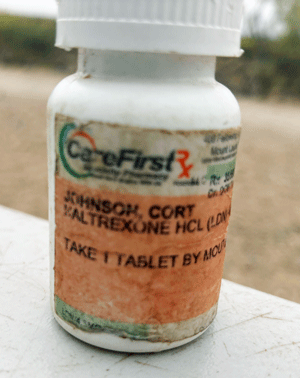
As this old bottle shows – LDN’s been around a long time now. We’ll finally get a handle on how well it works not just in long COVID but in ME/CFS as well. We may even learn why it’s helping when it does.
Low-dose naltrexone (LDN) is a great place to start. Widely used yet never the subject of a major clinical trial, LDN emerged as a possible treatment option in the scientific literature way back in 2009 with Jarred Younger’s paper. That same year, it was being discussed as a treatment option for ME/CFS in the Phoenix Rising Forums. By 2013, it was being used regularly in ME/CFS and fibromyalgia. The first ME/CFS study took place in 2019. All, however, were small trials. LDN has been due for more for quite a while, and it’s finally getting its due.
Since Long COVID Appeared
Luis Nacul’s large (n=160) LDN long COVID trial at the Complex Chronic Diseases Program (CCDP) in British Columbia was due to finish up in February 2026.
The Open Medicine Foundation’s 160-person ME/CFS/long-COVID LIFT study is going so far as to assess LDN’s effects separately and in conjunction with Mestinon, and will attempt to determine who benefits from the drug(s) and how it’s helping. It’s slated to end in late 2026.
The large RECOVER LDN long-COVID study is still in the planning stages, but it will, if successful, put a pin on LDN’s effectiveness. One unique thing RECOVER hopes to do, if the trial is successful, is to facilitate the development of an LDN drug that could gain FDA approval. (LDN is currently available via compounded pharmacies.)
LDN has been around for a while, but it’s never been studied like this. With several large ME/CFS and/or long-COVID studies underway or getting underway, we should learn much about how effective LDN is, how it does what it does, and who benefits from it.
Ivabradine
Ivabradine is an old drug that first showed up in the POTS literature around 2008. It provides a fascinating but possibly cautionary tale. Every trial up until this year has had positive results, which have shown improvements in 60-80 percent of POTS patients, and it’s been considered a standard of care. Only one small trial (n=22) in hyperadrenergic POTS was randomized, and the other three were retrospective chart-record studies. While the results were positive, Ivabradine’s effectiveness rested on a pretty weak evidential base.
Since Long COVID Appeared – Recent prepublication results from the large (n=181) RECOVER Initiative’s Long COVID POTS trial provided a shock for a drug one would have assumed would have aced this trial. While the drug reduced heart rates, when used alone, it did not improve symptoms. People who took Ivabradine and also got “coordinated treatment” did have improved symptoms, though, while those who got “usual care treatment” did not – leaving one to wonder what the heck is going on with one of the most popular POTS drugs. We’ll have to wait for the paper to learn more.
Midodrine
Midodrine has been used in ME/CFS and POTS for at least 20 years. I couldn’t find any ME/CFS studies, but at least 7 studies have assessed midodrine’s effectiveness in POTS. As is typical in these diseases, the studies were small, with few randomized controlled studies published. Midrodine’s, effectiveness, then, rested on a pretty weak evidentiary base.
Since Long COVID Appeared – Midodrine does not appear to have received new attention, however, since long COVID.
Pyridostigmine (Mestinon)

Dr. Systrom found that during exercise Mestinon temporarily improved energy production in ME/CFS
Dr. Goldstein suggested using Mestinon way back in the 1990s, but it didn’t gain much traction in the patient community until Dr. Systrom embraced it in ME/CFS. A small ME/CFS case series occurred in 2003, and a small randomized fibromyalgia trial was published in 2008. Systrom recently found that a single dose dramatically increased energy production during exercise.
Since Long COVID Appeared – The Open Medicine Foundation’s 160-person, randomized, double-blinded LIFT: Life Improvement Trial testing pyridostigmine (Mestinon) and low-dose naltrexone, alone and in combination, in ME/CFS is underway. The study, a model of its kind, will also dig deep into the participants’ physiology to learn which patients are helped and why.
Ketotifen (antihistamine/mast cell stabilizer)
Except for fibromyalgia, where a 51-patient randomized, double-blind, placebo-controlled trial found no significant benefit for pain or FIQR scores, no randomized studies have been done in ME/CFS.
Since Long COVID Appeared – no studies that I could find are underway.
Cromolyn (mast cell stabilizer)
A 2026 retrospective case series of 5 patients with ME/CFS, long COVID, orthostatic intolerance, and MCAS has addressed cromolyn. Otherwise, no studies that I could find have been done.
Since Long COVID Appeared – I could not find any trials underway.
Anti-herpesvirus Antiviral Drugs (Acyclovir, Valtrex, Valcyte, Tenofovir)
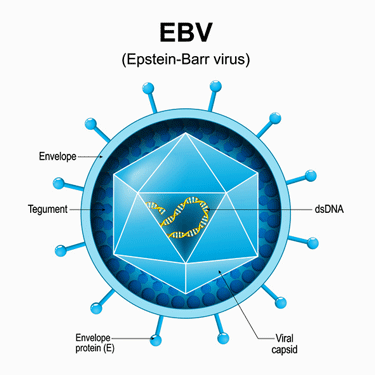
Despite the herpesvirus reactivation found in long COVID, I couldn’t find any ongoing anti-herpesvirus trials. (Putrino may be testing Pridgen’s triple antiviral protocol, though)
Despite the interest in EBV and HHV6, antiviral trials in ME/CFS have been few and far between. While Montoya ultimately struck out in his small, 2013 randomized Valcyte trial in ME/CFS, the results did suggest that a longer duration of the drug might be helpful. Lerner’s long-duration but methodologically suspect Valtrex trials found some success. After ten years of work, Pridgen’s duo-antiviral (Famvir/celexicob) attempt in fibromyalgia appears to be in cold storage.
Since Long COVID appeared – Even though numerous long-COVID studies have found herpesvirus reactivation, antiherpesvirus trials remain rare, and no large ones appear to be underway. One LC trial is testing Truvada (tenofovir disoproxil/emtricitabine) versus placebo, with another arm using maraviroc.
Antiviral Coronavirus Drugs
*Paxlovid – several short-term trials of Paxlovid have struck out. The RECOVER Vital trial, however, is still assessing whether longer duration use of Paxlovid is helpful. The Pridgen/Putrino valacyclovir + celecoxib + Paxlovid long-COVID trial was reportedly about to get underway, but has not yet been listed on the Clinicaltrials.gov website.
Antiplatelet Therapy
*Clopidogrel (Plavix) – Antiplatelet therapy is new to ME/CFS, but the amount of clotting found in long COVID has made it an area of interest. I could not, however, find evidence of any Plavix trials in long COVID.

IVIG is so expensive that the big question is who it can help. The results of the RECOVER IVIG study – due out in probably in early 2027 – may be able to answer that.
IVIG (Intravenous Gamma Globulin)
IVIG has been considered in ME/CFS and fibromyalgia, and ME/CFS experts have attested to its efficacy in some patients for quite some time, but thus far, only small pilot studies have been done.
Since Long COVID Appeared – Several small pilot studies have been done, but two randomized, placebo-controlled IVIG trials – one of them quite large – are underway.
The nine-month, 245-person, RECOVER IVIG trial is due to end in July 2026, and the 45-person, NIH Neurological long-COVID trial is due to end sometime in 2026.
Rapamycin
Rapamycin may seem like a new drug, but interest in it for ME/CFS predates long COVID. It first appeared on the Phoenix Rising forums in 2017. Things really picked up after 2022. Several uncontrolled studies have been conducted or are being conducted in ME/CFS, including Simmaron’s large observational study. A randomized, placebo-controlled study of uncertain size is underway at Mt. Sinai and is due to wrap up in Nov. 2026. While progress has been made with Rapamycin, it does not appear to have received the kinds of studies needed to bring it to the attention of most doctors.
Low Dose Aripiprazole (Abilify)
Low-dose Abilify first came to the attention of people with ME/CFS prior to the epidemic. Dr. Bonilla’s large 2021 retrospective study (n=102) found that about 3/4s of ME/CFS patients found it helpful, and it became an option for many. Bonilla’s smaller 2026 retrospective long-COVID study found modest improvements.
Abilify lacks a much-needed, placebo-controlled trial, and no current trials were found.
Modafinil (Provigil)

Could modafinil be giving some long COVID patient’s brains a boost?
Modafinil was being intermittently assessed in ME/CFS and fibromyalgia long before long COVID showed up. It’s received a smattering of small studies in ME/CFS, fibromyalgia, and long COVID. Some results have been positive, and some have been negative.
How modafinil got on RECOVER’s radar, given its rather weak record, is unclear, but it’s the recipient of a huge (n=474) long-COVID study.
That study is done – it was part of the first round of RECOVER clinical trials – and we should get the results by the end of this year.
*Guanfacine +/- NAC
An intriguing new entrant to the long-COVID/ME/CFS space, interest in Guanfacine + NAC (600 mg) was sparked by a small study (n=12) suggesting it improved cognitive functioning. Guanfacine is approved for use in ADHD – a disorder that may be common in these diseases – and in conjunction with stimulants.
Despite its obvious promise, and its overlap with ADHD (and its low price), I couldn’t find any follow-up studies.
Trazodone
Originally marketed as an antidepressant, Trazodone has been used off-label in ME/CFS and fibromyalgia for sleep for many years. An intriguing drug in many ways, Trazodone appears to have strong anti-inflammatory central nervous system properties. It may also be effective in reducing “physiological hyperarousal (i.e., activation of the stress system)” during sleep, which some studies suggest is common in ME/CFS. Dr. Ruhoy and Dr. Kaufman have both reported that trazodone was their go-to drug for sleep.
(On a personal note, my twin brother (who does not have ME/CFS) has found that low-dose trazodone and low-dose doxepin elixir (both of which may be tamping down the stress response during sleep) has done wonders for his sleep.)
Given trazodone’s prominence, it’s a bit of a surprise that RECOVER didn’t choose to pursue it. I did not find any long-COVID or ME/CFS trials underway.
*GLP-1 Receptor Agonists (Tirzepatide, Semaglutide, etc.)
Talk about a hot topic! Since Drs. Ruhoy and Kaufman talked about how excited doctors in their large complex illness listerv were about the new GLP-1 agonists. Interest in these brand-spanking-new drugs has boomed. Now the subject of dozens of clinical trials in numerous diseases, we’re going to learn a lot about this “wonder drug” over the next couple of years.
Anecdotally, we know that they can work very well in some people and can even markedly affect the most treatment-resistant symptom of all – fatigue – in some. On the other hand, anecdotal reports suggest that they also don’t help many people and can produce gut symptoms in some.
Their use is complicated in ME/CFS, long COVID, etc., by doctors’ advice to start slowly using doses that are considerably below those offered.
To say the response by long-COVID researchers and clinicians is astonishing hardly suffices. Despite the fact that the evidence base for GLP-1 agonists is almost entirely anecdotal, two randomized controlled long-COVID studies, one of them quite large, are either underway or will be soon.
“We’re seeing GLP-1 drugs show tremendous promise across a wide range of conditions, including improving markers of body-wide and brain inflammation, which is common in long COVID. Given the urgency of finding an effective treatment for long COVID, it’s critical that we test the most promising agent—tirzepatide is at the top of our list.” Eric Topol, executive vice president of Scripps Research and co-principal investigator of LoCITT.
The SCRIPPS LoCITT Tirzepatide study – this 1,000-person study is a monster. Besides being large, this study is long – approximately one year – and is fully remote – allowing housebound patients to participate. Activity trackers and smart scales are being used. The study is underway and is closed to participation. Data uptake will probably last into 2027. The study is being funded by the Schmidt Initiative for Long COVID (SILC). The SILC is a non-profit organization created in 2023 by Eric and Wendy Schmidt.
RECOVER’s TLC GLP-1 receptor agonist study – While we don’t know the size of this trial, if it’s like other RECOVER trials, it should be ample. The study parameters are being developed.
The potential fly in the ointment is dosage: both studies may be using a starting dose that is far, far larger than ME/CFS and long-COVID doctors have been using in their sensitive patients – and apparently far higher than has been necessary to produce results.
The STIMULATE-ICP Antihistamine/Mast cell/*Blood clot busting/*Inflammation trial (!)
Now for something very different. In one of the most fascinating studies to date, the University College London Hospitals Trust and University College London teamed up to deliver Stimulate-ICP, the largest (n=4,500), broadest (4 drugs), and most unusual (platform trial) long-COVID trial to date. Indeed, this trial is so big that it’s being called a “phase III” trial.
Platform Trial – this also appears to be the first “platform” trial done in long COVID (or ME/CFS). Platform trials tend to be more efficient because they use a single agreed-upon superstructure under which separate trials are conducted. Instead of having a control arm for each trial, only one control arm is needed for all the trials.
Perhaps because they’re larger and more complex, they haven’t been employed in a field like ME/CFS, which has had trouble putting on even small trials. RECOVER-TLC seemed to be moving towards platform trials, but has not produced one as yet.
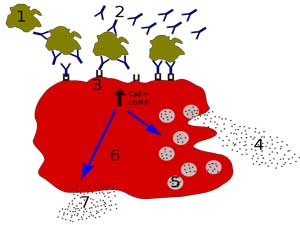
Mast cell treatments are an important part of many ME/CFS/long COVID doctor’s tool boxes but have received little study.
This is also the only trial I’m aware of that’s assessing mast cell/histamine blocking drugs. Mast cell blocking drugs may seem like a been there/done that option, but assessing them in a study is important given: a) how common mast cell activation syndrome (MCAS) appears to be, b) how accessible treatment can be given that these are mostly over-the-counter drugs, and c) how almost completely unknown MCAS and its treatments are to general practitioners. A successful study could open up a new world and a new class of drugs for many long-COVID patients and their doctors.
The Stimulate-ICP study will assess two mast cell/histamine-blocking drugs (famotidine (H2 blocker) and loratadine (H1 blocker)) in combination, as well as colchicine (anti-inflammatory) and Rivaroxaban (anti-clotting).
The good news is the trial has long been finished, and we expect a publication at any time.
*Nicotine Patches
Nicotine patches are one of the most unusual treatments to emerge from the long-COVID pandemic. The idea is that acting on nicotinic acetylcholine receptors (nAChRs) may improve autonomic nervous system function and reduce inflammation. An added bonus is that they can be purchased over the counter.
The evidence thus far is weak, but anecdotal reports suggest the patches can help. I could not find any clinical trials underway.
*Stellate Ganglion Blocks
Stellate ganglion blocks (SGBs) actually showed up in the Phoenix Rising thread back in 2013, but only became a more or less recognized treatment option in 2021. SGBs consist of introducing anesthesia to the sympathetic nervous nodes in the neck. They were first used in pain, blood vessel, and SNS conditions in the 1920s and have been used in various conditions since then.
The nice thing about SGB is that it’s a well-known procedure that can be done in the doctor’s office. Patients are cautioned, though, to seek out doctors with substantial experience in the procedure.
At least three SGB studies are underway or are getting underway, including two Canadian studies and a RECOVER study. A 40-patient study in Quebec, Canada, just began and is slated to end in 2027. A 78-person Toronto study is slated to begin soon (and is recruiting).
RECOVER surprised us (again) with a trial with a small evidentiary base, but apparently many positive patient reports. It’s not clear how large the RECOVER SGB study will be (one early report said 50), but it’s being described as a multi-site, randomized, blinded, sham-controlled trial. We should know more about it soon.
All in all, it doesn’t look like we’ll have a definitive result regarding SGB effectiveness in long COVID, but with several good studies underway, we should have a pretty good evidentiary base to build on if the results are positive.
Hyperbaric Oxygen Therapy (HBOT)
HBOT seems like the most futuristic of all the treatments in this guide, but get this, it was being discussed way back in 2009 as a possible treatment for ME/CFS/FM in the Phoenix Rising forums.
The study evidence is mixed with the usual provisos applied (small trials, heterogeneous protocols). A 2023 meta-analysis concluded that HBOT may improve fibromyalgia impact and tender-point outcomes. Two ME/CFS pilot studies have had mixed results, but a 2022 randomized, sham-controlled, double-blind trial of 73 long-COVID patients found significant improvements in several domains after 40 sessions (!) and a one-year follow-up study reported that the improvements had stuck.
That’s been enough to spark several HBOT trials. A 60-person, 40-session observational trial of long-COVID patients with ME/CFS just apparently ended in Berlin. A 40-person randomized LC trial has just begun in Toronto, and a 100-person, randomized, crossover trial is due to end in the Netherlands.
While we might not have a definitive answer regarding HBOT, we should soon have enough evidence to determine whether to proceed with larger trials.
Conclusion
Of the 20 treatments covered in this survey, I found 8 that post-dated (for the most part) long COVID. That means that in the past five years, the long COVID field has birthed 40% of the treatments covered in this survey. Long COVID also appears to have done what the ME/CFS field has been unable to do: spur large studies into no fewer than 11 treatments – a remarkable achievement given the extreme dearth of large treatment trials in ME/CFS.
The Future

With a host of large clinical trials underway, the future is looking a bit brighter.
Note that data collection for many of these trials is projected to end in 2026 meaning we should know their results at least by 2027. With any luck, we could have clear indications that LDN, Mestinon, GLP-1 inhibitors, IVIG, HBOT, mast cell inhibitors, and stellate ganglion blockades are helpful in these diseases over the next couple of years.
That’s just the start. The swath of other drugs also being assessed means that, at some point, we’re going to be hopping into clinical trial results.
With rigorously produced trials underway in Baricitinib (complete July 2027), Abrocitinib (Sept 2026), Besizterim (Aug. 2026), Upadacitinib (Rinvoq) (Dec. 2027), Pirfenidone, VYD2311 (mAb) (SPEAR section – long COVID and vaccine injury – early 2027), and Sipavibart (Dec. 2026), the next few years provide the possibility that several drugs may be found to help with these diseases. At the very least, we’ll know where not to look.
Getting FDA approval for a repurposed drug is much easier than for a new drug. Instead of a host of Phase 1, II, and III trials (and animal testing), the FDA usually requires at least one “adequate and well-controlled” trial. If that’s so, by 2027/2028, several drugs could either be FDA-approved or on their way to FDA approval for long COVID. Time, of course, will tell.
Except for LDN and Mestinon, ME/CFS will, as usual, have to wait, but success in long COVID should spark interest in ME/CFS, and many doctors will likely repurpose long COVID drugs for ME/CFS patients.




Thanks for the write-up, Cort. It would seem to me that, for ME/CFS, we don’t need any more clinical trials for the therapies that have been out for a long time. They’ve been discussed at length and tried by many in the ME/CFS community. If one of them was truly a game-changer (i.e., something that makes a significant improvement for many who take it), the word would be out and we would know by now.
I agree that there are no game changers out there among the tried and true treatments. The main benefit from studying something like LDN comes from getting the word out to primary care doctors and patients who otherwise would not have been aware of it – and while not earthshattering for those in the know – is helpful for them. Would I rather have a game changer? For sure 🙂
Who knows – maybe one lurks in the new studies underway. Wouldn’t that be nice?
Its really simple ask Amy from polybio.
She took an experimental drug, pulled her right out.
When did this happen?
For me and several other patients I’ve chatted with aciclovir is a gamechanger and suppresses our flares fully.
Thanks for mentioning it and the research into herpes viruses, especially HHV-6b against which the drug has activity.
There should be a study that links the two. Patients who have increased HHV-6b with symptom severity only should get the drug.
In the meantime I have developed a policy on when to take the drug and when not on my own – balancing risks and benefits as I see fit – and will check-in with my family doctor next week to give her an update.
I am very relieved because I realised that even when I can find a helpful infectiologist who can support me with this he, she will not have any research or experiential knowledge either on how to use aciclovir in ME/CFS and how to assess the risks and benefits properly.
I am planning to write up my eperiences and insights about using it so as to simply cover how aciclovir is that gamechanger for me and how I have learned to use the drug always considering in the back of my head that I don’t want to risk resistencies as long as there is no better understaning of the pathomechanism nor a therapy.
There are even better drugs against HHV-6b. They should be tested too soon in patients who do have increased virus loads.
Harvard have a study well advanced on a JAK1 inhibitor, with results likely to be available in the second half of this year.
Thanks – Abrocitinib – study expected to be completed by September of this year. Added it to the blog 🙂
Any news or updates on Inspiritol inhaled drug or is it in the dustbin of historic wannabe’s that died on the vine or awaits funding ?
Klimas was one of the researchers in a very limited initial study, and she never seems to follow through on treatment research or trials despite talking a good talk, so I wouldn’t invest hope in that one….
Consider adding trimetazadine to the list. Its being studied in australia At the moment for ME/CFS, and atleast 2 patients i know of (who may or may not have mecfs , have reported bigger benefits then LDN for example)
Hopefully its true, even if it just masks symptoms.
Interesting. Looks like it may not complete until 2028?
Yes, please! I second that!
oh gosh, the web page for the guide is so reasonable, too! i find resources that are easy to navigate are the exception, appreciate their attention to this. Tags: “Long COVID”, “treatment” and “guide”! Yes! Yes!!
AN EXCELLENT BLOG AND I WOULD LIKE TO ADD THIS REPORT FROM MAYO TO THE INFORMATION PRESENTED. THE BODY CHARTS OF SYMPTOMS ARE ESPECIALLY HELPFUL AS ARE THE TREATMENT OPTIONS..
https://cdn.prod-carehubs.net/n1/748e8fe697af5de8/uploads/2026/04/PIIS0025619623004020.pdf
I agree…excellent blog. I have no idea where else to get these kind of organized, understandable, big picture updates (that I feel confident have been appropriately “gate-keepered).”
I bought the recent book about lithium by Michael Nehls. It has a short chapter about cytokine storms and also a page about the vagus nerve.
but will doctors give us these treatments for me cfs if the studies are for long covid only. I mean in sweden I can just hear them be like “that’s not the same”. So it won’t benefit us??
On the RTHM website you will find excellent articles on MSM powder and NAC.
But the dosages are too low one needs to follow the high sulfur protocol developed by doctors such as DrJ Janel and modified by Dr Myhill for CFS..
I am on 30 g MSM every 2 days and 1000 mg of NAC. Plus Aspirin.
See Marian Lemle on hydrogen Sulfide.
I think GlyNAC is interesting. It’s on my list of things to try.
Apparently the glycine can significantly enhance the NAC.
Robust studies have shown efficacy in certain measures of ageing, including mitochondria, endothelial function and immunity – all things which are probably a bit out of whack in ME/CFS.
Whether efficacy in ageing could translate to efficacy in MECFS in terms of the same sort of measures? I am unsure
“N-Acetylcysteine and Other Sulfur-Donors as a Preventative and Adjunct Therapy for COVID-19 – PubMed” https://pubmed.ncbi.nlm.nih.gov/35992575/
I think this recent study is very interesting:
https://www.cambridge.org/core/journals/psychological-medicine/article/eegbased-frontal-excitationinhibition-balance-as-an-objective-biomarker-for-cognitive-fatigue-across-multiple-sclerosis-and-long-covid/9D2E5C84EF104D3B9E84C7B790B84B7E
Has anyone taken IVABRADINE for POTS?
Another brilliant and comprehensive post Cort, thank you!
RTHM also has an excellent guide on 5-mthf for those of us with M.E./cfs and EDS (& other comorbitants) which seems promising. It adds some information about some of our patient population carrying common genetic mutations that interfere with the folate metabolism and the methylation process, crucial to mitochondria (KREBS cycle) lowering neurotoxin inflammation and driving neurotransmitter production.
So having low and slow titration doses of 5-mthf +B12 could bypass the effected blockages, and improve brain fog, mood, fatigue, cognitive processing, and also plays a part in POTs (dysautonomia) and EDS due to its effects on collagen, and Mast cell activation MCAS.
The caution here is titration so as not to cause a folate ‘storm’ which can make things worse. Therefore starting at no higher than 1mg and carefully monitoring your reactions is key before increasing the dose.
I am about to add sublingual 5-mthf +B12 to my regime of microdosing L.D.N throughout the day (based on the Griffiths University protocol and upcoming trials). I’ve been on L.D.N since 2016, and it is the ONLY thing that has helped decrease crashes, PEM and gain any improvement in threshold.
I tried Mestinon (under medical supervision) to disasterous effects at the 3 week mark in 2024, and took 7 months to recover from. I discovered that for those of us with any kind of previous gut issues (MCAS, gallstones, fatty liver, SOD) it can cause severe reactions, so its good to be forewarned.
Hope this helps!
https://www.rthm.com/resources/blogs/5-mthf-supplement-guide